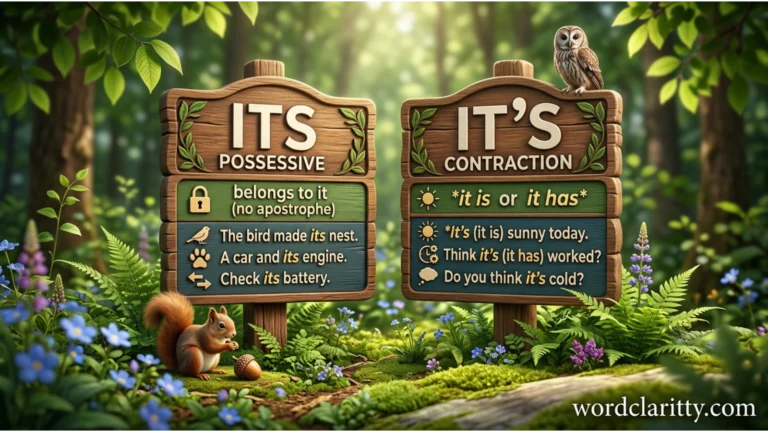
Its or it’s are two of the most commonly confused words in English. They look almost identical, sound the same when spoken, and appear frequently in everyday writing. However, they have completely different meanings and grammatical functions. The confusion often comes from the apostrophe, because apostrophes usually show possession in English. In this case, that rule does not work the same way.
Learning the difference between its and it’s is important because using the wrong form can change the meaning of a sentence and create grammar mistakes in emails, essays, websites, and everyday communication. The good news is that the difference is simple once you learn one reliable memory trick.
Why “Its” and “It’s” Are Confusing
Its and it’s are confusing because they have almost the same spelling and exactly the same pronunciation in standard English.
Similar pronunciation
When spoken aloud, its and it’s normally sound the same. This means you cannot always identify the correct word by listening.
For example:
- The dog hurt its paw.
- It’s raining outside.
The two words sound alike, but their meanings are different.
Similar spelling
The only visible difference is the apostrophe:
- its
- it’s
That small mark causes many mistakes because English learners often associate an apostrophe with possession.
Context confusion
The correct choice depends on what the sentence means.
Its shows possession or belonging:
The company changed its logo.
It’s is a contraction:
It’s a new logo.
Common learner mistakes
A common mistake is assuming that an apostrophe always means possession. In fact, it’s does not mean “belonging to it.”
Remember:
- its = possession
- it’s = it is or it has
Its vs It’s Explained Simply
The easiest way to understand the difference is to expand it’s.
Its means “belonging to it,” while it’s means “it is” or “it has.”
One-line distinction
Its shows possession; it’s is a shortened form of it is or it has.
Example sentences
- The cat cleaned its paws.
Here, its shows that the paws belong to the cat. - It’s getting late.
Here, it’s means it is.
Another useful test is to replace it’s with it is or it has. If the sentence still makes sense, it’s is probably correct.
For example:
It’s a beautiful day.
It is a beautiful day. ✓
But:
The bird spread it’s wings.
The bird spread it is wings. ✗
Therefore, its is correct in the second sentence.
Understanding Homophones in English
What Are Homophones?
Homophones are words that have the same pronunciation but different meanings, spellings, or both.
For example:
- to — used for direction or infinitives
- too — meaning “also” or “excessively”
- two — the number 2
Similarly, its and it’s sound the same but have different meanings and grammatical roles.
Why Homophones Cause Confusion
Homophones can be difficult because listening alone does not tell you which spelling to use.
Consider:
The dog wagged its tail.
When someone says this sentence, you hear the same sound as it’s, but the meaning tells you which spelling is correct.
This is why understanding the grammatical role of each word is more useful than relying only on pronunciation.
What Does “Its” Mean?
Definition and Core Meaning
Its is a possessive determiner. It shows that something belongs to, is connected with, or is associated with a thing, animal, organization, or sometimes a baby when the gender is unknown or not relevant.
For example:
The tree lost its leaves.
The leaves belong to the tree, so its is correct.
Origin and Historical Use
The possessive form its developed from older forms of the pronoun it. Historically, English used forms such as his and other constructions for possession. Over time, its became the standard possessive form associated with it.
Interestingly, early English usage did not always distinguish its and it’s in the way modern English does. The apostrophe in it’s eventually became associated with contraction.
Modern Usage and Synonyms
There is no perfect synonym for its, because it performs a specific grammatical function. Depending on the context, you may be able to rewrite a sentence using phrases such as:
- belonging to it
- of the thing
- of the animal
- associated with it
For example:
The company updated its website.
This can be rewritten as:
The website of the company was updated.
Key points about “its”
- Its is a possessive form.
- It shows belonging or association.
- It normally comes before a noun.
- It does not contain an apostrophe.
- It can refer to animals, objects, organizations, and other non-human entities.
Example sentences
- The dog wagged its tail.
- The company announced its new policy.
- The computer lost its connection.
- The country is known for its beautiful landscapes.
- The book has its own unique style.
What Does “It’s” Mean?
Definition and Core Meaning
It’s is a contraction. It can mean either:
- it is
- it has
The apostrophe indicates that letters have been omitted.
For example:
It’s cold today.
This means:
It is cold today.
Another example is:
It’s been a long day.
This means:
It has been a long day.
Origin and Historical Context
Contractions have been used in English for centuries to combine words and make speech and writing more concise. It’s developed as a shortened form of it is and later became commonly used for it has as well.
The apostrophe helps show that part of the original expression has been removed.
Modern Usage and Synonyms
It’s is extremely common in modern English, especially in conversation, informal writing, messages, and online communication.
Depending on the sentence, you can replace it with:
- it is
- it has
Examples:
It’s difficult.
It is difficult.
It’s already started.
It has already started.
Key points about “it’s”
- It’s is a contraction.
- It means it is or it has.
- It contains an apostrophe.
- It is common in everyday English.
- The apostrophe does not indicate possession.
Example sentences
- It’s time to leave.
- It’s a beautiful morning.
- It’s been three hours.
- It’s difficult to explain.
- It’s already finished.
Its vs It’s: Key Differences at a Glance
| Word | Part of Speech | Meaning | Example Context |
|---|---|---|---|
| its | Possessive determiner | Belonging to it | The dog hurt its leg. |
| it’s | Contraction | It is / it has | It’s raining. |
The quickest way to decide is to ask:
Can I replace “it’s” with “it is” or “it has”?
- If yes → use it’s.
- If no → use its.
How to Remember the Difference Between Its and It’s
A simple memory trick can help you avoid this mistake permanently.
Memory trick 1: Expand “it’s”
Whenever you see it’s, try expanding it:
it’s → it is
it’s → it has
If neither expansion works, use its.
For example:
The dog is licking its paw.
Try:
The dog is licking it is paw.
That sounds incorrect, so its must be right.
Memory trick 2: Think about the apostrophe
In it’s, the apostrophe represents missing letters:
it is → it’s
The apostrophe is not showing ownership.
Memory trick 3: Compare it with “his” and “her”
Possessive forms such as his and her do not use apostrophes:
- his car
- her car
- its car
So think:
his, her, its
All three can show possession.
One memorable example
It’s a dog enjoying its dinner.
The first it’s means it is. The second its shows possession.
Common Mistakes and Confusions
Mistake 1: Using “it’s” for possession
✘ The company changed it’s name.
This is incorrect because the name belongs to the company.
✔ The company changed its name.
Mistake 2: Using “its” instead of “it’s”
✘ Its raining outside.
Here, its cannot mean “it is.”
✔ It’s raining outside.
Mistake 3: Forgetting that “it’s” can mean “it has”
✘ Its been a busy week.
✔ It’s been a busy week.
Here, it’s means it has.
Mistake 4: Assuming every apostrophe shows possession
This is a common grammar misconception. Apostrophes can also create contractions.
For example:
- don’t = do not
- can’t = cannot
- it’s = it is / it has
Therefore, an apostrophe does not automatically mean ownership.
Examples Section: Correct and Incorrect Usage
Example 1
✔ Correct: The cat licked its fur.
✘ Incorrect: The cat licked it’s fur.
Explanation: The fur belongs to the cat, so use the possessive its.
Example 2
✔ Correct: It’s very cold today.
✘ Incorrect: Its very cold today.
Explanation: It’s means it is.
Example 3
✔ Correct: The school changed its schedule.
✘ Incorrect: The school changed it’s schedule.
Explanation: The schedule belongs to or is associated with the school.
Example 4
✔ Correct: It’s been a difficult morning.
✘ Incorrect: Its been a difficult morning.
Explanation: It’s means it has in this sentence.
Example 5
✔ Correct: The phone has lost its signal.
✘ Incorrect: The phone has lost it’s signal.
Explanation: The signal is associated with the phone, so its is required.
Example 6
✔ Correct: It’s time for dinner.
✘ Incorrect: Its time for dinner.
Explanation: The sentence means It is time for dinner.
Self Assessment: Test Your Knowledge
Fill in each blank with its or it’s.
- The dog is wagging _____ tail.
- _____ going to be a busy day.
- The company increased _____ prices.
- _____ been raining since morning.
Take a moment to answer before checking the solutions below.
Self Assessment Answers
- its — The tail belongs to the dog.
- it’s — It means it is going to be a busy day.
- its — The prices are associated with the company.
- it’s — It means it has been raining since morning.
FAQs:
Is “its” possessive?
Yes. Its is a possessive determiner used to show that something belongs to or is associated with something else.
The bird opened its wings.
Is “it’s” always short for “it is”?
No. It’s can mean either it is or it has.
It’s cold. = It is cold.
It’s been a long day. = It has been a long day.
Which is correct: “its” or “it’s”?
Both are correct words, but they are used in different situations. Use its for possession and it’s for it is or it has.
Why doesn’t the possessive “its” have an apostrophe?
English possessive pronouns and possessive determiners do not always use apostrophes. Its follows this pattern. The apostrophe in it’s indicates a contraction rather than possession.
Can “its” refer to people?
Normally, its is used for things, animals, organizations, and other non-human entities. For people, possessive forms such as his, her, or their are generally used.
Is “it’s” formal English?
Yes. It’s is grammatically correct in formal English when it means it is or it has. However, some formal writing styles may prefer the expanded form it is for a more formal tone.
How can I quickly check whether to use “its” or “it’s”?
Replace it’s with it is or it has. If the sentence still makes sense, use it’s. If the replacement does not work and the sentence expresses possession, use its.
Conclusion:
Understanding the difference between its and it’s is much easier once you focus on their grammatical jobs rather than their similar appearance. Its is the possessive form used to show that something belongs to or is connected with a thing, animal, organization, or another non-human subject. For example, “The company updated its website.” It’s, on the other hand, is a contraction of it is or it has, as in “It’s a beautiful day” or “It’s been a long week.”
The most useful memory trick is to expand it’s whenever you are unsure. If you can replace it with it is or it has, then it’s is correct. If the sentence describes ownership or association, choose its. Also remember that the apostrophe in it’s does not indicate possession; it shows that letters have been omitted from it is or it has.
With regular practice, this distinction becomes automatic. Pay attention to the meaning of the sentence, use the expansion test, and check whether you are expressing possession or a contraction. These simple habits will help you write more accurately in emails, assignments, professional documents, and everyday English. Keep practicing, and soon its and it’s will no longer be confusing.