English learners often come across words that look almost identical but leave them wondering which one is actually correct. One such pair is swap and swop.
At first glance, these words seem interchangeable because they sound the same and have very similar meanings. However, their usage differs depending on region, style, and modern language preferences.
Understanding the difference between swap vs swop can help you write more accurately and communicate with confidence. In this guide, you’ll learn what each word means, where it comes from, when to use it, and which form is considered standard in modern English.
Table of Contents
- Why “Swap” and “Swop” Are Confusing
- Swap vs Swop Explained Simply
- Understanding Homophones in English
- What Are Homophones?
- Why Homophones Cause Confusion
- What Does “Swap” Mean?
- What Does “Swop” Mean?
- Swap vs Swop: Key Differences at a Glance
- How to Remember the Difference Between Swap and Swop
- Common Mistakes and Confusions
- Examples Section: Correct and Incorrect Usage
- Self Assessment: Test Your Knowledge
- Self Assessment Answers
- FAQs About “Swap and Swop”
- Final Conclusion: Using “Swap” and “Swop” Correctly
Why “Swap” and “Swop” Are Confusing
Many English learners find swap and swop confusing because the two words are extremely similar.
Similar Pronunciation
Both words are pronounced exactly the same way in most English accents. This makes them homophones, meaning they sound alike even though their spellings differ.
Similar Spelling
The only difference between the two words is a single letter: a in swap and o in swop. Because of this small difference, people often assume both forms are equally common.
Context Confusion
Both words refer to exchanging one thing for another. Whether you’re talking about trading items, changing places, or exchanging information, both terms can technically be used.
Common Learner Mistakes
Learners often:
- Assume swop is a spelling mistake.
- Use swop in American English writing.
- Think swap and swop have different meanings.
- Confuse regional spelling preferences.
In reality, the meanings are nearly identical, but modern usage strongly favors one form over the other.
Swap vs Swop Explained Simply
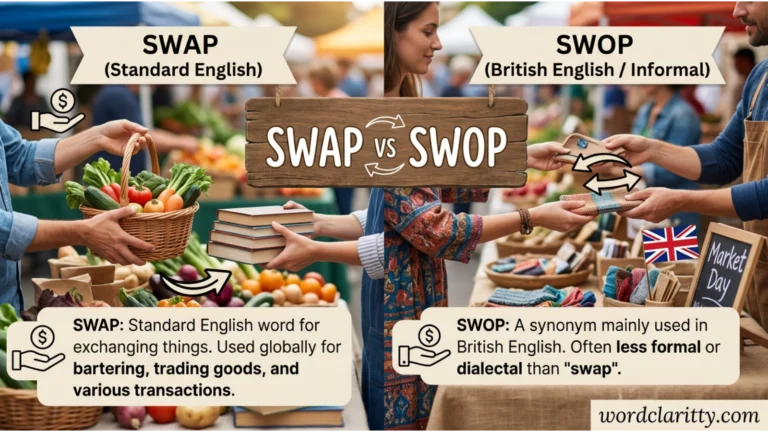
Swap means to exchange one thing for another, while swop is an alternative spelling of the same word, mainly used in some varieties of British English.
One-Line Distinction
Swap is the standard and widely accepted spelling, while swop is a less common regional variant.
Example Sentences
- We decided to swap seats during the movie.
- Can you swap your lunch with mine?
- They agreed to swop books after finishing them.
- She offered to swop her ticket for another date.
Although both sentences are correct, modern dictionaries and style guides generally prefer swap.
Understanding Homophones in English
What Are Homophones?
Homophones are words that sound the same but may have different spellings, meanings, or origins.
Example:
- Flower
- Flour
These words are pronounced alike but have different meanings.
Why Homophones Cause Confusion
Because English spelling does not always match pronunciation, learners often rely on sound when choosing words.
For example:
- Their
- There
- They’re
All three sound similar but serve different purposes. Likewise, swap and swop sound identical, which can lead to spelling confusion.
What Does “Swap” Mean?
Definition and Core Meaning
The word swap means to exchange, trade, or substitute one thing for another.
It can be used as both a verb and a noun.
As a verb:
- To exchange something.
As a noun:
- An act of exchanging things.
Origin and Historical Use
The word swap originated in English several centuries ago. Linguists believe it developed from dialect forms meaning “to strike” or “exchange.” Over time, it became the dominant spelling in both British and American English.
By the twentieth century, swap had become the preferred form in newspapers, books, schools, and business communication.
Modern Usage and Synonyms
Today, swap is used worldwide.
Common synonyms include:
- Exchange
- Trade
- Switch
- Replace
- Substitute
Key Points
- Standard modern spelling
- Accepted globally
- Used as both noun and verb
- Common in formal and informal writing
Example Sentences
- Let’s swap phone numbers.
- They swapped gifts at the party.
- The players agreed to swap positions.
- We completed a house swap during the holidays.
What Does “Swop” Mean?
Definition and Core Meaning
Swop means exactly the same thing as swap: to exchange or trade one thing for another.
There is no significant difference in meaning.
Origin and Historical Context
Swop developed as a variant spelling in British English. It became relatively common in parts of the United Kingdom during the nineteenth and early twentieth centuries.
However, as English became more standardized, the spelling swap gained greater acceptance and eventually became dominant.
Today, swop is considered less common and sometimes old-fashioned.
Modern Usage and Synonyms
Modern speakers rarely use swop, especially in international communication.
Synonyms include:
- Exchange
- Trade
- Switch
- Replace
- Barter
Key Points
- Alternative spelling of swap
- Mostly associated with British English
- Less common today
- Same meaning as swap
Example Sentences
- They agreed to swop jerseys after the match.
- She wanted to swop shifts with a coworker.
- The children swopped toys for the afternoon.
- He offered a swop instead of paying cash.
Swap vs Swop: Key Differences at a Glance
| Word | Part of Speech | Meaning | Example Context |
|---|---|---|---|
| Swap | Noun, Verb | To exchange or trade something | Let’s swap seats. |
| Swop | Noun, Verb | Alternative spelling of swap | They swopped books. |
Quick Summary
- Meaning: Same
- Pronunciation: Same
- Usage: Different frequency
- Preferred spelling: Swap
- Regional variant: Swop
How to Remember the Difference Between Swap and Swop
Learning a simple memory trick can make the distinction easier.
Easy Memory Tricks
Think of “A” in Swap as “Accepted.”
- Swap = Widely accepted spelling.
Association Techniques
Imagine seeing the word swap in newspapers, websites, and business documents. That’s because it is the modern standard spelling.
Think of swop as an older or regional variation that appears less frequently.
One Memorable Example
Swap is standard, swop is special.
If you’re unsure which spelling to use, choose swap.
Common Mistakes and Confusions
Many learners make errors because they assume both spellings are equally common.
Wrong Example
❌ I want to swop seats on my American Airlines flight.
Correct Version
✔ I want to swap seats on my American Airlines flight.
Explanation: American English almost always uses swap.
Wrong Example
❌ Swap and swop have different meanings.
Correct Version
✔ Swap and swop have the same meaning.
Explanation: The difference is mainly spelling preference, not meaning.
Wrong Example
❌ Swop is the standard global spelling.
Correct Version
✔ Swap is the standard global spelling.
Explanation: Swap is much more common internationally.
Examples Section: Correct and Incorrect Usage
Example 1
✔ Correct: We decided to swap our seats before takeoff.
✘ Incorrect: We decided to swop our seats in formal American business writing.
Example 2
✔ Correct: The children swapped trading cards.
✘ Incorrect: The children swopped trading cards in a style guide that requires standard spelling.
Example 3
✔ Correct: Can we swap shifts tomorrow?
✘ Incorrect: Can we swop shifts? (less preferred in modern international English)
Example 4
✔ Correct: They arranged a house swap for the summer.
✘ Incorrect: They arranged a house swop in a publication following modern standard English.
Example 5
✔ Correct: Let’s swap ideas and improve the project.
✘ Incorrect: Let’s swop ideas if your organization requires standard spelling.
Self Assessment: Test Your Knowledge
Fill in the blanks with swap or swop.
1.
Can we ______ our seats before the meeting starts?
2.
The two friends agreed to ______ books after reading them.
3.
In modern international English, ______ is the preferred spelling.
4.
Both ______ and swap mean to exchange something.
Self Assessment Answers
1.
swap
2.
swop or swap (both are correct)
3.
swap
4.
swop
FAQs About “Swap and Swop”
1. Is swop a real word?
Yes. Swop is a legitimate English word and an alternative spelling of swap.
2. Which is more common: swap or swop?
Swap is far more common in modern English.
3. Do swap and swop mean different things?
No. They have essentially the same meaning.
4. Is swop used in American English?
Rarely. American English almost exclusively uses swap.
5. Is swop old-fashioned?
Many people consider it less modern because it appears less frequently today.
6. Which spelling should English learners use?
English learners should generally use swap because it is universally recognized.
7. Can swap be both a noun and a verb?
Yes. It can refer to the act of exchanging something and also the action itself.
Final Conclusion: Using “Swap” and “Swop” Correctly
Understanding the difference between swap vs swop is actually simpler than many learners expect. Both words carry the same core meaning: to exchange, trade, or switch one thing for another. The main distinction lies not in meaning but in spelling preference and frequency of use. Today, swap is the standard spelling used throughout American English and most modern British English. It appears regularly in books, newspapers, business communication, websites, and everyday conversation. Meanwhile, swop survives as a less common regional or historical variant, mainly associated with certain British usage.
If you’re writing for an international audience, completing school assignments, creating professional documents, or simply aiming for clear communication, swap is usually the safest and most widely accepted choice. A helpful memory tip is to remember that the “A” in swap stands for accepted. This simple association can help you choose the correct spelling whenever you’re unsure.
Language learning becomes easier when you understand not only what words mean but also how they are used in real-world situations. By recognizing that swap is the modern standard and swop is an alternative variant, you can avoid common mistakes and write with greater confidence. Keep practicing, keep reading, and remember that every small distinction you learn strengthens your English skills.