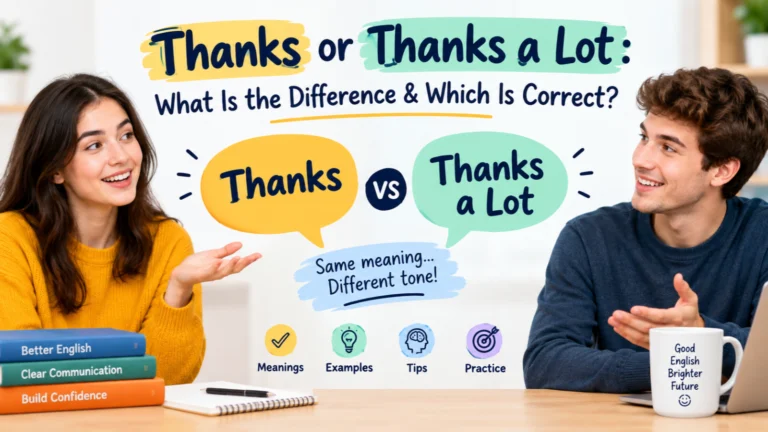
English learners often wonder whether “thanks” and “thanks a lot” mean the same thing and whether one is more correct than the other. The good news is that both expressions are grammatically correct and commonly used in everyday English. The main difference is the strength, tone, and context in which they are used.
“Thanks” is a simple and natural way to show gratitude, while “thanks a lot” can express stronger appreciation—but it can sometimes sound sarcastic depending on the speaker’s tone. Understanding this small difference can help you sound more natural, polite, and confident in conversations, emails, messages, and other forms of communication.
Why “Thanks” and “Thanks a Lot” Are Confusing
“Thanks” and “thanks a lot” are confusing because they are both used to express gratitude. In many situations, you can use either one without changing the basic meaning.
However, they are not exactly identical. “Thanks” is short and neutral, whereas “thanks a lot” usually adds emphasis. The exact feeling can also depend on the speaker’s voice, facial expression, and situation.
Similar pronunciation
The two expressions contain the same word, “thanks,” so they naturally sound similar. A learner who hears them in conversation may notice the extra words but not immediately understand the difference in tone.
For example:
- “Thanks for your help.”
- “Thanks a lot for your help.”
Both sentences show appreciation, but the second one places more emphasis on the gratitude.
Similar spelling
The spelling is also very similar because “thanks a lot” simply contains “thanks” plus “a lot.” This can make learners wonder whether “thanks a lot” is a special grammatical form. It is not. It is simply an expression used to give more emphasis to “thanks.”
Context confusion
Context is especially important. “Thanks a lot” is usually positive:
“Thanks a lot for helping me move!”
But it can also be sarcastic:
“You deleted my file? Thanks a lot!”
In the second sentence, the speaker is not genuinely thanking the other person. The expression means something closer to “I am very unhappy about what you did.”
Common learner mistakes
Common mistakes include:
- Thinking “thanks a lot” is always more polite than “thanks.”
- Believing “thanks” is too informal for every situation.
- Using “thanks a lot” when the intended meaning is sarcastic.
- Adding unnecessary words, such as “Thanks a lots.”
- Confusing “thanks a lot” with “thank you very much” in every situation.
“Thanks” vs “Thanks a Lot” Explained Simply
“Thanks” is a short, common expression used to show gratitude.
One-line distinction
“Thanks” is a simple expression of gratitude, while “thanks a lot” usually expresses stronger or more enthusiastic gratitude and can sometimes be sarcastic.
Example sentences
- Thanks for sending me the information.
- Thanks a lot for helping me with my project.
Both are correct. The second sentence sounds more emphatic.
Which one is correct?
Both “thanks” and “thanks a lot” are correct English. Neither expression is grammatically wrong.
Choose according to the situation:
- Use “thanks” for simple, everyday gratitude.
- Use “thanks a lot” when you want to emphasize your appreciation.
- Be careful with “thanks a lot” when the situation is negative because it can sound sarcastic.
For formal situations, alternatives such as “Thank you,” “Thank you very much,” or “I really appreciate it” may sound more appropriate.
Understanding Homophones in English
Although “thanks” and “thanks a lot” are sometimes discussed by English learners alongside confusing sound-alike expressions, they are not homophones.
What Are Homophones?
Homophones are words that sound the same but have different meanings, and often different spellings.
For example:
- two — the number 2
- too — also or excessively
- to — used for direction, purpose, or other grammatical functions
These words can sound identical in many varieties of English, but their meanings and spellings are different.
Why Homophones Cause Confusion
Homophones can be difficult because you may know how a word sounds but not which spelling fits the sentence.
For example:
“I have two books, too.”
A learner needs to understand the meaning of each word to choose the correct spelling.
“Thanks” and “thanks a lot” are different for another reason: they are expressions with different lengths and levels of emphasis, not homophones.
What Does “Thanks” Mean?
Definition and Core Meaning
“Thanks” is an informal expression used to show that you are grateful for something someone has done, given, or said.
It is commonly used in everyday conversations, text messages, emails, social media, and friendly professional communication.
For example:
“Thanks for your advice.”
The speaker is expressing gratitude for the advice.
“Thanks” is generally shorter and more casual than “thank you.”
Origin and Historical Use
The word “thanks” comes from the noun “thank,” which has roots in Old English and Germanic languages. Historically, the idea of “thank” was connected with gratitude, appreciation, or a favorable thought toward someone.
Over time, “thanks” developed into a common expression of gratitude. Today, it is one of the most frequently used ways to thank someone in English.
Modern Usage and Synonyms
In modern English, “thanks” can be used in many ways:
- Thanks! — simple and friendly gratitude.
- Thanks for your help. — gratitude for an action.
- Thanks for the information. — appreciation for something provided.
- Many thanks. — somewhat more formal or written.
- Thanks so much. — warm and emphatic.
- Thanks a bunch. — informal and friendly.
- Thanks anyway. — gratitude despite an unsuccessful attempt or result.
Example Sentences
- Thanks for calling me.
- Thanks for the delicious meal.
- Thanks for your advice.
- Thanks! I really needed that.
- Thanks for letting me know.
In all of these examples, “thanks” communicates appreciation without necessarily making the gratitude sound very strong.
What Does “Thanks a Lot” Mean?
Definition and Core Meaning
“Thanks a lot” is an informal expression meaning “thank you very much” or “I am very grateful.”
The phrase normally emphasizes the speaker’s gratitude.
For example:
“Thanks a lot for picking me up at the airport.”
Here, the speaker is showing strong appreciation for the favor.
However, context and tone matter greatly. “Thanks a lot” can also be used sarcastically when someone has caused a problem.
For example:
“You spilled coffee on my new shirt. Thanks a lot!”
Here, the speaker is probably expressing annoyance rather than gratitude.
Origin and Historical Context
“Thanks a lot” developed naturally from the combination of “thanks” and “a lot,” where “a lot” functions as an intensifier. The phrase became established in everyday English as a way of expressing a larger degree of gratitude.
It is not a separate grammatical form of the verb “thank.” Instead, it is a fixed conversational expression.
Modern Usage and Synonyms
Today, “thanks a lot” is especially common in informal speech and writing.
Similar expressions include:
- Thank you very much
- Thanks so much
- Many thanks
- I really appreciate it
- I can’t thank you enough
- Thank you so much
The best choice depends on the relationship between the speakers and the level of formality.
Example Sentences
- Thanks a lot for helping me with my homework.
- Thanks a lot for the birthday present!
- Thanks a lot for taking care of my dog.
- Thanks a lot—I really appreciate your support.
Remember that the same phrase can have an opposite meaning when spoken sarcastically:
“Thanks a lot for making me miss the bus.”
In this context, the speaker is unhappy.
“Thanks” vs “Thanks a Lot”: Key Differences at a Glance
| Word | Part of Speech | Meaning | Example Context |
|---|---|---|---|
| Thanks | Interjection / informal expression of gratitude | A simple way to express appreciation | “Thanks for your help.” |
| Thanks a lot | Idiomatic expression / phrase | Stronger or more emphatic gratitude; sometimes sarcasm | “Thanks a lot for helping me!” |
Important point
Neither expression is “more correct” in grammar. The difference is mainly tone, emphasis, and context.
For example:
“Thanks for the gift.”
This is perfectly natural.
“Thanks a lot for the gift.”
This is also perfectly natural and sounds more enthusiastic.
However, if you are writing a formal business email, “Thank you” or “Thank you very much” may be a better choice than either informal expression.
How to Remember the Difference Between “Thanks” and “Thanks a Lot”
Learning a simple association can make the distinction easier.
Easy memory tricks
Think of the expressions this way:
Thanks = normal gratitude
Thanks a lot = extra emphasis
The word “lot” can remind you that you are adding “more” to the expression.
Association techniques
Imagine two situations.
Situation 1: Someone opens the door for you.
You can simply say:
“Thanks!”
The favor is small, so a short expression is natural.
Situation 2: A friend spends three hours helping you prepare for an important exam.
You might say:
“Thanks a lot for helping me!”
The longer expression emphasizes how grateful you are.
One memorable example
Remember this sentence:
“Thanks” is a smile; “thanks a lot” turns up the volume.
This is not a strict grammar rule, but it is a useful way to remember the usual difference in emphasis.
Also remember the special warning:
“Thanks a lot” can become sarcastic when something goes wrong.
Common Mistakes and Confusions
Mistake 1: Thinking “thanks a lot” is always more polite
Wrong idea: “Thanks a lot” is always more polite than “thanks.”
Correct understanding: “Thanks a lot” is usually more emphatic, but politeness depends on context and tone.
For formal communication, “Thank you very much” may be more suitable.
Mistake 2: Writing “thanks a lots”
✘ Thanks a lots for your help.
✔ Thanks a lot for your help.
The expression is always “a lot,” not “a lots.”
Mistake 3: Using “thanks” when a formal expression is expected
“Thanks” is correct, but it can sound casual.
For example, in a formal business email:
Thank you for your assistance.
may be more appropriate than:
Thanks for your help.
This does not make “thanks” grammatically wrong. It simply makes “thank you” a better stylistic choice.
Mistake 4: Missing sarcasm
Consider:
“You forgot to tell me about the meeting. Thanks a lot!”
This may not be genuine gratitude. The speaker could actually mean:
“I am annoyed that you forgot.”
Always consider the situation and tone before interpreting “thanks a lot.”
Mistake 5: Assuming the two expressions have completely different meanings
They do not. Both expressions communicate gratitude in their normal use.
The main difference is degree and tone, not basic meaning.
Examples Section: Correct and Incorrect Usage
Example 1
✔ Correct: Thanks for your help.
This is a natural, informal way to express gratitude.
✘ Incorrect: Thanks a lots for your help.
“Lots” is incorrect in this expression. Use “a lot.”
Example 2
✔ Correct: Thanks a lot for driving me home.
This is natural when you want to emphasize your appreciation.
✘ Incorrect: Thanks a lot for driving me home. (if you actually mean it sarcastically)
The grammar is correct, but the expression may communicate the wrong feeling if the situation does not support genuine gratitude.
Example 3
✔ Correct: Thanks! I really appreciate it.
This is friendly and natural in everyday communication.
✘ Incorrect: Thankss for helping me.
“Thankss” is not the standard spelling. The correct spelling is “thanks.”
Example 4
✔ Correct: Thank you very much for your assistance.
This is a good choice for a more formal situation.
✘ Incorrect: Thanks a lot, dear Sir or Madam.
The problem here is not the grammar of “thanks a lot.” The whole sentence sounds stylistically awkward and mixes a casual expression with a very formal greeting.
Example 5
✔ Correct: Thanks a lot for the wonderful gift!
This sounds warm and enthusiastic.
✘ Incorrect: Thanks a lot of your wonderful gift!
After “thanks a lot,” use “for” when introducing the reason for your gratitude:
“Thanks a lot for your gift.”
Self Assessment: Test Your Knowledge
Fill in each blank with “thanks” or “thanks a lot.”
- ______ for helping me carry these boxes.
- ______ for staying late and helping me finish the project!
- “You lost my keys again? ______!”
- ______! I really appreciate your advice.
Self Assessment Answers
- Thanks — A simple expression of gratitude works naturally here.
- Thanks a lot — The speaker wants to emphasize appreciation for a significant favor.
- Thanks a lot — In this context, it is likely sarcastic because the speaker is unhappy about losing the keys.
- Thanks — A short, friendly expression is completely natural.
Remember that questions 1 and 2 can sometimes accept either expression depending on the speaker’s intended tone. The exercise focuses on the most natural choice for the given context.
FAQs:
Is “thanks a lot” grammatically correct?
Yes. “Thanks a lot” is grammatically correct and widely used in informal English. It is an expression of gratitude that usually adds emphasis.
Is “thanks” better than “thanks a lot”?
Neither is universally better. “Thanks” is shorter and more neutral, while “thanks a lot” usually sounds more emphatic. Choose based on the situation and your intended tone.
Is “thanks a lot” formal or informal?
“Thanks a lot” is generally informal. It is common in conversations, text messages, friendly emails, and casual communication. In formal situations, “Thank you very much” may be a safer choice.
Can “thanks a lot” be sarcastic?
Yes. This is one of the most important differences to understand. For example, if someone causes you to miss an important appointment, you might say “Thanks a lot!” sarcastically to show annoyance rather than gratitude.
Can I use “thanks” in a professional email?
Yes, especially in a friendly workplace. However, “Thank you” is often more polished and formal. For example, “Thank you for sending the report” is appropriate for most professional situations.
What is the difference between “thanks a lot” and “thank you very much”?
Both can express strong gratitude. “Thanks a lot” is generally more casual, while “thank you very much” works well in both polite everyday situations and more formal communication.
Are “thanks” and “thanks a lot” homophones?
No. They are not homophones. Homophones are words that sound alike but have different meanings, such as “two” and “too.” “Thanks” and “thanks a lot” are simply two related expressions of gratitude.
Conclusion:
Thanks” and “thanks a lot” are both correct English expressions, and both are used to show gratitude. The key difference is emphasis and tone. “Thanks” is short, natural, and very common in everyday situations. It works well when someone gives you something, helps you, provides information, or does a small favor. “Thanks a lot,” on the other hand, usually adds stronger emphasis and can communicate a deeper level of appreciation. For example, “Thanks for helping me” is simple and friendly, while “Thanks a lot for helping me” sounds more enthusiastic.
However, there is one important point to remember: “thanks a lot” can also be sarcastic. If someone causes a problem, saying “Thanks a lot!” may actually mean that you are annoyed. Therefore, always consider the context and the speaker’s tone.
For formal situations, expressions such as “Thank you,” “Thank you very much,” and “I really appreciate it” are often better choices. A simple memory trick is to think: “Thanks” = normal gratitude; “thanks a lot” = extra emphasis. Once you understand this difference, choosing the right expression becomes easy. Keep practicing these phrases in real conversations and writing, and you will quickly develop a more natural feel for English.