If you have ever seen the phrase “trunk or treat” and wondered whether it should actually be “trick or treat,” you are not alone. These expressions are closely connected to Halloween, so English learners can easily confuse them. However, they describe two different ways of celebrating Halloween.
Trick-or-treating usually means children visit homes and ask for candy, while trunk or treat usually means children collect treats from decorated cars in a parking area or another organized location. Understanding the difference is useful because both phrases are common in modern English. The good news is that both are correct when used in the right context.
Why “Trunk or Treat” and “Trick or Treat” Are Confusing
“Trunk or treat” and “trick or treat” are easy to mix up because both phrases are associated with Halloween, costumes, candy, and children. They also have a similar rhythm when spoken.
Similar pronunciation
The two expressions have a similar sound pattern:
- trunk or treat
- trick or treat
The word “trunk” begins with a strong tr sound, while “trick” also begins with tr. Because the phrases are often spoken quickly, learners may hear one phrase and think it is the other.
Similar spelling
The phrases contain several of the same letters and the exact same words “or treat.” Only the first word changes:
- trunk or treat
- trick or treat
This small spelling difference can be easy to miss, especially when reading quickly.
Context confusion
Both expressions involve receiving Halloween treats. The main difference is where the treats are collected.
With traditional trick-or-treating, children normally go from house to house. With a trunk-or-treat event, people usually gather in one place, and children walk from one decorated vehicle to another.
Common learner mistakes
English learners may:
- Use trunk or treat when talking about visiting houses.
- Use trick or treat for an event where candy is given from car trunks.
- Think trunk or treat is a spelling mistake.
- Assume the two phrases have exactly the same meaning.
- Write trunk-or-treat and trick-or-treat without understanding the difference.
The important point is simple: neither phrase is a mistake. They refer to different Halloween activities.
Trunk or Treat vs. Trick or Treat Explained Simply
Simple explanation
Trunk or treat is a Halloween activity in which children collect candy or other treats from decorated cars, often in a parking lot or organized community event.
Trick or treat refers to the traditional Halloween custom in which children visit homes, usually in costumes, and ask for treats.
One-line distinction
Trunk or treat happens around decorated cars; trick or treat usually happens from house to house.
Example sentences
- Our school is hosting a trunk-or-treat event in the parking lot.
- The children went trick-or-treating around the neighborhood on Halloween night.
So, if you are talking about a community event with decorated vehicles, trunk or treat is the appropriate expression. If children are walking around the neighborhood and visiting homes, trick or treat is the traditional term.
Understanding Homophones in English
What Are Homophones?
Homophones are words that sound the same, or nearly the same, but have different meanings, spellings, or both.
For example:
- right = correct
- write = to put words on paper
These words sound the same in many varieties of English, but their meanings and spellings are different.
Importantly, “trunk” and “trick” are not homophones. They have different sounds and meanings. The confusion comes mainly from their similar spelling, pronunciation, rhythm, and Halloween context.
Why Homophones Cause Confusion
Homophones can be difficult because English spelling does not always show pronunciation clearly. For example, a learner may hear “right” and not know whether the speaker means right or write.
Although trunk or treat and trick or treat are not homophones, they create a similar learning problem. A listener may recognize the familiar phrase “___ or treat” but misunderstand the first word.
The best solution is to learn the meaning of the complete phrase rather than focusing only on how it sounds.
What Does “Trunk or Treat” Mean?
Definition and Core Meaning
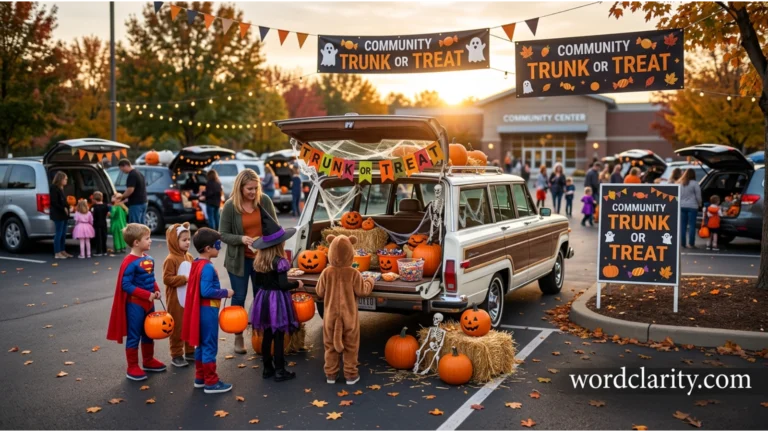
Trunk or treat is a Halloween event where children receive candy, snacks, or small prizes from the trunks of decorated cars.
Instead of walking from house to house, families usually meet at a specific location. Adults decorate their vehicles with Halloween themes, and children move from car to car to collect treats.
The expression is a modern variation of traditional trick-or-treating.
Origin and Historical Use
The phrase trunk or treat developed as a name for organized Halloween gatherings involving decorated vehicle trunks. These events became increasingly common in communities, schools, churches, and other organizations.
The exact origin of the phrase is not usually important for everyday English. What matters is how it is used today: it describes an organized Halloween activity centered around cars.
The word “trunk” is especially important in American English. In this context, a trunk is the enclosed storage area at the back of a car.
In British English, this part of a car is commonly called a boot.
Modern Usage and Synonyms
Today, you may see the expression written in several forms:
- trunk or treat
- trunk-or-treat
- Trunk or Treat
- Trunk-or-Treat event
The hyphenated form is especially common when the phrase works as a compound modifier, such as “a trunk-or-treat event.” Event names may also capitalize the words.
Related expressions include:
- Halloween car event
- community Halloween event
- decorated-car Halloween event
- Halloween candy event
Example sentences
- The community is holding a trunk-or-treat event on Saturday.
- We decorated the trunk of our car for trunk or treat.
- The children collected candy from several cars at the trunk-or-treat event.
- Our school parking lot was full of decorated vehicles for trunk or treat.
Notice that trunk or treat describes the activity or event, not simply the act of saying “trunk or treat.”
What Does “Trick or Treat” Mean?
Definition and Core Meaning
Trick or treat is the traditional Halloween expression and activity in which children visit homes and ask for candy or other treats.
A child may knock on a door and say:
“Trick or treat!”
The expression traditionally suggests a playful choice between receiving a treat and having a “trick” played on the person who answers. In modern practice, however, the phrase is usually simply a familiar Halloween greeting used when asking for candy.
Origin and Historical Context
The modern custom of trick-or-treating developed from older Halloween traditions in which people went from door to door asking for food, treats, or other gifts.
Over time, the practice became strongly associated with children wearing costumes and collecting candy from homes.
The expression is now widely recognized in American and Canadian English and is closely associated with Halloween.
Modern Usage and Synonyms
Trick or treat can refer to both the phrase children say and the activity itself.
Common forms include:
- trick or treat
- trick-or-treating
- go trick-or-treating
- trick-or-treaters
- trick-or-treat night
Examples of related vocabulary include:
- Halloween
- costumes
- candy
- treats
- decorated houses
- trick-or-treaters
- Halloween night
Example sentences
- The children went trick-or-treating after dinner.
- We bought candy for the trick-or-treaters.
- Someone knocked on the door and shouted, “Trick or treat!”
- Many families decorate their houses for trick-or-treat night.
The expression trick or treat is therefore the traditional term for going around to homes for Halloween treats.
Trunk or Treat vs. Trick or Treat: Key Differences at a Glance
| Word | Part of Speech | Meaning | Example Context |
|---|---|---|---|
| Trunk or treat | Noun phrase / event name | An organized Halloween activity involving decorated car trunks | “The school is having a trunk-or-treat event.” |
| Trick or treat | Noun phrase / expression | The traditional Halloween custom of visiting homes for treats | “The children went trick-or-treating.” |
| Trunk | Noun | The storage compartment at the back of a car in American English | “Put the candy in the trunk.” |
| Trick | Noun / verb | A playful action, deception, or practical joke | “The Halloween costume was part of a fun trick.” |
| Treat | Noun / verb | Something enjoyable or a special food; also to give something enjoyable | “We gave the children treats.” |
The central difference is location and format. Trunk or treat usually gathers people in one place around decorated vehicles, while traditional trick-or-treating usually involves going from home to home.
How to Remember the Difference Between Trunk or Treat and Trick or Treat
Easy memory tricks
The easiest memory trick is to focus on the first word.
TRUNK = CAR
Think:
Trunk or treat = treats from a car trunk.
For trick or treat, think:
Trick or treat = the traditional Halloween door-to-door activity.
Another simple trick is to imagine two pictures:
- 🚗 Trunk or treat: cars, parking lot, decorated trunks, candy
- 🏠 Trick or treat: houses, doors, costumes, candy
Association techniques
Connect trunk with another sentence:
“The candy is in the trunk.”
Then connect trunk or treat with:
“The candy comes from the trunk.”
For trick or treat, remember:
“Knock on the door and say, ‘Trick or treat!’”
This association makes the difference easier to recall than simply memorizing two definitions.
One memorable example
Imagine a Halloween parking lot filled with decorated cars. Children walk from car to car collecting candy.
That is Trick or treat.
Now imagine children walking down a street, knocking on different doors, and saying, “Trick or treat!”
That is trick or treat.
Common Mistakes and Confusions
Mistake 1: Calling door-to-door Halloween visits “Trick or treat”
✘ We went treat around the neighborhood and visited ten houses.
✔ We went trick-or-treating around the neighborhood and visited ten houses.
Explanation: Visiting houses is traditional trick-or-treating.
Mistake 2: Calling a car-based event “trick or treat”
✘ Our school held trick-or-treat in the parking lot with decorated cars.
✔ Our school held a Trick-or-treat event in the parking lot.
Explanation: When the event centers on decorated vehicles and their trunks,Trick or treat is the more specific term.
Mistake 3: Thinking “trunk or treat” is incorrect English
✘ “Trunk or treat” is always a spelling mistake.
✔ “Trunk or treat” is a recognized expression for a particular Halloween event.
Explanation: It is not simply a misspelling of trick or treat. The phrases describe different activities.
Mistake 4: Confusing “trunk” with the body part
The word trunk can have several meanings. It can refer to the main stem of a tree, the long nose of an elephant, or a car’s storage compartment.
In trunk or treat, it means the storage compartment at the back of a car.
Examples Section: Correct and Incorrect Usage
Example 1
✔ Correct: The children went trick-or-treating from house to house.
✘ Incorrect: The children went Trick or treat from house to house.
Why? The activity is door-to-door, so trick-or-treating is the appropriate expression.
Example 2
✔ Correct: Our church is organizing a Trick-or-treat event.
✘ Incorrect: Our church is organizing a trunk-or-treating event from house to house.
Why? A trunk-or-treat event normally involves cars gathered at a particular location.
Example 3
✔ Correct: We decorated the car for trunk or treat.
✘ Incorrect: We decorated the car for trick or treat.
Why? The decoration is specifically for a vehicle-based Halloween event.
Example 4
✔ Correct: The trick-or-treaters knocked on our door.
✘ Incorrect: The trunk-or-treaters knocked on every door in the neighborhood.
Why? The term trick-or-treaters is commonly used for children who go from house to house asking for treats.
Example 5
✔ Correct: There will be a Trickor-treat event in the school parking lot.
✘ Incorrect: There will be treat event at every house on our street.
Why? A trunk-or-treat event is generally organized around decorated vehicles rather than individual homes.
Self Assessment: Test Your Knowledge
Fill in each blank with trunk or treat or trick or treat.
- The children walked from house to house saying, “__________!”
- Our school is holding a __________ event with decorated cars.
- We went __________ around the neighborhood and collected candy from our neighbors.
- The families decorated their cars for the __________ event.
Self Assessment Answers
- trick or treat — Children traditionally say “Trick or treat!” when visiting homes.
- treat — A car-based Halloween event is called a Trick or-treat event.
- trick or treat — Going around the neighborhood from house to house is traditional trick-or-treating.
- treat — Decorated cars are a central part of a treat event.
FAQs:
Is “Trick or treat” correct English?
Yes. Trick or treat is a correct modern expression for an organized Halloween activity where children collect treats from decorated car trunks.
Is “trick or treat” or “trunk or treat” correct?
Both are correct, but they describe different activities. Trick or treat refers to the traditional door-to-door Halloween custom, while treat generally refers to a car-based Halloween event.
What is the difference between treat and trick or treat?
The main difference is the setting. Trick-or-treating usually takes place from house to house. Trick or treat usually takes place in one location where children collect treats from decorated vehicles.
Why is it called “Trick or treat”?
It is called Trick or treat because the treats are typically distributed from the trunks of cars. The phrase is modeled on the familiar expression “trick or treat.”
treat safer than trick-or-treating?
A treat event can provide a more organized setting because participants gather in one location. However, safety depends on how each event is organized, including traffic control, supervision, lighting, and other local arrangements.
Do you say “trunk or treat” at a trunk-or-treat event?
The exact practice can vary by event. The name trunk or treat describes the event itself. Children may still say “trick or treat” when approaching a decorated vehicle, or organizers may use their own traditions.
Should “trunk or treat” be hyphenated?
The spelling can depend on how the phrase is used. “Trunk or treat” is common when naming the activity, while “trunk-or-treat event” uses hyphens because the phrase acts as a compound modifier before event. Capitalization may also vary in official event names.
Conclusion:
Understanding the difference between trunk or treat and trick or treat is easier once you focus on the setting. Trick or treat is the traditional Halloween expression and activity associated with children visiting homes, usually in costumes, to ask for candy or other treats. Trunk or treat, on the other hand, is a modern, organized Halloween activity in which children typically collect treats from decorated car trunks at a central location. Therefore, neither expression is simply a “wrong” version of the other. They have different meanings and are used in different situations.
For English learners, one memory trick works especially well: trunk means car, so trunk or treat means a Halloween event involving car trunks. If children are walking from house to house, think trick or treat. Also remember that although the two phrases sound and look similar, trunk and trick are not homophones. Learning the context is the key to choosing the right expression. With these simple associations, you can use both phrases naturally and confidently. Keep noticing how native speakers use Halloween vocabulary in real conversations, and your English vocabulary will become clearer with practice.

Bilal Hassan is a Master’s graduate, content writer, and author at WordClaritty.com. He specializes in creating clear, informative, and reader-friendly content focused on language, word meanings, and educational topics. With a passion for accuracy and simplicity, he helps readers expand their knowledge through engaging and easy-to-understand articles.