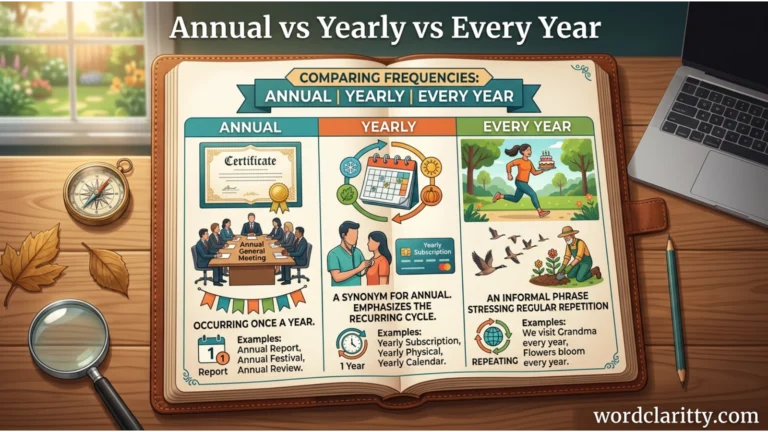
Annual vs Yearly vs Every Year are three common English terms that often seem interchangeable, which can make them confusing for learners and writers. While both words generally refer to something that happens once every twelve months, there are subtle differences in how they are used in different contexts.
Understanding these distinctions can help you communicate more accurately in business, education, finance, and everyday conversations. In this guide, we will explore the meaning, usage, and key differences between these terms with clear examples. By the end, you will know when to use each word correctly and avoid common mistakes. Whether you are improving your English skills or refining your writing, understanding Annual vs Yearly vs Every Year is an important step toward clearer communication.
Table of Contents
- Introduction
- Why “Annual,” “Yearly,” and “Every Year” Are Confusing
- Annual vs Yearly vs Every Year Explained Simply
- Understanding Similar English Expressions
- What Are Similar Expressions?
- Why They Cause Confusion
- What Does “Annual” Mean?
- What Does “Yearly” Mean?
- What Does “Every Year” Mean?
- Annual vs Yearly vs Every Year: Key Differences at a Glance
- How to Remember the Difference
- Common Mistakes and Confusions
- Examples Section: Correct and Incorrect Usage
- Self Assessment: Test Your Knowledge
- Self Assessment Answers
- FAQs About Annual, Yearly, and Every Year
- Final Conclusion
Why “Annual,” “Yearly,” and “Every Year” Are Confusing
English learners often mix up these terms because they all refer to events or actions that occur once within a twelve-month period.
Similar Pronunciation
Although the words do not sound exactly alike, they are commonly heard in similar contexts. This can make it difficult for learners to distinguish between them.
Similar Meaning
All three expressions generally describe something that happens once per year. Because of this shared meaning, learners often assume they are always interchangeable.
Context Confusion
The choice between these expressions often depends on formality and sentence structure. For example, business reports frequently use annual, while casual conversations often use every year.
Common Learner Mistakes
- Using annual when an adverbial phrase is needed.
- Using yearly in very formal business writing where annual sounds more natural.
- Assuming all three can be used in exactly the same way in every sentence.
Annual vs Yearly vs Every Year Explained Simply
Annual means something happens once a year and is often used in formal contexts.
Yearly means something happens once a year and is slightly more common in everyday English.
Every year is a phrase that simply means once each year and is widely used in both speech and writing.
One-Line Distinction
Annual is usually more formal, yearly is more neutral, and every year is the most conversational.
Example Sentences
- The company publishes an annual report.
- We have a yearly medical checkup.
- My family visits the beach every year.
- The school organizes an annual sports day.
Understanding Homophones in English
What Are Homophones?
Homophones are words that sound the same but have different meanings and spellings.
Example:
- Flower
- Flour
These two words sound alike but have completely different meanings.
Why Homophones Cause Confusion
Homophones can confuse learners because they rely on context rather than pronunciation.
For example:
- I bought some flour for baking.
- The garden is full of beautiful flowers.
Even though annual, yearly, and every year are not homophones, they create a similar type of confusion because their meanings overlap significantly.
What Does “Annual” Mean?
Definition and Core Meaning
Annual means occurring once every year or relating to a year.
It is commonly used as an adjective before a noun.
Origin and Historical Use
The word annual comes from the Latin word annus, meaning “year.” It entered English centuries ago and became widely used in official, academic, and business contexts.
Modern Usage and Synonyms
Common synonyms include:
- Yearly
- Once-a-year
- Per year
Key Points
- Usually used as an adjective.
- Common in formal writing.
- Frequently appears in business, education, and government documents.
- Often modifies a noun.
Example Sentences
- The organization held its annual meeting in June.
- We received the annual financial report.
- The city hosts an annual cultural festival.
- Employees receive an annual performance review.
What Does “Yearly” Mean?
Definition and Core Meaning
Yearly means happening once every year.
It can function as both an adjective and an adverb.
Origin and Historical Context
The word developed from the English word year combined with the suffix -ly. It has been used for centuries in everyday English.
Modern Usage and Synonyms
Common synonyms include:
- Annual
- Every year
- Once a year
Key Points
- Less formal than annual.
- Can be used as an adjective or adverb.
- Common in everyday communication.
- Often appears in schedules and routines.
Example Sentences
- We schedule a yearly inspection.
- The club charges a yearly membership fee.
- The event occurs yearly.
- They review their goals yearly.
What Does “Every Year” Mean?
Definition and Core Meaning
Every year is a phrase meaning once each year.
Unlike annual and yearly, it is not a single word. It functions as a time expression.
Origin and Historical Context
The phrase developed naturally in English from combining the words every and year. It remains one of the most common ways to express yearly repetition.
Modern Usage and Synonyms
Common synonyms include:
- Annually
- Yearly
- Once a year
Key Points
- Very common in conversation.
- Easy for learners to understand.
- Works well in both speaking and writing.
- Usually appears at the beginning or end of a sentence.
Example Sentences
- We travel abroad every year.
- The flowers bloom every year.
- She attends the conference every year.
- The competition takes place every year.
Annual vs Yearly vs Every Year: Key Differences at a Glance
| Word | Part of Speech | Meaning | Example Context |
|---|---|---|---|
| Annual | Adjective | Occurring once a year | Annual report |
| Yearly | Adjective/Adverb | Happening once a year | Yearly membership fee |
| Every Year | Phrase | Once each year | We travel every year |
| Annual | More formal | Often used in professional writing | Annual conference |
| Yearly | Neutral | Common in general English | Yearly review |
| Every Year | Conversational | Natural in everyday speech | We celebrate every year |
How to Remember the Difference Between Annual, Yearly, and Every Year
Easy Memory Tricks
- Annual = Official
- Yearly = Regular
- Every Year = Conversational
Association Techniques
Think of an office report.
- Annual report sounds professional.
- Yearly report sounds acceptable but less formal.
- We publish a report every year sounds conversational.
One Memorable Example
Imagine a company event:
- Formal announcement: “Our annual conference begins tomorrow.”
- General description: “The conference is yearly.”
- Casual speech: “We hold it every year.”
Common Mistakes and Confusions
Mistake 1
❌ The company publishes every year report.
✔ The company publishes an annual report.
Explanation: “Every year” cannot directly modify a noun.
Mistake 2
❌ We attend an every year festival.
✔ We attend the annual festival.
Explanation: Use an adjective before the noun.
Mistake 3
❌ The event happens annual.
✔ The event happens yearly.
✔ The event happens every year.
Explanation: “Annual” is usually not used as an adverb.
Mistake 4
❌ The annual happens in July.
✔ The annual event happens in July.
Explanation: Annual usually needs a noun after it.
Examples Section: Correct and Incorrect Usage
Example 1
✔ Correct: The company releases an annual report.
✘ Incorrect: The company releases an every year report.
Example 2
✔ Correct: We visit our grandparents every year.
✘ Incorrect: We visit our grandparents annual.
Example 3
✔ Correct: The school organizes an annual sports day.
✘ Incorrect: The school organizes a yearly every year sports day.
Example 4
✔ Correct: Membership fees are paid yearly.
✘ Incorrect: Membership fees are paid annual.
Example 5
✔ Correct: Thousands of tourists attend the festival every year.
✘ Incorrect: Thousands of tourists attend the festival annual.
Example 6
✔ Correct: The organization conducts yearly training sessions.
✘ Incorrect: The organization conducts every year training sessions.
Self Assessment: Test Your Knowledge
Fill in the blanks with annual, yearly, or every year.
- The company publishes an __________ report.
- We go hiking __________.
- The museum hosts a __________ exhibition.
- Members must renew their subscription __________.
Self Assessment Answers
- annual
- every year
- annual
- yearly
FAQs About Annual, Yearly, and Every Year
Is annual the same as yearly?
Yes, both generally mean “once a year,” but annual is usually more formal.
Which is more formal: annual or yearly?
Annual is considered more formal and is commonly used in business and official documents.
Can I use annual and yearly interchangeably?
In many situations, yes. However, annual is often preferred in professional contexts.
Is every year grammatically correct?
Yes. It is a common and natural phrase used by native speakers.
Can every year be used before a noun?
Generally no. Use annual or yearly before nouns.
What is the difference between annually and every year?
Both mean once a year. Annually is an adverb, while every year is a time phrase.
Which expression is best for everyday conversation?
Every year is often the most natural choice in casual speech.
Final Conclusion: Using Annual, Yearly, and Every Year Correctly
Understanding the difference between annual, yearly, and every year can make your English sound more natural and accurate. Although all three expressions describe something that happens once during a twelve-month period, they are not always used in exactly the same way. Annual is generally the most formal option and commonly appears in business reports, official documents, meetings, and professional communication. Yearly has a similar meaning but feels slightly less formal and works well in everyday writing and speech. Meanwhile, every year is the simplest and most conversational choice, making it perfect for daily conversations and informal writing.
A useful way to remember the difference is to think of annual as the formal adjective, yearly as the flexible everyday alternative, and every year as the natural time phrase used in conversation. When modifying a noun such as report, meeting, or festival, choose annual or yearly. When describing when something happens, every year often sounds best.
The more examples you read and practice, the easier these expressions become. Keep paying attention to how native speakers use them, and soon choosing between annual, yearly, and every year will feel effortless. Every small improvement brings you one step closer to mastering English with confidence.