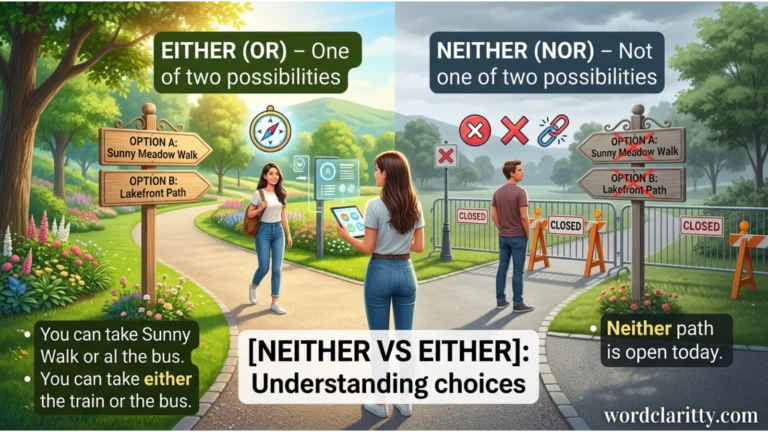
Neither vs Either is one of the most common grammar topics that confuses English learners because both words are used when talking about choices, agreements, and negative statements.
Although they may look similar, they have different meanings and are used in different situations. Understanding the difference between these two words can help you communicate more clearly and avoid common mistakes in speaking and writing. In everyday English, you will often hear expressions such as “either this or that” and “neither one of them,” making it important to know when each word is appropriate. This guide on Neither vs Either will explain their meanings, usage rules, and examples in simple language so you can use them confidently in conversations and written English.
Table of Contents
- Introduction
- Why “Neither” and “Either” Are Confusing
- Neither vs Either Explained Simply
- Understanding Homophones in English
- What Are Homophones?
- Why Homophones Cause Confusion
- What Does “Neither” Mean?
- What Does “Either” Mean?
- Neither vs Either: Key Differences at a Glance
- How to Remember the Difference Between Neither and Either
- Common Mistakes and Confusions
- Examples Section: Correct and Incorrect Usage
- Self Assessment: Test Your Knowledge
- Self Assessment Answers
- FAQs About Neither and Either
- Final Conclusion: Using Neither and Either Correctly
Why “Neither” and “Either” Are Confusing
English learners often mix up neither and either because they are connected in meaning and grammar.
Similar Pronunciation
The pronunciation of both words can vary between regions. Some speakers say nee-ther and eye-ther, while others say nye-ther and ee-ther. This variation can make them harder to distinguish.
Similar Spelling
Both words end with -ther, making them look similar at first glance.
Context Confusion
They are often used when talking about two choices, options, people, or things. Because they frequently appear in similar sentence patterns, learners may not know which one fits the situation.
Common Learner Mistakes
Many learners use either when they mean neither, especially in negative sentences.
For example:
- Incorrect: Either of the answers is correct. (when none are correct)
- Correct: Neither of the answers is correct.
The key challenge is remembering that either usually refers to one of two options, while neither means not one and not the other.
Neither vs Either Explained Simply
Neither means “not one and not the other,” while either means “one or the other.”
One-Line Distinction
Neither = none of two options.
Either = one of two options.
Example Sentences
- Neither student passed the exam.
- Neither of the roads leads to the village.
- You can choose either dress.
- Either answer is acceptable.
In simple terms:
“Neither” means no option is chosen, while “either” means one of the two options can be chosen.
Understanding Homophones in English
What Are Homophones?
Homophones are words that sound the same or nearly the same but have different meanings and sometimes different spellings.
Example:
- Their
- There
- They’re
These words sound alike but have different uses.
Why Homophones Cause Confusion
When words sound similar, learners may rely on pronunciation rather than meaning.
For example:
- Their house is beautiful.
- There is a park nearby.
Although these words sound similar, they serve completely different grammatical purposes. The same type of confusion can occur with words like neither and either, especially when spoken quickly.
What Does “Neither” Mean?
Definition and Core Meaning
Neither means not one and not the other when referring to two people, things, choices, or possibilities.
It expresses a negative idea.
Origin and Historical Use
The word neither comes from Old English and originally meant “not either.” Over time, it developed into a common word used to reject both of two alternatives.
Modern Usage and Synonyms
Today, neither is widely used in everyday English.
Possible synonyms include:
- Not one
- Not either
- None of the two
- Not any
Common Uses of Neither
- To reject two options
- To make negative statements
- As a pronoun, adjective, or conjunction
Examples:
- Neither candidate won the election.
- Neither book belongs to me.
- Neither Sarah nor Emma attended the meeting.
- I like neither coffee nor tea.
Example Sentences
- Neither answer was correct.
- Neither team scored a goal.
- Neither of the brothers lives here.
- She invited neither friend to the party.
What Does “Either” Mean?
Definition and Core Meaning
Either means one or the other of two options.
It indicates a choice, possibility, or alternative.
Origin and Historical Context
The word either comes from Old English and originally meant one of two. It has remained an important part of English for centuries.
Modern Usage and Synonyms
Modern synonyms include:
- One or the other
- Any one of the two
- Whichever
Common Uses of Either
- To offer a choice
- To indicate alternatives
- In negative sentences meaning “also”
Examples:
- You may choose either option.
- Either route will get you there.
- I don’t like broccoli. I don’t like spinach either.
Example Sentences
- Either student can represent the class.
- You can sit in either seat.
- Either solution will work.
- We can leave on either day.
Neither vs Either: Key Differences at a Glance
| Word | Part of Speech | Meaning | Example Context |
|---|---|---|---|
| Neither | Pronoun, adjective, conjunction | Not one and not the other | Neither road leads home. |
| Either | Pronoun, adjective, adverb, conjunction | One or the other | Either road will take you there. |
| Neither | Negative meaning | Rejects both choices | Neither answer is correct. |
| Either | Positive or alternative meaning | Accepts one choice | Either answer is acceptable. |
How to Remember the Difference Between Neither and Either
Learning a simple memory trick can make these words easier to remember.
Easy Memory Tricks
Neither = Negative
Notice that neither contains the idea of no.
Think:
Neither = Not either.
Association Technique
Associate either with options.
Think:
Either = One option from two choices.
Memorable Example
Imagine two ice cream flavors:
- Chocolate
- Vanilla
If you like one of them:
I’ll take either flavor.
If you want neither:
I’ll take neither flavor.
This simple image can help you remember the difference instantly.
Common Mistakes and Confusions
Mistake 1
❌ Either of them are coming.
✔ Neither of them is coming.
Explanation: The sentence is negative, so neither is needed.
Mistake 2
❌ Neither of these shirts will be fine.
✔ Either of these shirts will be fine.
Explanation: The speaker accepts one of the options.
Mistake 3
❌ I don’t like coffee and neither tea.
✔ I don’t like coffee or tea.
✔ I like neither coffee nor tea.
Explanation: The structure with neither usually pairs with nor.
Mistake 4
❌ Either John nor Peter attended.
✔ Neither John nor Peter attended.
Explanation: Use neither…nor together.
Examples Section: Correct and Incorrect Usage
Example 1
✔ Correct: Neither of the answers is correct.
✘ Incorrect: Either of the answers is correct. (when both are wrong)
Example 2
✔ Correct: You may choose either book.
✘ Incorrect: You may choose neither book. (if a choice is required)
Example 3
✔ Correct: Neither Tom nor Jerry was present.
✘ Incorrect: Either Tom nor Jerry was present.
Example 4
✔ Correct: Either road leads to the city.
✘ Incorrect: Neither road leads to the city. (if both roads actually reach the city)
Example 5
✔ Correct: I don’t like pizza either.
✘ Incorrect: I don’t like pizza neither.
Example 6
✔ Correct: Neither solution solved the problem.
✘ Incorrect: Either solution solved the problem. (when both failed)
Self Assessment: Test Your Knowledge
Fill in the blanks with either or neither.
1.
________ of the two candidates received enough votes.
2.
You can choose ________ option.
3.
________ my brother nor my sister can attend.
4.
I don’t want tea, and I don’t want coffee ________.
Self Assessment Answers
1.
Neither
Neither of the two candidates received enough votes.
2.
Either
You can choose either option.
3.
Neither
Neither my brother nor my sister can attend.
4.
Either
I don’t want tea, and I don’t want coffee either.
FAQs About Neither and Either
1. What is the main difference between neither and either?
Neither means not one and not the other, while either means one or the other.
2. Can neither and either be used as pronouns?
Yes. Both can function as pronouns.
Examples:
- Neither is available.
- Either will work.
3. Do I use nor with neither?
Yes. The standard structure is:
Neither…nor
Example:
- Neither Anna nor Lisa attended.
4. Can either mean “also”?
Yes. In negative sentences, either can mean “also.”
Example:
- I don’t like it either.
5. Is “Neither of them are” correct?
Traditional grammar prefers:
- Neither of them is available.
However, informal speech sometimes uses are.
6. Can either refer to more than two things?
Traditionally, either refers to two options. In modern conversation, some speakers use it more loosely, but two options remain the standard usage.
7. Is neither always negative?
Yes. Neither carries a negative meaning because it rejects both options.
Final Conclusion: Using “Neither” and “Either” Correctly
Understanding the difference between neither and either is an important step toward mastering everyday English. While these two words often appear in similar contexts, their meanings are very different. Neither means not one and not the other, making it the correct choice when both options are rejected. Either, on the other hand, means one or the other, making it useful when one choice from two possibilities is acceptable.
In real-world communication, you’ll frequently encounter these words in conversations, emails, books, and exams. Knowing when to use neither and either can help you express choices, preferences, and negative statements accurately. A simple memory trick is to remember that neither is negative and usually pairs with nor, while either focuses on alternatives and choices. Think of either as opening a door to options and neither as closing both doors.
The more examples you read and practice, the more natural these words will become. Don’t worry if you occasionally mix them up—many English learners do. With regular practice and attention to context, you’ll soon be able to use neither and either confidently in both speaking and writing. Keep learning, keep practicing, and your English skills will continue to grow stronger every day.