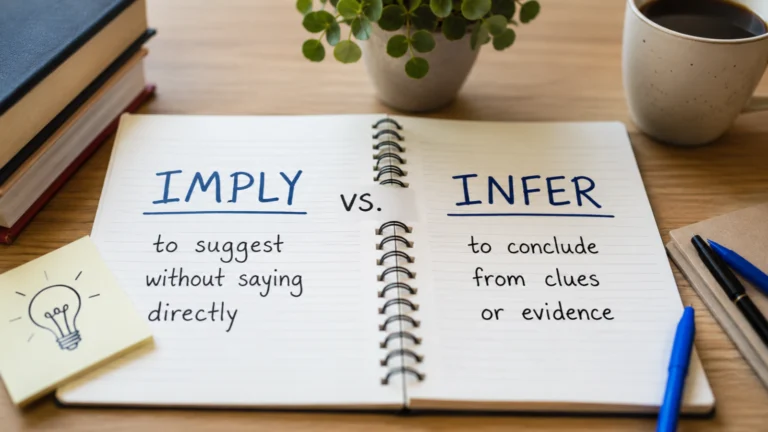
Imply vs Infer is one of the most commonly confused word pairs in English because both involve communication, yet they describe different actions. Many English learners and even native speakers use these terms interchangeably, which can lead to misunderstandings in writing and conversation. The key difference is simple: a speaker or writer implies something, while a listener or reader infers its meaning. Understanding this distinction will help you communicate more accurately, improve your grammar, and avoid common language mistakes. In this guide, you’ll learn the meanings, differences, examples, and practical tips that make these confusing words easy to remember. By the end, Imply vs Infer will no longer be a source of confusion, allowing you to use both words with confidence.
Table of Contents
- Introduction
- Why “Imply” and “Infer” Are Confusing
- Imply vs Infer Explained Simply
- Understanding Homophones in English
- What Are Homophones?
- Why Homophones Cause Confusion
- What Does “Imply” Mean?
- What Does “Infer” Mean?
- Imply vs Infer: Key Differences at a Glance
- How to Remember the Difference Between Imply and Infer
- Common Mistakes and Confusions
- Examples Section: Correct and Incorrect Usage
- Self Assessment: Test Your Knowledge
- Self Assessment Answers
- FAQs About “Imply” and “Infer”
- Final Conclusion: Using “Imply” and “Infer” Correctly
Why “Imply” and “Infer” Are Confusing
Many people confuse imply and infer because the two words describe different sides of the same communication process.
Here are the main reasons for the confusion:
Similar Pronunciation
Both words are short, begin with the letter I, and have similar sounds. This makes them easy to mix up during conversations.
Similar Spelling
Although they are not spelled alike, both words have similar structures and are often learned together in English classes.
Context Confusion
People often use both words when discussing hidden meanings or indirect communication. Because they appear in similar situations, learners sometimes think they are interchangeable.
Common Learner Mistakes
Common mistakes include:
- Saying “I implied that he was angry” when they actually mean “I inferred that he was angry.”
- Using infer when talking about the speaker’s message instead of the listener’s conclusion.
- Assuming both words have exactly the same meaning.
Remember: one person implies, while another person infers.
Imply vs Infer Explained Simply
Imply means to suggest something without saying it directly, while infer means to reach a conclusion based on evidence or hints.
One-Line Distinction
The speaker implies; the listener infers.
Examples
Imply means to suggest.
- She implied that the meeting was unnecessary.
- His smile implied that he already knew the answer.
Infer means to conclude.
- I inferred from her silence that she disagreed.
- The detective inferred that the suspect had left early.
Understanding Homophones in English
What Are Homophones?
Homophones are words that sound the same but have different meanings and sometimes different spellings.
Example:
- Sea
- See
They sound alike but have different meanings.
Why Homophones Cause Confusion
Homophones can confuse learners because hearing the word alone does not reveal its spelling or meaning.
For example:
“I’ll meet you by the sea.”
Without context, someone might hear see instead of sea.
Note: Imply and infer are not homophones. They are simply commonly confused words because they relate to the same idea.
What Does “Imply” Mean?
Definition and Core Meaning
Imply means to suggest or hint at something without expressing it directly.
Instead of stating an idea openly, the speaker leaves clues for others to understand.
Origin and Historical Use
The word imply comes from the Latin word implicare, meaning “to fold into” or “to involve.” It entered English in the late Middle Ages and gradually developed the meaning of suggesting something indirectly.
Modern Usage and Synonyms
Today, imply is commonly used in conversations, writing, journalism, business communication, and literature.
Common synonyms include:
- Suggest
- Hint
- Indicate
- Insinuate
- Signal
Key Points
- Used by the speaker or writer.
- Expresses an indirect message.
- Often requires interpretation.
Example Sentences
- She implied that the project needed more work.
- His tone implied disappointment.
- The teacher implied that the exam would be difficult.
- The article implied that changes were coming soon.
What Does “Infer” Mean?
Definition and Core Meaning
Infer means to understand or conclude something from evidence, clues, or indirect information.
Rather than receiving a direct statement, the listener or reader figures out the meaning.
Origin and Historical Context
Infer comes from the Latin word inferre, meaning “to bring in” or “to conclude.” It has been used in English for centuries to describe drawing conclusions from available information.
Modern Usage and Synonyms
Today, infer is widely used in education, research, reading comprehension, science, and everyday conversation.
Common synonyms include:
- Conclude
- Deduce
- Reason
- Gather
- Understand
Key Points
- Used by the listener or reader.
- Based on clues or evidence.
- Requires logical thinking.
Example Sentences
- We inferred that the store was closed because the lights were off.
- The jury inferred that the witness was telling the truth.
- Readers can infer the character’s emotions from the dialogue.
- Scientists infer past climates from ice samples.
Imply vs Infer: Key Differences at a Glance
| Word | Part of Speech | Meaning | Example Context |
|---|---|---|---|
| Imply | Verb | To suggest indirectly | The manager implied that changes were coming. |
| Infer | Verb | To draw a conclusion from clues | Employees inferred that a new policy would begin soon. |
How to Remember the Difference Between Imply and Infer
Learning a simple memory trick can help you remember these words forever.
Easy Memory Tricks
- Imply = I Message
- Infer = I Figure It Out
Think of it this way:
- The speaker implies.
- The listener infers.
Association Techniques
Imagine someone drops a hint.
They imply the message.
You hear the hint and understand it.
You infer the meaning.
Memorable Example
Teacher:
“Some students may want to study a little harder.”
The teacher implies the exam will be difficult.
The students infer that they should prepare more.
Common Mistakes and Confusions
Wrong Example
✘ I implied that she was unhappy because she looked upset.
Correct Version
✔ I inferred that she was unhappy because she looked upset.
Explanation: You reached a conclusion based on her appearance.
Wrong Example
✘ The article inferred that prices would rise.
Correct Version
✔ The article implied that prices would rise.
Explanation: The article suggested the idea.
Wrong Example
✘ I implied from his face that he was tired.
Correct Version
✔ I inferred from his face that he was tired.
Explanation: You observed clues and reached a conclusion.
Wrong Example
✘ The speaker inferred that more volunteers were needed.
Correct Version
✔ The speaker implied that more volunteers were needed.
Explanation: The speaker gave the indirect message.
Examples Section: Correct and Incorrect Usage
Example 1
✔ Correct: She implied that she wanted to leave early.
✘ Incorrect: She inferred that she wanted to leave early.
Example 2
✔ Correct: I inferred that he was busy because he never answered.
✘ Incorrect: I implied that he was busy because he never answered.
Example 3
✔ Correct: His words implied he was disappointed.
✘ Incorrect: His words inferred he was disappointed.
Example 4
✔ Correct: We inferred from the report that sales had increased.
✘ Incorrect: We implied from the report that sales had increased.
Example 5
✔ Correct: The email implied there would be changes.
✘ Incorrect: The email inferred there would be changes.
Self Assessment: Test Your Knowledge
Fill in the blanks with imply or infer.
- The manager __________ that promotions would happen soon.
- We __________ from her smile that she was happy.
- The author’s words __________ a hidden meaning.
- Readers often __________ the emotions of characters from their actions.
Self Assessment Answers
- implied
- inferred
- implied
- infer
FAQs About “Imply” and “Infer”
1. What is the main difference between imply and infer?
Imply means to suggest something indirectly, while infer means to understand or conclude that hidden meaning.
2. Is imply the same as infer?
No. They describe different roles in communication. The speaker implies, and the listener infers.
3. Which comes first, imply or infer?
Usually, someone implies something first, and another person infers the intended meaning afterward.
4. Can imply and infer be used interchangeably?
No. Although they are related, they cannot replace each other without changing the meaning.
5. Is infer always based on evidence?
Yes. An inference is made using clues, observations, or logical reasoning.
6. Why do English learners confuse imply and infer?
Because both words deal with indirect communication and often appear together in similar contexts.
7. How can I remember the difference easily?
Remember this sentence:
“The speaker implies. The listener infers.”
This simple rule works in almost every situation.
Final Conclusion: Using “Imply” and “Infer” Correctly
Understanding the difference between imply and infer is an important step toward becoming a more confident English speaker and writer. Although these two verbs are closely connected, they describe different parts of communication. Imply is what a speaker or writer does when giving an indirect message, while infer is what a listener or reader does when interpreting that message. Keeping this distinction in mind will help you avoid one of the most common vocabulary mistakes in English.
Whenever you are unsure which word to use, ask yourself a simple question: Who is doing the action? If someone is giving a hint or suggesting something without saying it directly, the correct word is imply. If someone is understanding the hidden meaning or drawing a conclusion from clues, the correct word is infer. This easy test works in everyday conversations, academic writing, workplace communication, and reading comprehension.
Practice with real examples whenever you read books, articles, or news stories. Notice when authors imply ideas and when readers must infer them. The more you observe these words in context, the more natural they will become. Language learning takes time, but every new distinction you master strengthens your communication skills. Keep practicing, stay curious, and soon using imply and infer correctly will become second nature.