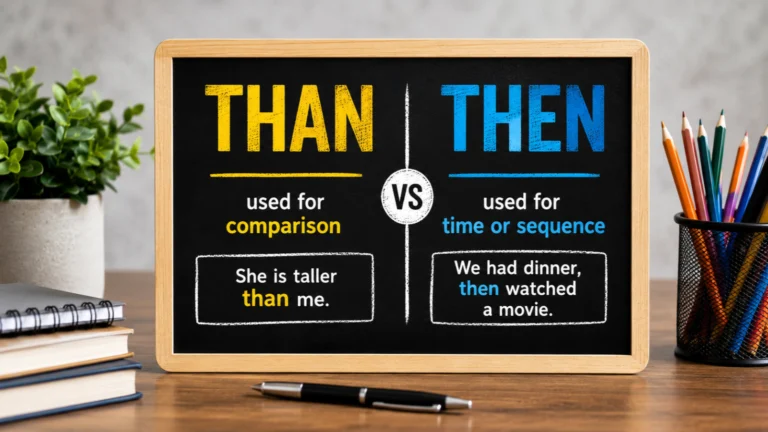
Than vs Then is one of the most common grammar topics that confuses English learners because the two words look and sound similar but have completely different meanings. Many people accidentally use one in place of the other, leading to mistakes in writing and everyday communication. Understanding the difference is essential for writing clearly, speaking confidently, and avoiding common grammar errors. In this guide, you’ll learn when to use each word, simple rules to remember, practical examples, and easy tips to prevent confusion. By the end of this article, Than vs Then will no longer be a tricky grammar question, and you’ll know exactly which word is correct in every situation.
Table of Contents
- Introduction
- Why “Than” and “Then” Are Confusing
- Than vs Then Explained Simply
- Understanding Homophones in English
- What Are Homophones?
- Why Homophones Cause Confusion
- What Does “Than” Mean?
- What Does “Then” Mean?
- Than vs Then: Key Differences at a Glance
- How to Remember the Difference Between Than and Then
- Common Mistakes and Confusions
- Examples Section: Correct and Incorrect Usage
- Self Assessment: Test Your Knowledge
- Self Assessment Answers
- FAQs About “Than” and “Then”
- Final Conclusion: Using “Than” and “Then” Correctly
Why “Than” and “Then” Are Confusing
English learners often confuse than and then for several reasons.
Similar Pronunciation
In everyday speech, these words may sound very similar, especially when spoken quickly. This makes it difficult for learners to hear the difference.
Similar Spelling
The words differ by only one letter—a and e. When typing or writing, it is easy to choose the wrong one by mistake.
Context Confusion
Both words frequently appear in everyday English. Learners sometimes know the meanings but become confused while forming sentences.
Common Learner Mistakes
Some of the most common mistakes include:
- Using then after comparative adjectives.
- Using than when talking about time.
- Typing the wrong word because of autocorrect or fast typing.
- Forgetting that one word compares while the other refers to time or sequence.
Than vs Then Explained Simply
Than is used to compare two or more people, things, ideas, or actions.
Then is used to talk about time, order, or what happens next.
One-Line Distinction
Than means comparison, while then means time or sequence.
Examples
Than
- Sarah is taller than Emma.
- Reading is more enjoyable than watching television.
Then
- Finish your homework, then you can play.
- We had dinner and then watched a movie.
Understanding Homophones in English
What Are Homophones?
Homophones are words that sound the same or almost the same but have different meanings and spellings.
Example:
- Their
- There
Although they sound alike, they have completely different meanings.
Why Homophones Cause Confusion
Homophones can easily confuse learners because listening alone may not reveal which word is correct.
For example:
“I’ll call you then.”
“He is taller than me.”
Both words sound similar, but only one fits each sentence.
What Does “Than” Mean?
Definition and Core Meaning
Than is a conjunction or preposition used to compare people, objects, actions, qualities, or amounts.
It answers questions like:
- Which is bigger?
- Which is faster?
- Which is better?
Origin and Historical Use
The word than comes from Old English and has been used for centuries to express comparison between two things.
Modern Usage and Synonyms
Common situations where than is used include:
- Comparing people
- Comparing numbers
- Comparing opinions
- Comparing abilities
Possible alternatives (depending on context):
- Compared with
- Compared to
- Rather than
Example Sentences
- This road is shorter than the other one.
- My brother is younger than I am.
- Apples are cheaper than oranges.
- She works harder than anyone else.
What Does “Then” Mean?
Definition and Core Meaning
Then is an adverb that refers to time, sequence, or the next step in a process.
It answers questions like:
- When?
- What happened next?
Origin and Historical Context
The word then also comes from Old English and has long been used to indicate time or order.
Modern Usage and Synonyms
Today, then commonly means:
- Next
- After that
- At that time
- In that case
Similar words include:
- Next
- Afterwards
- Later
- Subsequently
Example Sentences
- Brush your teeth, then go to bed.
- We arrived early and then checked into the hotel.
- Life was very different back then.
- If that’s true, then we should leave now.
Than vs Then: Key Differences at a Glance
| Word | Part of Speech | Meaning | Example Context |
|---|---|---|---|
| Than | Conjunction / Preposition | Used for comparison | She is taller than her sister. |
| Then | Adverb | Refers to time or sequence | We ate lunch, then went shopping. |
How to Remember the Difference Between Than and Then
Fortunately, remembering the difference is easier than it seems.
Easy Memory Tricks
- Than has the letter A, just like Comparison (both involve comparing).
- Then has the letter E, just like Next Event.
Association Techniques
Think of these phrases:
- Better than
- Bigger than
- Smaller than
Now think of:
- First…
- Then…
- Finally…
One Memorable Example
“I studied first, then I took the test, and my score was higher than before.”
This single sentence uses both words correctly.
Common Mistakes and Confusions
Wrong
She is smarter then me.
Correct
She is smarter than me.
Explanation: Comparisons require than.
Wrong
We ate dinner than watched TV.
Correct
We ate dinner then watched TV.
Explanation: The sentence describes sequence, so then is correct.
Wrong
This book is more interesting then that one.
Correct
This book is more interesting than that one.
Explanation: Comparative adjectives use than.
Wrong
Finish your work than call me.
Correct
Finish your work then call me.
Explanation: The sentence describes what happens next.
Examples Section: Correct and Incorrect Usage
Example 1
✔ Correct: My car is faster than yours.
✘ Incorrect: My car is faster then yours.
Example 2
✔ Correct: We cleaned the house, then relaxed.
✘ Incorrect: We cleaned the house, than relaxed.
Example 3
✔ Correct: This phone costs less than that one.
✘ Incorrect: This phone costs less then that one.
Example 4
✔ Correct: Finish your breakfast, then get ready for school.
✘ Incorrect: Finish your breakfast, than get ready for school.
Self Assessment: Test Your Knowledge
Fill in the blanks with than or then.
- My sister is older ______ me.
- We packed our bags and ______ left for the airport.
- This exercise is easier ______ the previous one.
- Finish your project, ______ send it to your teacher.
Self Assessment Answers
- than
- then
- than
- then
FAQs About “Than” and “Then”
1. What is the main difference between than and then?
Than is used for comparison, while then refers to time, sequence, or the next event.
2. Is it “better than” or “better then”?
The correct phrase is better than because it compares two things.
3. Can then be used for comparison?
No. Then should not be used when comparing people, objects, or ideas.
4. Why do people confuse than and then?
They look similar, sound alike in many accents, and are frequently used in everyday English.
5. Is “first… then…” grammatically correct?
Yes. This is a common way to describe the order of events.
6. How can I remember which word to use?
Remember that than is for comparison, while then is for time or what happens next.
7. Are than and then homophones?
They are considered near-homophones because many speakers pronounce them very similarly, which contributes to confusion.
Final Conclusion: Using “Than” and “Then” Correctly
Learning the difference between than and then is an important step toward writing and speaking English more accurately. Although these words are similar in spelling and pronunciation, they serve completely different purposes. Than is the word you need whenever you compare two or more things, such as saying one person is taller, one product is cheaper, or one choice is better than another. Then, on the other hand, helps you describe time, order, or the next event in a sequence. It answers questions like “What happened next?” or “When did it happen?”
A simple way to remember the difference is to connect than with comparison and then with time. You can also think of common expressions like “better than” for comparisons and “first, then, finally” for sequences. Reading English regularly, paying attention to these patterns, and practicing with your own sentences will help make the correct choice feel natural.
Mistakes are a normal part of learning any language, so don’t worry if you occasionally mix these words up. The more you practice, the easier it becomes to recognize the correct usage instantly. Keep reviewing examples, test yourself with exercises, and apply what you’ve learned in everyday writing. With consistent practice, you’ll confidently use than and then correctly in conversations, emails, essays, and professional communication.