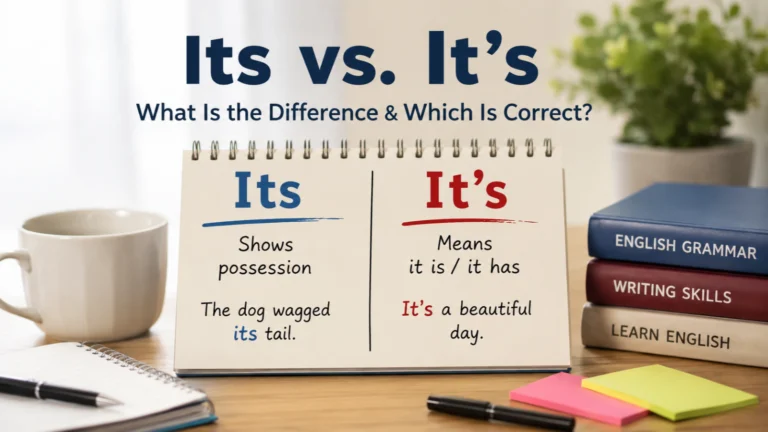
Its vs It’s is one of the most common grammar topics that confuses English learners and even native speakers. Although these two words look almost identical, they have completely different meanings and uses. Understanding the difference can help you write more clearly, avoid embarrassing mistakes, and improve your grammar in emails, essays, blog posts, and everyday conversations. Its vs. It’s becomes easy to master once you know a simple rule: one shows possession, while the other is a contraction of “it is” or “it has.” In this guide, you’ll learn the meaning of each word, their grammar rules, practical examples, common mistakes to avoid, and simple tips to remember the correct usage every time you write.
Table of Contents
- Introduction
- Why “Its” and “It’s” Are Confusing
- Its vs. It’s Explained Simply
- Understanding Homophones in English
- What Are Homophones?
- Why Homophones Cause Confusion
- What Does “Its” Mean?
- What Does “It’s” Mean?
- Its vs. It’s: Key Differences at a Glance
- How to Remember the Difference Between Its and It’s
- Common Mistakes and Confusions
- Examples Section: Correct and Incorrect Usage
- Self Assessment: Test Your Knowledge
- Self Assessment Answers
- FAQs About “Its” and “It’s”
- Final Conclusion: Using “Its” and “It’s” Correctly
Why “Its” and “It’s” Are Confusing
Many people accidentally use its and it’s incorrectly because they appear nearly identical. Understanding why they cause confusion can help you avoid common writing mistakes.
Similar Pronunciation
Both words are pronounced exactly the same. Since English learners often rely on pronunciation, it is easy to choose the wrong spelling.
Similar Spelling
The only visible difference is the apostrophe. However, that tiny punctuation mark completely changes the meaning.
Context Confusion
Sometimes both words fit naturally into a sentence until you think about their grammatical roles. One shows possession, while the other is a contraction.
Common Learner Mistakes
Learners often believe every possessive word needs an apostrophe. This is true for many nouns, such as:
- Sarah’s book
- John’s bicycle
However, its is an important exception. It never uses an apostrophe to show possession.
Its vs. It’s Explained Simply
Its means something belongs to an animal, object, organization, or idea, while it’s is the shortened form of it is or it has.
One-Line Distinction
Its = possession
It’s = it is / it has
Examples
- The cat cleaned its paws.
- The company changed its logo.
- It’s raining outside.
- It’s been a wonderful day.
Understanding Homophones in English
What Are Homophones?
Homophones are words that sound the same but have different meanings and spellings.
Example:
- there
- their
Although they sound alike, they are used differently.
Why Homophones Cause Confusion
When speaking, you cannot hear the spelling difference. This means writers must depend on grammar instead of pronunciation.
For example:
- They’re going home.
- Their house is beautiful.
Both begin with the same sound, but each serves a different purpose.
The same idea applies to its and it’s.
What Does “Its” Mean?
Definition and Core Meaning
Its is a possessive determiner. It shows that something belongs to an animal, thing, organization, country, or idea.
Examples include ownership, characteristics, or parts of something.
Examples
- The dog wagged its tail.
- The tree lost its leaves.
- The company announced its plans.
Origin and Historical Use
The possessive form its became common in English during the 17th century. Before that, writers sometimes used his when referring to objects or animals.
As English developed, its became the accepted possessive form of it.
Modern Usage and Synonyms
Although its has no direct synonym, it often means:
- belonging to it
- owned by it
- associated with it
Common Uses
- Possession
- Ownership
- Characteristics
- Parts of an object
- Features of an organization
More Examples
- The computer restarted on its own.
- Every country has its own traditions.
- The bird built its nest.
What Does “It’s” Mean?
Definition and Core Meaning
It’s is a contraction.
It can mean:
- It is
- It has
If you can replace it’s with it is or it has, then using it’s is correct.
Origin and Historical Context
English contractions became common to make speech and writing more natural. The apostrophe replaces missing letters.
Examples:
- don’t = do not
- can’t = cannot
- it’s = it is / it has
Modern Usage and Synonyms
Possible expansions include:
- it is
- it has
Common Uses
- Introducing statements
- Describing situations
- Talking about time
- Discussing weather
- Present perfect tense
Examples
- It’s a beautiful morning.
- It’s already five o’clock.
- It’s been an exciting week.
- It’s easy to understand.
Its vs. It’s: Key Differences at a Glance
| Word | Part of Speech | Meaning | Example Context |
|---|---|---|---|
| Its | Possessive determiner | Belonging to it | The robot lost its battery. |
| It’s | Contraction | It is / It has | It’s almost lunchtime. |
How to Remember the Difference Between Its and It’s
Learning one simple trick can help you avoid this mistake forever.
Easy Memory Tricks
Trick 1: Expand It
Replace it’s with it is.
If the sentence still makes sense, use it’s.
Example:
- It’s cold today.
- It is cold today. ✔
Trick 2: Think About Ownership
If something belongs to an object or animal, choose its.
Example:
- The rabbit cleaned its ears.
The ears belong to the rabbit.
Association Technique
Remember this sentence:
Apostrophe = Missing Letters, Not Ownership (for “its”).
Memorable Example
It’s happy because its owner came home.
The first word means it is.
The second word shows possession.
Common Mistakes and Confusions
Wrong
❌ The dog wagged it’s tail.
✅ The dog wagged its tail.
Explanation: The tail belongs to the dog.
Wrong
❌ Its raining today.
✅ It’s raining today.
Explanation: It means it is raining.
Wrong
❌ The school changed it’s rules.
✅ The school changed its rules.
Explanation: The rules belong to the school.
Wrong
❌ Its been a long week.
✅ It’s been a long week.
Explanation: It means it has been.
Examples Section: Correct and Incorrect Usage
Example 1
✔ Correct: The lion protected its cubs.
✘ Incorrect: The lion protected it’s cubs.
Example 2
✔ Correct: It’s my favorite movie.
✘ Incorrect: Its my favorite movie.
Example 3
✔ Correct: Every phone has its own serial number.
✘ Incorrect: Every phone has it’s own serial number.
Example 4
✔ Correct: It’s been an amazing experience.
✘ Incorrect: Its been an amazing experience.
Example 5
✔ Correct: The museum updated its exhibits.
✘ Incorrect: The museum updated it’s exhibits.
Example 6
✔ Correct: It’s difficult to learn every grammar rule at once.
✘ Incorrect: Its difficult to learn every grammar rule at once.
Self Assessment: Test Your Knowledge
Fill in the blanks with its or it’s.
- The horse lifted _____ head proudly.
- _____ going to snow tonight.
- The company announced _____ annual report.
- _____ been a busy month.
Self Assessment Answers
- its
- It’s
- its
- It’s
FAQs About “Its” and “It’s”
1. What is the difference between its and it’s?
Its shows possession, while it’s means it is or it has.
2. Is “its” a possessive word?
Yes. Its is the possessive form of it and does not use an apostrophe.
3. Why doesn’t “its” have an apostrophe?
Unlike most nouns, the possessive pronoun its is an exception in English grammar. The apostrophe is reserved for the contraction it’s.
4. How can I check whether I should use “it’s”?
Replace it’s with it is or it has. If the sentence still makes sense, it’s is correct.
5. Can “it’s” show ownership?
No. It’s never shows possession. It only means it is or it has.
6. Do native English speakers confuse its and it’s?
Yes. This is one of the most common grammar mistakes in English, even among experienced writers.
7. What is the easiest way to remember the difference?
Remember:
- Its = belongs to it
- It’s = it is / it has
If you can expand the word into it is or it has, use it’s.
Final Conclusion: Using “Its” and “It’s” Correctly
Understanding the difference between its and it’s is one of the simplest ways to improve your English writing. Although the two words sound exactly the same, they serve very different purposes. Its is a possessive determiner that shows ownership or belonging, such as in the sentence “The bird built its nest.” In contrast, it’s is a contraction for it is or it has, as in “It’s a beautiful day” or “It’s been a wonderful experience.” Keeping this distinction in mind will help you write more clearly and confidently.
A useful memory trick is to test whether you can replace it’s with it is or it has. If the sentence still makes sense, the contraction is correct. If you are talking about something belonging to an object, animal, organization, or idea, use its instead. This quick check works in almost every situation and can prevent one of the most common grammar mistakes in English.
The more you read and write, the more natural this rule will become. Pay attention to how its and it’s appear in books, articles, and everyday conversations. With regular practice and careful proofreading, you’ll soon use both words correctly without even thinking about it. Every grammar rule you master makes your English stronger, clearer, and more confident, so keep learning and enjoy the journey.