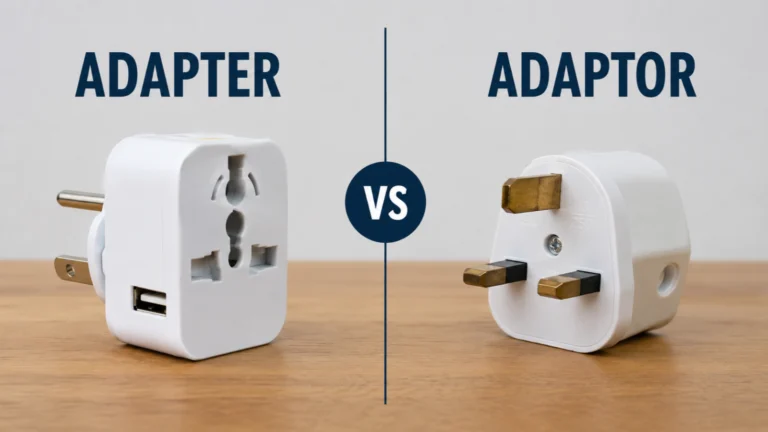
Adapter vs Adaptor is a common spelling question that often confuses English learners, writers, and professionals. Although both words refer to a device or person that enables something to fit, connect, or work together, their usage depends largely on regional English preferences and specific industries. Understanding the distinction helps you choose the correct term for academic writing, technical documents, business communication, and everyday conversations. In this guide, you’ll discover whether the two spellings have different meanings, which one is more widely accepted, and when each should be used. By the end, adapter vs adaptor will no longer be a source of confusion, allowing you to write with greater confidence and accuracy.
Table of Contents
- Introduction
- Why “adapter” and “adaptor” Are Confusing
- adapter vs adaptor Explained Simply
- Understanding Homophones in English
- What Are Homophones?
- Why Homophones Cause Confusion
- What Does “adapter” Mean?
- What Does “adaptor” Mean?
- adapter vs adaptor: Key Differences at a Glance
- How to Remember the Difference Between adapter and adaptor
- Common Mistakes and Confusions
- Examples Section: Correct and Incorrect Usage
- Self Assessment: Test Your Knowledge
- Self Assessment Answers
- FAQs About “adapter and adaptor”
- Final Conclusion: Using “adapter” and “adaptor” Correctly
Why “adapter” and “adaptor” Are Confusing
Many people struggle with adapter and adaptor because they appear to be different words, but they usually have the same meaning.
Similar Pronunciation
Both words are pronounced exactly the same:
adapter = adaptor
Because there is no difference in pronunciation, people often assume the spelling does not matter.
Similar Spelling
The only difference is one letter:
- adapter
- adaptor
Since English contains many words with multiple accepted spellings, learners naturally become uncertain.
Context Confusion
Both spellings refer to something that allows two different things to work together.
Examples include:
- USB adapter
- Travel adaptor
- Power adapter
- AC adaptor
Different companies, dictionaries, and countries may prefer one spelling over the other.
Common Learner Mistakes
Learners often:
- Think one spelling is wrong.
- Believe they have different meanings.
- Switch spellings within the same document.
- Assume British English and American English always follow strict rules.
In reality, both spellings are accepted, although adapter is generally more common today.
adapter vs adaptor Explained Simply
The easiest way to understand these words is this:
“Adapter” means a device or thing that allows two different items to connect or work together, while “adaptor” is simply an alternative spelling of the same word.
One-Line Distinction
Adapter is the more common modern spelling, while adaptor is an accepted alternative, especially in certain technical fields and publications.
Examples
- I bought a USB adapter for my laptop.
- The camera adaptor allows different lenses to fit.
Understanding Homophones in English
What Are Homophones?
Homophones are words that have the same pronunciation but different spellings, meanings, or both.
Example:
- flower
- flour
They sound identical but have different meanings.
Although adapter and adaptor have the same pronunciation, they are actually variant spellings rather than true homophones because they share the same meaning.
Why Homophones Cause Confusion
English learners often depend on pronunciation when learning vocabulary. When two words sound identical, choosing the correct spelling becomes difficult.
For example:
- Their
- There
Both sound alike but serve different purposes.
Similarly, adapter and adaptor sound identical, leading many writers to wonder which spelling they should use.
What Does “adapter” Mean?
Definition and Core Meaning
An adapter is something that enables two different devices, systems, or parts to work together.
It often refers to:
- An electrical connector
- A travel plug
- A computer accessory
- A person or thing that adapts something
Origin and Historical Use
The word comes from the verb adapt, meaning “to make suitable.”
The spelling adapter became increasingly popular during the twentieth century, especially in American English. Today it is the preferred spelling in most dictionaries, technology companies, and product packaging.
Modern Usage and Synonyms
Common uses include:
- Power adapter
- Network adapter
- USB adapter
- Travel adapter
Synonyms include:
- Connector
- Converter
- Interface
- Coupler (in some technical contexts)
Example Sentences
- My laptop charger came with a universal adapter.
- I need an HDMI adapter to connect the monitor.
What Does “adaptor” Mean?
Definition and Core Meaning
An adaptor has exactly the same meaning as adapter.
It refers to something that connects, converts, or makes different parts compatible.
Origin and Historical Context
The spelling adaptor appeared in earlier English usage and continues to exist today.
Some publishers, engineering companies, and manufacturers still prefer adaptor, particularly in certain technical documents or British publications.
Modern Usage and Synonyms
Common examples include:
- Lens adaptor
- AC adaptor
- Power adaptor
- Audio adaptor
Synonyms include:
- Connector
- Converter
- Interface
- Coupler
Example Sentences
- The microscope requires a special adaptor.
- This adaptor lets older devices connect to modern equipment.
adapter vs adaptor: Key Differences at a Glance
| Word | Part of Speech | Meaning | Example Context |
|---|---|---|---|
| adapter | Noun | A device or item that connects different things | USB adapter, travel adapter |
| adaptor | Noun | Alternative spelling of adapter | Camera adaptor, AC adaptor |
Key takeaway: The meaning is the same. The difference is mainly spelling preference.
How to Remember the Difference Between adapter and adaptor
Fortunately, remembering these words is easy.
Easy Memory Tricks
- Think of adapter as the spelling you will see most often.
- If you are unsure, choose adapter because it is the more common modern form.
Association Techniques
Imagine buying electronics online.
Most product listings say:
- USB adapter
- Power adapter
- Bluetooth adapter
Seeing this repeatedly helps reinforce the spelling.
Memorable Example
“When buying computer accessories, I usually look for an adapter.”
Since online stores commonly use adapter, this spelling becomes easier to remember.
Common Mistakes and Confusions
Wrong Example
❌ I need an adapter, but my report later calls it an adaptor without any reason.
Correct Version
✔ Use one spelling consistently throughout the same document.
Wrong Example
❌ Adapter and adaptor have different meanings.
Correct Version
✔ Adapter and adaptor usually mean exactly the same thing.
Wrong Example
❌ Adaptor is always British English.
Correct Version
✔ Both spellings appear in British English, although preferences vary by publisher.
Wrong Example
❌ Adapter is incorrect.
Correct Version
✔ Adapter is the most widely used modern spelling.
Examples Section: Correct and Incorrect Usage
Example 1
✔ Correct: I bought a travel adapter before flying overseas.
✘ Incorrect: I bought a travel adapter, but later claimed adapters and adaptors are different devices.
Example 2
✔ Correct: The camera adaptor fits several lens types.
✘ Incorrect: The camera adaptor is a completely different tool from an adapter.
Example 3
✔ Correct: My USB adapter connects my phone to the computer.
✘ Incorrect: My USB adapter cannot connect because adapter means software.
Example 4
✔ Correct: The company sells both AC adapters and battery chargers.
✘ Incorrect: Only adaptor is accepted in English.
Self Assessment: Test Your Knowledge
1.
I forgot my phone ________ at home.
2.
Both adapter and ________ are accepted spellings.
3.
Which spelling is more common in modern English?
4.
A travel ________ allows different electrical plugs to fit local sockets.
Self Assessment Answers
- adapter
- adaptor
- adapter
- adapter (adaptor is also acceptable)
FAQs About “adapter and adaptor”
1. Is adapter or adaptor correct?
Both are correct. Adapter is simply more common in modern English.
2. Is adaptor old-fashioned?
Not exactly. It is still widely used in technical writing and by some manufacturers.
3. Which spelling should students use?
Students should generally use adapter, as it is the preferred spelling in most dictionaries and educational materials.
4. Do adapter and adaptor have different meanings?
No. They normally refer to exactly the same thing.
5. Which spelling is more common in American English?
Adapter is overwhelmingly more common in American English.
6. Can I use adaptor in British English?
Yes. British English accepts both spellings, although adapter is also very common.
7. Should I mix both spellings in one document?
No. Choose one spelling and use it consistently throughout your writing.
Final Conclusion: Using “adapter” and “adaptor” Correctly
Understanding the difference between adapter and adaptor is much easier than many English learners expect. Unlike many confusing English word pairs, these two words do not have different meanings. Instead, they are simply two accepted spellings of the same noun, referring to a device or item that allows different objects, systems, or connections to work together. Today, adapter is the spelling you will encounter most often in modern English, especially in technology, education, online shopping, and American English. Meanwhile, adaptor continues to appear in technical documents, product names, and some British publications.
The best approach is to choose one spelling and remain consistent throughout your writing. If you are unsure which version to use, adapter is generally the safest choice because it is the most widely recognized and commonly used. A simple memory trick is to think about the electronics you buy every day—most packages and websites use adapter, making it easier to remember. Reading authentic English materials and noticing how these words are used will strengthen your confidence over time. Every small distinction you learn adds to your overall language skills, helping you communicate more clearly and naturally. Keep practicing, stay curious, and remember that mastering these small spelling differences is another step toward becoming a more confident English writer and speaker.