
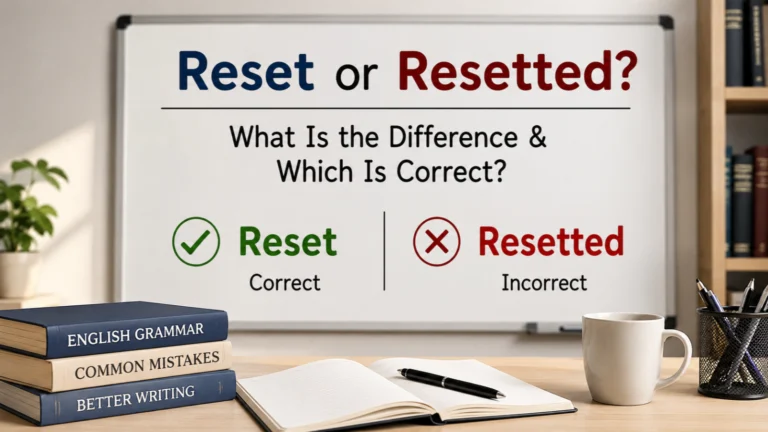
English learners often wonder whether reset or resetted is the correct past tense of the verb reset. Since many English verbs form their past tense by adding -ed, it seems natural to think that resetted should be correct. However, English has many exceptions, and reset is one of them. Understanding the difference between reset and resetted helps you write more accurately in school, business, technology, and everyday communication. In this guide, you’ll learn which form is correct, why people get confused, and how to remember the difference with simple explanations, examples, and practical tips
Why “Reset” and “Resetted” Are Confusing
Many English learners mix up reset and resetted because English spelling and grammar can be unpredictable.
Similar Pronunciation
Both words sound almost the same when spoken quickly, making it difficult to notice the difference.
Similar Spelling
The only visible difference is the extra -ted ending in resetted, which makes it look like a regular past-tense verb.
Context Confusion
People often read or hear sentences such as:
- “I reset my phone yesterday.”
- “The computer was reset.”
Because many verbs follow the verb + ed rule, learners assume resetted should also exist.
Common Learner Mistakes
Some common mistakes include:
- Writing resetted in essays.
- Using resetted in emails.
- Assuming spell-check is always correct.
- Following incorrect examples found online.
The truth is simple:
Reset is both the present tense and the standard past tense and past participle.
Reset vs Resetted Explained Simply
Reset means to return something to its original state, while resetted is generally considered incorrect in standard English.
One-Line Distinction
Reset is the correct word. Resetted is a nonstandard form that should usually be avoided.
Examples
- I reset my password yesterday.
- She has reset the system successfully.
Understanding Homophones in English
What Are Homophones?
Homophones are words that sound alike but have different meanings or spellings.
Example:
- Right
- Write
They sound the same but mean different things.
Why Homophones Cause Confusion
Although reset and resetted are not true homophones, learners often confuse similar-looking and similar-sounding words in the same way.
For example:
- Their
- There
- They’re
These words demonstrate how pronunciation can make spelling more difficult.
What Does “Reset” Mean?
Definition and Core Meaning
Reset means:
- To return something to its original setting.
- To start again.
- To restore default settings.
- To begin from the beginning.
It is commonly used with:
- Computers
- Mobile phones
- Passwords
- Games
- Machines
- Goals
- Habits
Origin and Historical Use
The word reset comes from combining:
- re- (again)
- set (place or position)
The verb became especially popular with the growth of electronics and computing during the twentieth century.
Unlike many English verbs, reset keeps the same form in:
- Present tense
- Past tense
- Past participle
Modern Usage and Synonyms
Common synonyms include:
- Restore
- Restart
- Reboot
- Reinitialize
- Renew
- Begin again
Example Sentences
- I reset my laptop after the update.
- She reset the alarm clock.
- We reset the experiment and tried again.
- The technician reset the router.
What Does “Resetted” Mean?
Definition and Core Meaning
Resetted is generally considered a nonstandard or incorrect past tense of reset.
Most dictionaries and style guides recommend using reset instead.
Origin and Historical Context
People formed resetted by applying the regular -ed rule.
For example:
- Walk → Walked
- Jump → Jumped
- Clean → Cleaned
However, reset belongs to a group of verbs that keep the same form in different tenses.
Modern Usage and Synonyms
You may occasionally see resetted in:
- Informal internet posts
- Old software documentation
- Non-native English writing
However, it is rarely accepted in professional writing.
Use reset instead.
Example Sentences
Incorrect:
- The password was resetted.
Correct:
- The password was reset.
Incorrect:
- I resetted the modem.
Correct:
- I reset the modem.
Reset vs Resetted: Key Differences at a Glance
| Word | Part of Speech | Meaning | Example Context |
|---|---|---|---|
| Reset | Verb | Return to original settings; restart | I reset my phone yesterday. |
| Resetted | Nonstandard verb form | Incorrect past tense of reset in standard English | Avoid using this form in formal writing. |
How to Remember the Difference Between Reset and Resetted
Remember these simple tricks:
- Think of set.
- The past tense of set is set.
- Therefore, reset also stays reset.
Association Technique
Imagine pressing the Reset button on your computer.
You would never see a button labeled Resetted.
Memorable Example
Correct:
Yesterday I reset my computer.
Not:
Yesterday I resetted my computer.
If you remember set → set, you’ll easily remember reset → reset.
Common Mistakes and Confusions
Wrong
I resetted my password.
Correct
I reset my password.
Explanation:
Reset already functions as the past tense.
Wrong
The machine was resetted.
Correct
The machine was reset.
Explanation:
Standard English uses reset.
Wrong
She has resetted the router.
Correct
She has reset the router.
Explanation:
The past participle is also reset.
Wrong
We resetted the game.
Correct
We reset the game.
Explanation:
Do not add -ed.
Examples Section: Correct and Incorrect Usage
Example 1
✔ Correct:
I reset the printer before printing.
✘ Incorrect:
I resetted the printer before printing.
Example 2
✔ Correct:
She reset her phone yesterday.
✘ Incorrect:
She resetted her phone yesterday.
Example 3
✔ Correct:
The engineer has reset the server.
✘ Incorrect:
The engineer has resetted the server.
Example 4
✔ Correct:
We reset the settings after the software update.
✘ Incorrect:
We resetted the settings after the software update.
Self Assessment: Test Your Knowledge
Fill in the blanks.
1.
Yesterday, I ______ my computer.
2.
The technician has ______ the router.
3.
The password was ______ successfully.
4.
Which word is correct?
- reset
- resetted
Self Assessment Answers
- reset
- reset
- reset
- reset
FAQs About “Reset” and “Resetted”
1. Is “resetted” a real English word?
It occasionally appears in informal writing, but it is considered nonstandard. Standard English uses reset.
2. What is the past tense of reset?
The correct past tense is reset.
Example:
“I reset my phone yesterday.”
3. What is the past participle of reset?
The past participle is also reset.
Example:
“I have reset the password.”
4. Why doesn’t reset become resetted?
Because reset is an irregular verb that keeps the same spelling in the present, past, and past participle.
5. Is “resetted” grammatically wrong?
In formal English, yes. Most dictionaries, teachers, and style guides recommend using reset.
6. Do native English speakers use “resetted”?
Occasionally in casual conversation or online forums, but professional writing almost always uses reset.
7. Should I ever use “resetted”?
For academic, business, technical, and everyday standard English, it is best to avoid resetted and use reset instead.
Final Conclusion: Using “Reset” and “Resetted” Correctly
Understanding the difference between reset and resetted is easier than it first appears. Although many English verbs form their past tense by adding -ed, reset is an exception. In standard English, reset serves as the present tense, the past tense, and the past participle. This means you should write “I reset my computer yesterday,” “She has reset her password,” and “The device was reset.” Using resetted may seem logical because it follows the pattern of regular verbs, but it is generally regarded as a nonstandard form and is not recommended in formal writing, academic work, business communication, or technical documentation.
A simple way to remember this rule is to compare reset with set. Just as we say “I set the table yesterday,” not “I setted the table,” we also say “I reset the system yesterday,” not “I resetted the system.” This easy association can help you avoid one of the most common grammar mistakes made by English learners. The more you read, write, and practice correct examples, the more natural this usage will become. English has many unusual verb forms, but learning them one at a time builds confidence and accuracy. Keep practicing, pay attention to authentic English examples, and remember that every small grammar improvement brings you one step closer to fluent and confident communication.

