Many English learners wonder whether they should use scrap or scrape because the two words look and sound similar. Although they differ by only one letter, their meanings are completely different. Using the wrong word can change the meaning of your sentence and make your writing confusing. Whether you’re writing an email, talking about recycling, describing an injury, or explaining how to remove paint from a wall, knowing the difference is important. In this guide, you’ll learn the meanings of scrap and scrape in simple English, discover when to use each word correctly, and avoid common mistakes with easy examples and practical memory tips.
Table of Contents
- Introduction
- Why “Scrap” and “Scrape” Are Confusing
- Scrap vs Scrape Explained Simply
- Understanding Homophones in English
- What Are Homophones?
- Why Homophones Cause Confusion
- What Does “Scrap” Mean?
- What Does “Scrape” Mean?
- Scrap vs Scrape: Key Differences at a Glance
- How to Remember the Difference Between Scrap and Scrape
- Common Mistakes and Confusions
- Examples Section: Correct and Incorrect Usage
- Self Assessment: Test Your Knowledge
- Self Assessment Answers
- FAQs About “Scrap” and “Scrape”
- Final Conclusion: Using “Scrap” and “Scrape” Correctly
Why “Scrap” and “Scrape” Are Confusing
Many people mix up scrap and scrape because they are very similar in pronunciation and spelling. However, they have different meanings and are used in different situations.
Similar Pronunciation
Both words begin with scra- and sound almost the same when spoken quickly. The only noticeable difference is the ending sound.
Similar Spelling
The words differ by just one letter—scrap ends with p, while scrape ends with pe. This small spelling difference often leads to typing or writing mistakes.
Context Confusion
Both words can appear in situations involving objects or materials. For example, someone may talk about scrap metal or scraping paint, making learners think the words are interchangeable.
Common Learner Mistakes
Some common mistakes include:
- Saying “scrape paper” instead of scrap paper.
- Writing “scrap the ice off the windshield” instead of scrape the ice off the windshield.
- Confusing scrap as a verb with scrape because both involve removing or getting rid of something.
Scrap vs Scrape Explained Simply
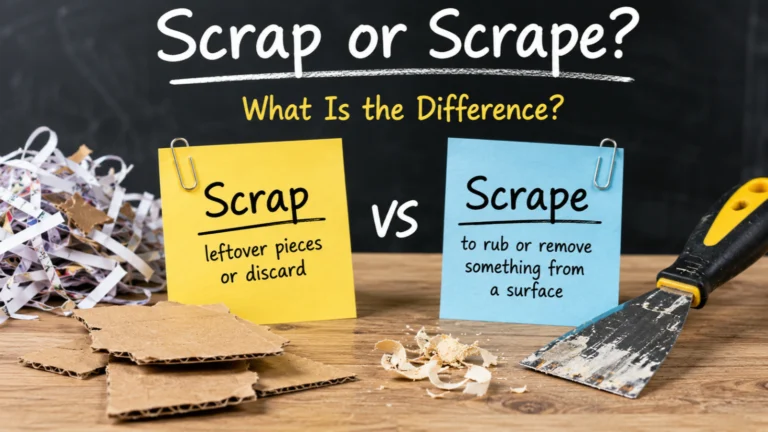
Scrap means a small leftover piece or to throw something away because it is no longer useful, while scrape means to rub or remove something by using a sharp edge or rough surface.
One-line distinction
Scrap = discard or leftover pieces.
Scrape = rub, remove, or scratch a surface.
Examples
Scrap
- We sold the old car for scrap.
- They decided to scrap the project.
Scrape
- Please scrape the mud off your shoes.
- I accidentally scraped my knee on the pavement.
Understanding Homophones in English
What Are Homophones?
Homophones are words that sound the same or almost the same but have different meanings and spellings.
Example:
- right
- write
These words sound alike but mean different things.
Why Homophones Cause Confusion
English has many words with similar sounds. Learners often choose the wrong spelling because they rely on pronunciation instead of meaning.
For example:
- I need to write a letter.
- Turn right at the traffic light.
Although scrap and scrape are not perfect homophones, their similar pronunciation makes them easy to confuse.
What Does “Scrap” Mean?
Definition and Core Meaning
Scrap can be a noun or a verb.
As a noun, it refers to a small leftover piece or waste material.
As a verb, it means to discard, cancel, or abandon something because it is no longer useful.
Origin and Historical Use
The word scrap comes from Old Norse and Middle English, where it referred to small pieces or fragments. Over time, it also came to mean abandoning or canceling plans, equipment, or projects.
Modern Usage and Synonyms
Modern meanings include:
- Leftover material
- Waste metal
- Canceling plans
- Discarding old equipment
Synonyms
- discard
- throw away
- abandon
- reject
- leftover
- fragment
Example Sentences
- We collected scrap metal for recycling.
- The company scrapped the old design.
- She kept a scrap of fabric for sewing.
- They decided to scrap the proposal.
What Does “Scrape” Mean?
Definition and Core Meaning
Scrape is mainly a verb.
It means to rub a surface with something sharp, remove material, or scratch against something.
It can also be used as a noun to describe a scratch or a difficult situation.
Origin and Historical Context
The word scrape comes from Germanic languages and has long been associated with rubbing, scratching, or cleaning surfaces.
Modern Usage and Synonyms
Today, scrape commonly refers to:
- Cleaning surfaces
- Removing paint
- Removing ice
- Light injuries
- Barely achieving something
Synonyms
- scratch
- rub
- clean
- shave
- remove
- peel
Example Sentences
- Use a knife to scrape the butter from the bowl.
- He scraped the paint off the wall.
- I scraped my elbow during the game.
- She managed to scrape enough money together for the trip.
Scrap vs Scrape: Key Differences at a Glance
| Word | Part of Speech | Meaning | Example Context |
|---|---|---|---|
| Scrap | Noun, Verb | Leftover material or discard something | They scrapped the old machine. |
| Scrape | Verb, Noun | Rub or remove material from a surface | Please scrape the mud off your boots. |
How to Remember the Difference Between Scrap and Scrape
Learning memory tricks makes confusing words easier.
Easy Memory Tricks
- Scrap = Stop using it.
- Scrape = Scratch a surface.
Association Techniques
Think of scrap metal at a recycling yard.
Think of scraping paint from a wall.
One involves throwing away.
The other involves removing from a surface.
Memorable Example
The broken bike became scrap, but first we scraped off the old paint.
This sentence uses both words correctly and shows their different meanings.
Common Mistakes and Confusions
Wrong
We need to scrape the old project.
Correct
We need to scrap the old project.
Explanation: A project is canceled, not rubbed.
Wrong
Please scrap the mud off your shoes.
Correct
Please scrape the mud off your shoes.
Explanation: Mud is removed by rubbing.
Wrong
The factory sells scrape metal.
Correct
The factory sells scrap metal.
Explanation: Leftover metal is called scrap metal.
Wrong
He scrapped his knee on the ground.
Correct
He scraped his knee on the ground.
Explanation: A knee gets scraped, not scrapped.
Examples Section: Correct and Incorrect Usage
Example 1
✔ Correct: They decided to scrap the outdated software.
✘ Incorrect: They decided to scrape the outdated software.
Example 2
✔ Correct: Please scrape the ice off the windshield.
✘ Incorrect: Please scrap the ice off the windshield.
Example 3
✔ Correct: We sold the old pipes as scrap.
✘ Incorrect: We sold the old pipes as scrape.
Example 4
✔ Correct: She accidentally scraped her hand on the fence.
✘ Incorrect: She accidentally scrapped her hand on the fence.
Self Assessment: Test Your Knowledge
Fill in the blanks.
- The company decided to ______ the old business plan.
- Please ______ the burnt food from the pan.
- The workers collected ______ metal for recycling.
- I ______ my arm while climbing the wall.
Self Assessment Answers
- scrap
- scrape
- scrap
- scraped
FAQs About “Scrap” and “Scrape”
Is it scrap or scrape metal?
The correct expression is scrap metal because it refers to leftover or waste metal that can be recycled.
Can scrap be used as a verb?
Yes. Scrap means to cancel, abandon, or throw away something that is no longer useful.
What does scrape mean?
Scrape means to rub, scratch, or remove material from a surface using force or a sharp edge.
Is “scraped my knee” correct?
Yes. If you lightly injure your skin by rubbing it against a rough surface, you scrape your knee.
Can scrape be used figuratively?
Yes. For example, scrape together enough money means to gather money with difficulty.
Why do learners confuse scrap and scrape?
They look and sound similar, but one refers to discarding or leftover material, while the other refers to rubbing or removing something from a surface.
Final Conclusion: Using “Scrap” and “Scrape” Correctly
Although scrap and scrape differ by only one letter, they have distinct meanings that are easy to remember once you understand their uses. Scrap usually refers to leftover pieces, waste materials, or the act of throwing away or canceling something that is no longer needed. You’ll often hear phrases like scrap metal, scrap paper, or scrap a project. Scrape, on the other hand, is all about rubbing, scratching, or removing something from a surface. Common examples include scrape the ice off a windshield, scrape paint from a wall, or scrape your knee after a fall.
A simple memory trick can help: scrap means stop using it, while scrape means scratch or remove it. Whenever you’re unsure, think about whether you’re talking about discarding something or cleaning, scratching, or removing something from a surface. This quick check will usually lead you to the correct word.
The more you read, write, and practice with real-life examples, the more natural these words will become. Don’t be discouraged if you make mistakes—confusing similar English words is a normal part of learning. Keep practicing, review the examples in this guide, and soon you’ll be using scrap and scrape confidently and accurately in both spoken and written English.