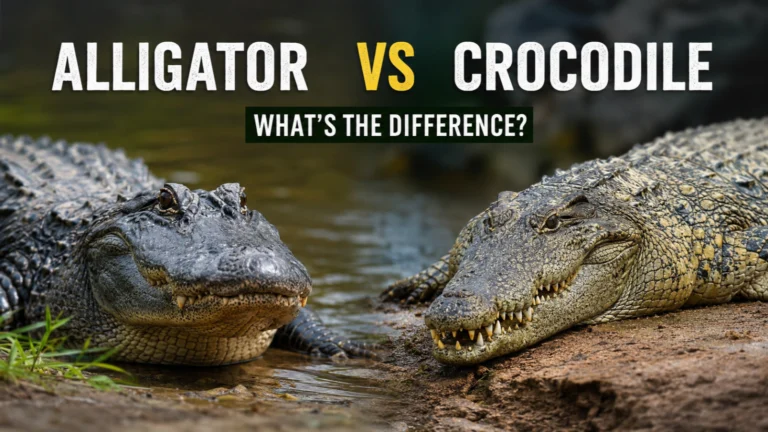
Alligator vs Crocodile is one of the most common wildlife comparisons because these two reptiles look very similar at first glance. Many people struggle to tell them apart, especially when seeing photos or watching nature documentaries. Although they belong to the same reptile order, they have several important differences in appearance, habitat, behavior, and diet. Understanding these distinctions can help you identify each species with confidence and avoid common misconceptions. In this guide, we’ll explore the key features that set them apart, including their snout shape, teeth, color, size, and preferred environments. By the end, Alligator vs Crocodile will no longer be confusing, and you’ll clearly understand which reptile you’re looking at. Whether you’re a student, wildlife enthusiast, or simply curious, this Alligator vs Crocodile comparison will make identification quick and easy.
Why “Alligator” and “Crocodile” Are Confusing
Many people mistakenly believe that an alligator and a crocodile are the same animal. While they belong to the same reptile order (Crocodilia), they are different species with noticeable differences.
Similar Pronunciation
Both words are pronounced clearly in English and often appear together in wildlife discussions. Because they describe similar-looking reptiles, learners may mix them up.
Similar Spelling
The words do not have identical spelling, but they both end with “-tor” or “-dile” sounds that learners sometimes confuse, especially when reading quickly.
Context Confusion
Television shows, cartoons, and casual conversations sometimes use crocodile and alligator interchangeably, even though this is scientifically incorrect.
Common Learner Mistakes
- Calling every large water reptile a crocodile.
- Referring to an alligator when describing a crocodile.
- Thinking the words are synonyms.
- Assuming they have identical habitats and behavior.
Alligator vs Crocodile Explained Simply
An alligator is a large reptile with a broad, U-shaped snout that usually lives in freshwater.
A crocodile is a large reptile with a longer, V-shaped snout that can live in both freshwater and saltwater.
One-line Distinction
Alligators have broad snouts, while crocodiles have narrow, pointed snouts.
Example Sentences
- We saw an alligator resting beside a freshwater lake.
- A large crocodile crossed the river during the safari.
Alligator means a freshwater reptile with a broad snout, while crocodile means a similar reptile with a longer, narrower snout that often tolerates saltwater.
Understanding Homophones in English
What Are Homophones?
Homophones are words that sound the same but have different meanings and spellings.
Example:
- Sea and see
Although they sound alike, they have different meanings.
Why Homophones Cause Confusion
English learners often rely on pronunciation. When two words sound similar, choosing the correct spelling becomes difficult.
Example:
- I can see the ocean.
- The sea is calm today.
Note: Alligator and crocodile are not homophones. They simply refer to similar animals, which is why learners confuse them.
What Does “Alligator” Mean?
Definition and Core Meaning
An alligator is a large, meat-eating reptile that belongs to the family Alligatoridae. It is known for its broad snout, powerful tail, and strong jaws.
Origin and Historical Use
The word alligator comes from the Spanish phrase “el lagarto,” meaning “the lizard.” English speakers gradually changed the pronunciation over time until it became alligator.
Modern Usage and Synonyms
Although there is no perfect synonym, related words include:
- American alligator
- Chinese alligator
- Reptile
- Predator
- Freshwater reptile
Key Characteristics
- Broad U-shaped snout
- Usually dark gray or black
- Lives mainly in freshwater
- Less aggressive than most crocodiles
- Native to the southeastern United States and parts of China
Example Sentences
- An alligator quietly floated across the swamp.
- The park protects hundreds of wild alligators.
- We learned about the American alligator in biology class.
- Never feed a wild alligator.
What Does “Crocodile” Mean?
Definition and Core Meaning
A crocodile is a large carnivorous reptile belonging to the family Crocodylidae. It has a longer, pointed snout and often lives in tropical regions.
Origin and Historical Context
The word crocodile comes from the ancient Greek word “krokodilos.” It has been used in English for many centuries to describe these ancient reptiles.
Modern Usage and Synonyms
Related words include:
- Saltwater crocodile
- Nile crocodile
- Reptile
- Predator
- Carnivore
Key Characteristics
- Long V-shaped snout
- Olive or lighter-colored skin
- Lives in freshwater and saltwater
- Often more aggressive
- Found in Africa, Asia, Australia, and the Americas
Example Sentences
- A huge crocodile waited near the riverbank.
- The guide warned us about saltwater crocodiles.
- Crocodiles are excellent swimmers.
- Some crocodiles grow over six meters long.
Alligator vs Crocodile: Key Differences at a Glance
| Word | Part of Speech | Meaning | Example Context |
|---|---|---|---|
| Alligator | Noun | A broad-snouted freshwater reptile | The alligator slept beside the swamp. |
| Crocodile | Noun | A narrow-snouted reptile found in fresh and saltwater | We spotted a crocodile during the safari. |
Additional Differences
| Feature | Alligator | Crocodile |
|---|---|---|
| Snout | Broad (U-shaped) | Narrow (V-shaped) |
| Habitat | Mostly freshwater | Freshwater and saltwater |
| Color | Dark gray or black | Olive, tan, or brown |
| Teeth | Lower teeth mostly hidden | Upper and lower teeth visible |
| Temperament | Generally less aggressive | Often more aggressive |
How to Remember the Difference Between Alligator and Crocodile
Here are some simple memory tricks.
Easy Memory Tricks
- A = Alligator = America, where American alligators are common.
- C = Crocodile = Coast, because many crocodiles can live near saltwater.
Association Techniques
Imagine an alligator with a wide smile. Its broad mouth matches its broad snout.
Picture a crocodile with a sharp, pointed nose, matching its V-shaped snout.
One Memorable Example
Alligator = Broad mouth. Crocodile = Pointed mouth.
This simple comparison helps many learners remember the difference instantly.
Common Mistakes and Confusions
Wrong Example
❌ We saw an alligator in the Nile River.
Correct Version
✔ We saw a crocodile in the Nile River.
Explanation: The Nile is famous for Nile crocodiles.
Wrong Example
❌ Every crocodile has a broad U-shaped snout.
Correct Version
✔ Alligators have broad U-shaped snouts.
Explanation: Crocodiles usually have narrower snouts.
Wrong Example
❌ Crocodiles only live in freshwater.
Correct Version
✔ Many crocodiles can live in both freshwater and saltwater.
Wrong Example
❌ Alligator and crocodile are exactly the same animal.
Correct Version
✔ Alligators and crocodiles are different reptiles in related families.
Examples Section: Correct and Incorrect Usage
Example 1
✔ Correct: The alligator rested beside a freshwater lake.
✘ Incorrect: The crocodile rested beside the Florida swamp because all Florida reptiles are crocodiles.
Example 2
✔ Correct: We photographed a crocodile during our African safari.
✘ Incorrect: We photographed an alligator in the Nile River.
Example 3
✔ Correct: An alligator has a broader snout than a crocodile.
✘ Incorrect: A crocodile always has a broader snout than an alligator.
Example 4
✔ Correct: Crocodiles are found in many tropical regions around the world.
✘ Incorrect: All crocodiles live only in North America.
Self Assessment: Test Your Knowledge
1.
An __________ usually has a broad U-shaped snout.
2.
A __________ can often live in saltwater.
3.
The Nile River is famous for __________.
4.
An American __________ is commonly found in freshwater wetlands.
Self Assessment Answers
- alligator
- crocodile
- crocodiles
- alligator
FAQs About “Alligator and Crocodile”
1. Are alligators and crocodiles the same?
No. They are different reptiles with different physical characteristics, habitats, and behaviors.
2. Which is more dangerous?
Generally, crocodiles are considered more aggressive than alligators, although both are dangerous wild animals.
3. Can crocodiles live in saltwater?
Yes. Many crocodile species can survive in both freshwater and saltwater environments.
4. Which has the wider snout?
Alligators have broader, U-shaped snouts, while crocodiles have narrower, V-shaped snouts.
5. Where are alligators commonly found?
They mainly live in the southeastern United States and parts of China.
6. How can I identify a crocodile?
Look for its pointed snout and visible lower teeth even when its mouth is closed.
7. Why do English learners confuse these words?
Because both animals look similar, belong to the same reptile order, and are often shown together in books, documentaries, and movies.
Final Conclusion: Using “Alligator” and “Crocodile” Correctly
Understanding the difference between alligator and crocodile is easier once you focus on their key characteristics rather than their similar appearance. An alligator is a broad-snouted reptile that usually lives in freshwater environments, while a crocodile has a longer, pointed snout and is often able to live in both freshwater and saltwater habitats. Although both belong to the same reptile order and share many similarities, they are different animals with unique physical features, geographical distributions, and behaviors.
When speaking or writing English, choosing the correct word makes your communication more accurate and demonstrates a stronger vocabulary. A simple way to remember the difference is to associate alligator with a broad mouth and America, while linking crocodile with a pointed snout and coastal waters. These easy memory tricks can help you recall the correct term whenever you read about wildlife, watch nature documentaries, or discuss animals in class.
Keep practicing by reading articles, observing pictures, and using both words in your own sentences. The more often you compare them in context, the more natural the distinction will become. Building your English vocabulary is a gradual process, and every new word you master brings greater confidence. Stay curious, keep learning, and remember that even small differences in word choice can make your English clearer, more precise, and more effective.