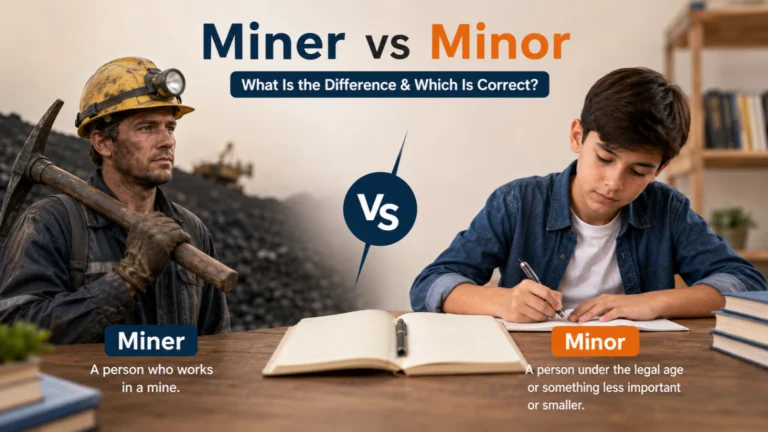
Miner vs Minor is a common word pair that confuses many English learners because the two words sound exactly alike but have completely different meanings. Miner vs Minor often appears in writing, exams, and everyday conversations, making it important to understand when to use each one correctly. A miner is a person who works in a mine, extracting coal, gold, or other minerals, while minor usually refers to something that is smaller, less important, or a person under the legal age of adulthood. Learning the distinction can help you avoid embarrassing mistakes and improve your writing accuracy. In this guide, you’ll discover the definitions, meanings, examples, pronunciation, and easy memory tricks to master Miner vs Minor with confidence.
Why “Miner” and “Minor” Are Confusing
Many people accidentally mix up miner and minor because they sound identical in spoken English. However, they have different spellings, meanings, and uses.
Similar Pronunciation
Both miner and minor are pronounced as MY-ner. Since there is no difference in pronunciation, listeners rely on context to understand which word is intended.
Similar Spelling
The two words differ by only one letter:
- Miner
- Minor
Because they look almost the same, they are easy to confuse while reading or writing quickly.
Context Confusion
Both words can appear in news articles, conversations, and educational materials, but they refer to completely different things.
For example:
- A miner works underground.
- A minor is someone under the legal adult age.
Without enough context, learners may choose the wrong spelling.
Common Learner Mistakes
Some common mistakes include:
- Writing minor when referring to someone working in a mine.
- Writing miner when talking about a child under 18.
- Assuming both words have related meanings because they sound alike.
Miner vs Minor Explained Simply
Miner means a person who works in a mine, while minor usually means someone under the legal age or something that is small or less important.
One-line Distinction
A miner digs for minerals, while a minor is under the age of adulthood or refers to something less significant.
Example Sentences
Miner
- The miner spent ten hours underground.
- Safety equipment protects every miner.
Minor
- A minor cannot vote in many countries.
- The doctor said the injury was minor.
Understanding Homophones in English
What Are Homophones?
Homophones are words that sound the same but have different spellings and meanings.
Example:
- Sea
- See
Although they sound alike, they mean different things.
Why Homophones Cause Confusion
Homophones often confuse learners because pronunciation provides no clue about spelling.
Example:
- The miner entered the coal mine.
- The minor needed parental permission.
The spoken sentences sound similar, but the meanings are completely different.
What Does “Miner” Mean?
Definition and Core Meaning
A miner is a person whose job is extracting minerals, coal, metals, or precious stones from beneath the earth.
It is a noun referring to an occupation.
Origin and Historical Use
The word miner comes from the Middle English word related to mine, meaning a place where valuable minerals are extracted.
Mining has existed for thousands of years, making miner one of the oldest occupational terms in English.
Modern Usage and Synonyms
Today, miner commonly refers to workers in:
- Coal mines
- Gold mines
- Diamond mines
- Copper mines
- Salt mines
Synonyms include:
- Mine worker
- Pit worker
- Excavator (in certain contexts)
- Underground worker
Key Points
- Refers to a person
- Is always a noun
- Connected with mining
- Common in industries and history
Example Sentences
- Every miner wore a protective helmet.
- The miner found a valuable diamond.
- Experienced miners follow strict safety rules.
- The rescue team searched for trapped miners.
What Does “Minor” Mean?
Definition and Core Meaning
Minor has several meanings depending on context.
Most commonly, it refers to:
- A person under the legal age of adulthood.
- Something that is less important or smaller.
- A lower level or degree.
It can function as both a noun and an adjective.
Origin and Historical Context
The word minor comes from the Latin word minor, meaning smaller or lesser.
Over time, English adopted it for legal, educational, and general use.
Modern Usage and Synonyms
As an adjective:
- Small
- Slight
- Lesser
- Secondary
As a noun:
- Child
- Underage person
- Juvenile
Key Points
- Can describe age.
- Can describe importance.
- Can describe size or degree.
- Functions as both a noun and adjective.
Example Sentences
- She is still a minor.
- The accident caused only minor damage.
- He declared a minor in economics at university.
- The issue was considered minor by the manager.
Miner vs Minor: Key Differences at a Glance
| Word | Part of Speech | Meaning | Example Context |
|---|---|---|---|
| Miner | Noun | A person who works in a mine | The miner found gold underground. |
| Minor | Noun, Adjective | A person under legal age; something less important or smaller | She is still a minor. |
How to Remember the Difference Between Miner and Minor
Learning a simple memory trick makes these words much easier to remember.
Easy Memory Tricks
- Miner contains mine.
- A miner works in a mine.
- Minor contains or, reminding you of underage or less important situations.
Association Techniques
Picture a worker wearing a helmet inside a mine.
That’s a miner.
Now picture a teenager who cannot legally drive or vote.
That’s a minor.
Memorable Example
The miner works in the mine, but the minor needs parental permission.
This sentence clearly separates both meanings.
Common Mistakes and Confusions
Wrong Example
The minor rescued workers from the mine.
Correct Version
The miner rescued workers from the mine.
Explanation:
The sentence refers to someone working in a mine.
Wrong Example
The miner cannot legally sign the contract because he is under 18.
Correct Version
The minor cannot legally sign the contract because he is under 18.
Explanation:
Someone under the legal age is called a minor.
Wrong Example
The injury was miner.
Correct Version
The injury was minor.
Explanation:
Here, minor means small or not serious.
Examples Section: Correct and Incorrect Usage
Example 1
✔ Correct: The miner worked underground for twelve hours.
✘ Incorrect: The minor worked underground for twelve hours.
Example 2
✔ Correct: The boy is still a minor.
✘ Incorrect: The boy is still a miner.
Example 3
✔ Correct: The earthquake caused only minor damage.
✘ Incorrect: The earthquake caused only miner damage.
Example 4
✔ Correct: The miner discovered a large gold deposit.
✘ Incorrect: The minor discovered a large gold deposit.
Example 5
✔ Correct: A minor usually needs parental consent.
✘ Incorrect: A miner usually needs parental consent.
Example 6
✔ Correct: The experienced miner followed all safety procedures.
✘ Incorrect: The experienced minor followed all safety procedures.
Self Assessment: Test Your Knowledge
Fill in the blanks using miner or minor.
- The ______ discovered silver deep underground.
- Anyone under eighteen may be considered a ______.
- The accident caused only ______ injuries.
- Every ______ must wear protective equipment inside the mine.
Self Assessment Answers
- miner
- minor
- minor
- miner
FAQs About “Miner and Minor”
1. Are miner and minor homophones?
Yes. They sound exactly the same but have different spellings and meanings.
2. What does miner mean?
A miner is someone who works in a mine extracting minerals or other natural resources.
3. What does minor mean?
A minor is someone under the legal age of adulthood or something that is less important or less serious.
4. Is minor a noun or an adjective?
It can be both. It is a noun when referring to an underage person and an adjective when describing something small or less important.
5. Can miner be used as an adjective?
No. Miner is generally used only as a noun.
6. How can I remember the difference?
Remember that miner contains mine, so it refers to someone working in a mine. Minor usually relates to age, size, or importance.
7. Which word is more common in everyday English?
Minor is generally more common because it appears in legal, educational, medical, and everyday conversations. Miner is mainly used when discussing mining, history, geology, or related industries.
Final Conclusion: Using “Miner” and “Minor” Correctly
Understanding the difference between miner and minor is easier once you focus on their meanings instead of their pronunciation. Although these words sound exactly alike, they belong to completely different contexts. A miner is a person who works in a mine, extracting valuable resources such as coal, gold, or diamonds. In contrast, a minor usually refers to someone who has not yet reached the legal age of adulthood or describes something that is less important, less serious, or smaller in degree. Remember the simple memory trick: a miner works in a mine, while a minor is underage or refers to something minor in importance. Reading authentic English texts, paying attention to context, and practicing with example sentences will help reinforce the correct usage.
When you encounter these homophones, pause for a moment and ask yourself whether the sentence is about mining or about age, size, or importance. That quick check can prevent common spelling mistakes and improve both your writing and speaking. As you continue learning English, you’ll discover many similar word pairs, and mastering them one at a time will steadily build your confidence. Keep practicing, review examples regularly, and don’t be discouraged by occasional mistakes—every correct use brings you one step closer to fluent, accurate English.