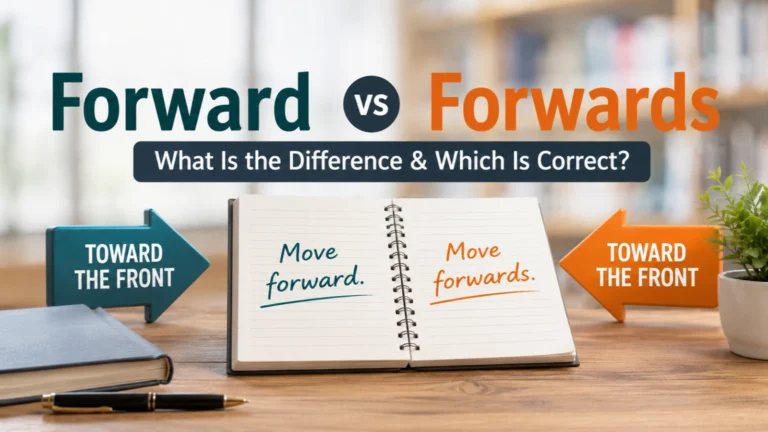
Forward vs Forwards is a common grammar topic that confuses many English learners and even native speakers. Although these two words look almost identical, they are not always used in the same way. Understanding when to use Forward vs Forwards correctly can improve your writing, speaking, and overall confidence in English. In some situations, both forms are acceptable, while in others, one is preferred depending on regional English or the sentence structure. Knowing these subtle differences helps you avoid common mistakes in everyday communication, academic writing, and professional documents. This guide will explain the meaning, usage, and key differences with simple examples, making it easy to decide which form fits your sentence. By the end, Forward vs Forwards will no longer be a source of confusion.
Table of Contents
- Introduction
- Why “Forward” and “Forwards” Are Confusing
- Forward vs Forwards Explained Simply
- Understanding Homophones in English
- What Are Homophones?
- Why Homophones Cause Confusion
- What Does “Forward” Mean?
- What Does “Forwards” Mean?
- Forward vs Forwards: Key Differences at a Glance
- How to Remember the Difference Between Forward and Forwards
- Common Mistakes and Confusions
- Examples Section: Correct and Incorrect Usage
- Self Assessment: Test Your Knowledge
- Self Assessment Answers
- FAQs About “Forward” and “Forwards”
- Final Conclusion: Using “Forward” and “Forwards” Correctly
Why “Forward” and “Forwards” Are Confusing
Many English learners mix up forward and forwards because they are extremely similar.
Similar Pronunciation
Both words are pronounced almost exactly the same. Most native speakers do not stress the final -s, making them sound identical in normal conversation.
Similar Spelling
The only visible difference is the letter s at the end of forwards. Because of this small change, learners often assume one of them must be wrong.
Context Confusion
Both words can describe movement toward the front.
For example:
- Move forward.
- Move forwards.
Both sentences are correct in many varieties of English.
Common Learner Mistakes
Learners often:
- Think forwards is incorrect.
- Believe forward is always American English.
- Use forwards as an adjective, where only forward is correct.
- Replace one with the other without considering grammar or style.
Forward vs Forwards Explained Simply
The easiest way to understand the difference is this:
Forward can be an adjective, adverb, verb, or noun.
Forwards is mainly used as an adverb and is more common in British English.
One-line distinction
Forward is the more versatile word, while forwards is mainly an adverb meaning “toward the front.”
Simple explanation
Forward means “toward the front,” “ahead,” or “progressing.”
Forwards also means “toward the front,” but it is mostly used when describing movement.
Examples
- Please move forward in the line.
- The children ran forwards across the playground.
Understanding Homophones in English
What Are Homophones?
Homophones are words that sound the same but have different meanings or spellings.
Example:
- Sea
- See
These two words sound identical but have different meanings.
Why Homophones Cause Confusion
When two words sound alike, learners often choose the wrong spelling while writing.
For example:
“I can see the ocean.”
Not:
“I can sea the ocean.”
Although forward and forwards are not true homophones with different meanings, their nearly identical pronunciation creates similar confusion.
What Does “Forward” Mean?
Definition and Core Meaning
Forward generally means:
- Toward the front
- Ahead
- In the direction of progress
- To send something onward
It is one of the most flexible words in English.
Origin and Historical Use
The word forward comes from Old English, where it referred to movement toward the front or ahead. It has been part of English for hundreds of years and gradually developed additional meanings relating to progress, leadership, and communication.
Modern Usage and Synonyms
Today, forward appears in everyday speech, business, sports, and technology.
Common synonyms include:
- Ahead
- Onward
- Frontward
- Progressive
- Advance
Examples
- Step forward, please.
- She looked forward to the holiday.
- Please forward this email to your manager.
- The football team’s forward scored twice.
Notice that forward can function as different parts of speech.
What Does “Forwards” Mean?
Definition and Core Meaning
Forwards means:
- Toward the front
- In a forward direction
Unlike forward, it is mainly used as an adverb.
Origin and Historical Context
The form forwards developed later in British English, where adding -s to directional adverbs became common.
Examples include:
- Afterwards
- Towards
- Backwards
- Forwards
American English gradually preferred forms without the -s.
Modern Usage and Synonyms
Today, forwards is especially common in British English.
Synonyms include:
- Ahead
- Onward
- Toward the front
Examples
- The car rolled forwards slowly.
- Everyone moved forwards together.
- He leaned forwards to hear better.
Forward vs Forwards: Key Differences at a Glance
| Word | Part of Speech | Meaning | Example Context |
|---|---|---|---|
| Forward | Adjective, adverb, verb, noun | Toward the front, ahead, send onward | Please move forward. |
| Forwards | Mainly adverb | Toward the front | The children ran forwards. |
Quick Tip
- American English: usually prefers forward
- British English: uses both, but forwards is more common as an adverb
How to Remember the Difference Between Forward and Forwards
Here are some easy memory tricks.
Easy Memory Trick 1
If you are writing American English, choose forward unless you have a special reason not to.
Easy Memory Trick 2
Remember:
Forward does more jobs.
It can be:
- adjective
- noun
- verb
- adverb
Forwards mostly does only one job—an adverb.
Association Technique
Think:
No “s” = More uses
With “s” = Mostly movement
Memorable Example
Imagine a teacher saying:
“Take one step forward.”
Now imagine a British sports commentator saying:
“The players are moving forwards quickly.”
Both sound natural.
Common Mistakes and Confusions
Wrong
She is a forwards thinker.
Correct
She is a forward thinker.
Explanation:
The adjective form is always forward, not forwards.
Wrong
Please forwards this email.
Correct
Please forward this email.
Explanation:
The verb is forward, never forwards.
Wrong
He is our best forwards.
Correct
He is our best forward.
Explanation:
In sports, the player position is called a forward.
Wrong
I look forwards to meeting you.
Correct
I look forward to meeting you.
Explanation:
The fixed expression is look forward to, never look forwards to.
Examples Section: Correct and Incorrect Usage
Example 1
✔ Correct: Please move forward.
✘ Incorrect: Please move forwards. (Not incorrect in British English, but less common in American English.)
Example 2
✔ Correct: He leaned forwards to listen.
✘ Incorrect: He leaned forwardly to listen.
Example 3
✔ Correct: Please forward the message.
✘ Incorrect: Please forwards the message.
Example 4
✔ Correct: We are looking forward to your visit.
✘ Incorrect: We are looking forwards to your visit.
Example 5
✔ Correct: The team signed a talented forward.
✘ Incorrect: The team signed a talented forwards.
Example 6
✔ Correct: The horse stepped forward confidently.
✘ Incorrect: The horse stepped forwardly confidently.
Self Assessment: Test Your Knowledge
Fill in the blanks.
- Please ________ this document to the manager.
- The children walked ________ together.
- We look ________ to seeing you next week.
- The football ________ scored the winning goal.
Self Assessment Answers
- forward
- forwards (or forward in American English)
- forward
- forward
FAQs About “Forward” and “Forwards”
Is “forward” or “forwards” more correct?
Both are correct. Forward is preferred in American English, while forwards is more common as an adverb in British English.
Is “look forwards to” correct?
No. The correct expression is look forward to.
Can “forward” be a verb?
Yes. For example:
“Please forward the email.”
Why does British English use “forwards”?
British English often keeps the -s on directional adverbs such as towards, backwards, and forwards.
Is “forwards” ever an adjective?
No. Use forward as the adjective.
Example:
“A forward movement.”
Which word should English learners use?
If you are unsure, forward is the safest choice because it works in almost every situation and is accepted worldwide.
Is “forwards” wrong in American English?
Not completely. Americans understand it, but forward is much more common and sounds more natural.
Final Conclusion: Using “Forward” and “Forwards” Correctly
The difference between forward and forwards is much simpler than many English learners first think. In most cases, both words describe movement toward the front, and native speakers understand either form. However, forward is the more flexible and widely used option. It works as an adjective, adverb, noun, and verb, making it suitable for a wide variety of situations. It is also the preferred spelling in American English and appears in common expressions such as look forward to, forward an email, and a forward player. On the other hand, forwards is mainly an adverb used to describe movement and is especially common in British English.
A helpful way to remember the difference is to think of forward as the all-purpose choice, while forwards is mostly limited to describing direction. Whenever you are unsure, choosing forward is usually the safest decision because it is accepted in international English and fits almost every context. With regular reading, listening, and practice, recognizing the correct form will become automatic. Small grammar differences like this may seem challenging at first, but each one you master brings you closer to speaking and writing English with greater confidence, accuracy, and fluency.

Bilal Hassan is a Master’s graduate, content writer, and author at WordClaritty.com. He specializes in creating clear, informative, and reader-friendly content focused on language, word meanings, and educational topics. With a passion for accuracy and simplicity, he helps readers expand their knowledge through engaging and easy-to-understand articles.