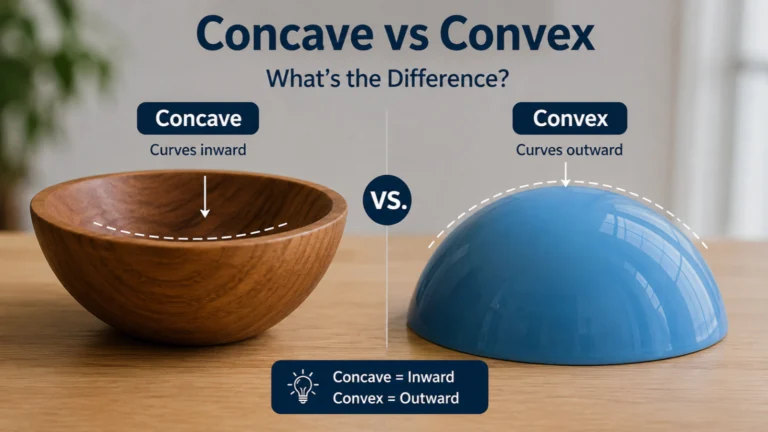
Concave vs Convex can be confusing because the two words look and sound similar, yet they describe completely opposite shapes. Whether you are studying geometry, physics, optics, or simply trying to improve your English vocabulary, understanding Concave vs Convex is essential. A concave surface curves inward like the inside of a bowl, while a convex surface curves outward like the outside of a ball. Knowing this difference helps you use the correct term in school, science, and everyday conversations. In this guide, you’ll learn the meanings, key differences, examples, and simple memory tricks that make Concave vs Convex easy to remember. By the end, you’ll be able to identify each shape with confidence and avoid common mistakes.
Why “Concave” and “Convex” Are Confusing
Many learners accidentally mix up concave and convex because they describe similar types of shapes but in opposite directions.
Similar Pronunciation
Both words begin with con- and end with -ave or -ex. Their pronunciation is similar enough that learners may confuse them during conversation.
Similar Spelling
The words share the same first three letters, making them easy to mix up when reading or writing.
Context Confusion
Both words appear in geometry, science, optics, engineering, medicine, and everyday descriptions of objects. Since they are often introduced together, students sometimes remember one but forget which shape it describes.
Common Learner Mistakes
Common mistakes include:
- Calling a bowl-shaped surface convex instead of concave.
- Describing a bulging mirror as concave.
- Forgetting that the two words are opposites.
Understanding the direction of the curve is the key to using these words correctly.
Concave vs Convex Explained Simply
Concave means a surface curves inward, while convex means a surface curves outward.
One-line distinction
Concave curves inward like a cave, while convex bulges outward.
Examples
Concave
- The inside of a spoon is concave.
- A concave mirror can focus light.
Convex
- A football has a convex surface.
- A convex mirror provides a wider field of view.
Understanding Homophones in English
What Are Homophones?
Homophones are words that sound the same but have different meanings and spellings.
Example:
- Sea
- See
Although concave and convex are not true homophones, learners often confuse them because they sound somewhat alike and are usually learned together.
Why Homophones Cause Confusion
Words that sound alike—or nearly alike—can easily be mixed up in speech and writing.
Example:
- Their
- There
Similarly, students may accidentally choose concave instead of convex because both relate to curved shapes.
What Does “Concave” Mean?
Definition and Core Meaning
Concave describes something that curves inward, creating a hollow or cave-like shape.
The center of a concave surface is lower than its edges.
Origin and Historical Use
The word concave comes from the Latin word concavus, meaning hollow or arched inward. It has been used in English since the late Middle Ages, especially in mathematics and science.
Modern Usage and Synonyms
Common uses include:
- Concave mirror
- Concave lens
- Concave surface
- Concave polygon
Synonyms include:
- Hollow
- Curved inward
- Bowl-shaped
- Indented
Key Points
- Curves inward
- Looks hollow
- Opposite of convex
- Common in geometry and optics
Example Sentences
- The cave entrance had a concave shape.
- The inside of a bowl is concave.
- Scientists used a concave mirror to concentrate sunlight.
- The spoon’s inner surface is concave.
What Does “Convex” Mean?
Definition and Core Meaning
Convex describes something that curves outward or bulges away from the center.
The center of a convex surface extends outward farther than the edges.
Origin and Historical Context
The word convex comes from the Latin convexus, meaning vaulted or arched outward. It has long been used in mathematics, architecture, engineering, and optics.
Modern Usage and Synonyms
Common uses include:
- Convex mirror
- Convex lens
- Convex polygon
- Convex surface
Synonyms include:
- Bulging
- Rounded
- Curved outward
- Raised
Key Points
- Curves outward
- Bulges away from the center
- Opposite of concave
- Common in science and geometry
Example Sentences
- The outside of a basketball is convex.
- Most car side mirrors are convex.
- The hill has a convex shape.
- The lens has a slightly convex surface.
Concave vs Convex: Key Differences at a Glance
| Word | Part of Speech | Meaning | Example Context |
|---|---|---|---|
| Concave | Adjective | Curving inward | The inside of a bowl is concave. |
| Convex | Adjective | Curving outward | The outside of a ball is convex. |
How to Remember the Difference Between Concave and Convex
Learning these words becomes much easier with simple memory tricks.
Easy Memory Tricks
- Concave = Cave
- A cave goes inward.
- Think: ConCAVE contains the word cave.
- Convex = Exit
- Imagine the shape pushing outward or sticking out.
Association Techniques
Imagine holding a spoon.
- Inside of the spoon = Concave
- Outside of the spoon = Convex
This is one of the easiest visual examples.
One Memorable Example
Think of a cereal bowl.
- Inside = Concave
- Outside = Convex
Whenever you see a bowl, you’ll remember the difference.
Common Mistakes and Confusions
Wrong
The outside of a basketball is concave.
Correct
The outside of a basketball is convex.
Explanation: The surface bulges outward.
Wrong
The inside of the bowl is convex.
Correct
The inside of the bowl is concave.
Explanation: The surface curves inward.
Wrong
A convex mirror curves inward.
Correct
A convex mirror curves outward.
Explanation: Convex mirrors bulge outward and provide a wider view.
Wrong
A concave mirror bulges outward.
Correct
A concave mirror curves inward.
Explanation: Concave mirrors curve inward and can focus light.
Examples Section: Correct and Incorrect Usage
Example 1
✔ Correct: The inside of the cup is concave.
✘ Incorrect: The inside of the cup is convex.
Example 2
✔ Correct: The outside of the globe is convex.
✘ Incorrect: The outside of the globe is concave.
Example 3
✔ Correct: A concave mirror can produce a magnified image.
✘ Incorrect: A convex mirror always produces a magnified image.
Example 4
✔ Correct: The spoon has both a concave side and a convex side.
✘ Incorrect: Both sides of the spoon are concave.
Self Assessment: Test Your Knowledge
Fill in the blanks.
- The inside of a bowl is __________.
- A car’s side mirror is usually __________.
- A shape that curves outward is called __________.
- The inside of a spoon is __________.
Self Assessment Answers
- Concave
- Convex
- Convex
- Concave
FAQs About “Concave and Convex”
1. What is the main difference between concave and convex?
A concave surface curves inward, while a convex surface curves outward.
2. Is the inside of a spoon concave?
Yes. The inside curves inward, making it concave.
3. Are car side mirrors concave or convex?
Most car side mirrors are convex because they provide a wider field of view.
4. Which word describes the outside of a ball?
Convex.
5. Are concave and convex opposites?
Yes. They describe opposite directions of curvature.
6. Where are these words commonly used?
They are widely used in geometry, mathematics, optics, engineering, architecture, physics, and everyday descriptions of shapes.
7. Can an object have both concave and convex surfaces?
Yes. A spoon is a common example because one side is concave and the other side is convex.
Final Conclusion: Using “Concave” and “Convex” Correctly
Understanding the difference between concave and convex is easier than it first appears. The key idea is to focus on the direction of the curve. A concave surface curves inward, creating a hollow shape similar to the inside of a bowl or spoon. In contrast, a convex surface curves outward, like the outside of a ball or the back of a spoon.
Although these words are often introduced together in science and mathematics, they also appear in everyday conversations about mirrors, lenses, containers, buildings, and natural objects. Remembering the simple phrase “concave is like a cave” can help you instantly identify an inward curve. Likewise, thinking of a rounded ball can remind you that convex means bulging outward. As you continue learning English, pay attention to how these words are used in real contexts, and practice describing familiar objects around you. The more examples you read and create yourself, the more natural the distinction will become.
With regular practice and these easy memory tricks, you’ll confidently choose the correct word every time and strengthen both your vocabulary and your understanding of descriptive English.

Bilal Hassan is a Master’s graduate, content writer, and author at WordClaritty.com. He specializes in creating clear, informative, and reader-friendly content focused on language, word meanings, and educational topics. With a passion for accuracy and simplicity, he helps readers expand their knowledge through engaging and easy-to-understand articles.