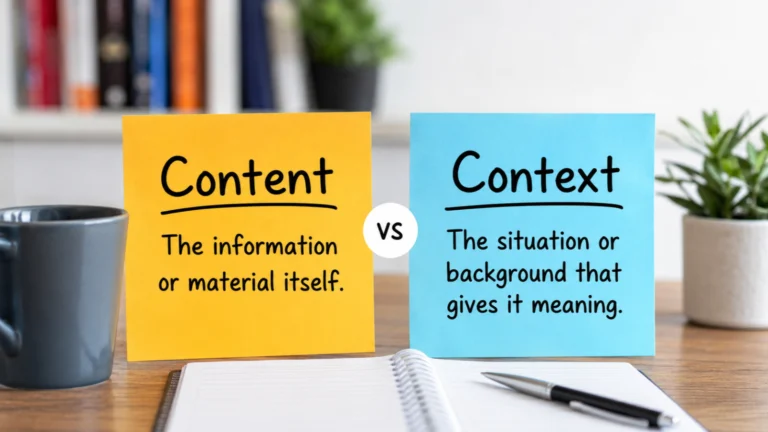
Content vs Context is a common grammar and communication topic that often confuses English learners, writers, and professionals. While the two terms are closely connected, they have very different meanings and purposes.
Content refers to the actual words, ideas, or information being shared, whereas context explains the situation, background, or circumstances that give those words meaning. Understanding this distinction helps you avoid misunderstandings, improve your writing, and communicate more effectively in both personal and professional settings. In this guide, you’ll learn the key differences, practical examples, and simple tips for using each term correctly. By the end, Content vs Context will be much easier to understand, and you’ll know exactly when to use each one.
If you’re studying English or improving your writing skills, Content vs Context is an essential concept to master.
Why “Content” and “Context” Are Confusing
Many learners accidentally use content when they mean context, or vice versa. Although the words begin with the same letters, they describe different ideas.
Similar Pronunciation
Both words start with the sound “con-“, making them sound somewhat alike, especially in fast speech.
Similar Spelling
The words differ by only a few letters:
- Content
- Context
Because they look similar, learners often confuse them while reading or writing.
Context Confusion
These words frequently appear together.
For example:
- “The content of the article depends on its context.”
Seeing both words in the same sentence can make it difficult to remember which one refers to information and which one refers to surrounding circumstances.
Common Learner Mistakes
Some common mistakes include:
- Saying “The content helps us understand the meaning of the conversation” when context is intended.
- Using context when talking about videos, articles, or website material instead of content.
Content vs Context Explained Simply
Content means the information or material itself, while context means the situation or surroundings that help explain that information.
One-Line Distinction
Content is what something contains; context is the situation that gives it meaning.
Examples
Content
- The content of the book is very informative.
- She creates educational content for YouTube.
Context
- You misunderstood my words because you ignored the context.
- Understanding historical context improves reading comprehension.
Understanding Homophones in English
What Are Homophones?
Homophones are words that sound the same but have different meanings and spellings.
Example:
- Sea
- See
These two words sound alike but mean different things.
Why Homophones Cause Confusion
Although content and context are not true homophones, English contains many similar-sounding words that confuse learners.
Example:
- Their
- There
- They’re
Learning each word’s meaning through examples helps prevent mistakes.
What Does “Content” Mean?
Definition and Core Meaning
Content refers to the information, ideas, text, images, videos, or other material contained in something.
It can also describe what is inside a book, website, speech, course, or social media post.
As an adjective, content means happy or satisfied, though this meaning is less common in everyday conversation.
Origin and Historical Use
The word comes from the Latin contentum, meaning “that which is contained.”
Over time, it became widely used in education, publishing, journalism, marketing, and digital media.
Modern Usage and Synonyms
Modern meanings include:
- Information
- Material
- Text
- Subject matter
- Media
- Resources
Example Sentences
- The course content is easy to understand.
- Please review the website content before publishing it.
- Good content attracts more readers.
- The teacher updated the lesson content.
What Does “Context” Mean?
Definition and Core Meaning
Context means the surrounding situation, background, or circumstances that help explain the meaning of something.
Without context, words or actions may be misunderstood.
Origin and Historical Context
The word comes from the Latin contextus, meaning “to weave together.”
It originally referred to how different parts connect to create meaning.
Today, it is widely used in language learning, history, literature, communication, and psychology.
Modern Usage and Synonyms
Common synonyms include:
- Background
- Situation
- Circumstances
- Setting
- Framework
- Environment
Example Sentences
- Always read a quote in its full context.
- Historical context helps us understand old documents.
- The joke makes sense only in context.
- Context changes how people interpret words.
Content vs Context: Key Differences at a Glance
| Word | Part of Speech | Meaning | Example Context |
|---|---|---|---|
| Content | Noun (also adjective) | Information or material inside something | The content of the article explains grammar. |
| Context | Noun | The surrounding situation that explains meaning | The context makes the sentence easier to understand. |
How to Remember the Difference Between Content and Context
Here are some easy tricks.
Memory Trick 1
Content = Contains information
Think:
Content contains information.
Both words begin with cont-.
Memory Trick 2
Context = Surrounding text
Notice the word text inside context.
Context helps explain the text around it.
Association Technique
Imagine reading a newspaper.
- The articles are the content.
- The news event behind those articles is the context.
Memorable Example
“The content tells the story, but the context explains why the story matters.”
Common Mistakes and Confusions
Wrong
The teacher explained the lesson’s context very clearly.
Correct
The teacher explained the lesson’s content very clearly.
Explanation:
The teacher explained the information itself.
Wrong
Without reading the full content, the quote seems offensive.
Correct
Without reading the full context, the quote seems offensive.
Explanation:
The surrounding information explains the quote’s true meaning.
Wrong
This website has excellent educational context.
Correct
This website has excellent educational content.
Wrong
History books provide useful content for understanding ancient events.
Better
History books provide useful context for understanding ancient events.
Examples Section: Correct and Incorrect Usage
Example 1
✔ Correct:
The content of the lesson includes grammar exercises.
✘ Incorrect:
The context of the lesson includes grammar exercises.
Example 2
✔ Correct:
You should understand the historical context before judging the event.
✘ Incorrect:
You should understand the historical content before judging the event.
Example 3
✔ Correct:
She creates cooking content on social media.
✘ Incorrect:
She creates cooking context on social media.
Example 4
✔ Correct:
His comment sounded rude without the proper context.
✘ Incorrect:
His comment sounded rude without the proper content.
Self Assessment: Test Your Knowledge
Fill in the blanks.
1.
The YouTube _________ was uploaded yesterday.
2.
Understanding the historical _________ makes the speech clearer.
3.
The teacher updated the course _________ before class.
4.
Never judge a sentence without knowing its _________.
Self Assessment Answers
- content
- context
- content
- context
FAQs About “Content” and “Context”
1. What is the main difference between content and context?
Content is the information itself, while context is the background or situation that explains it.
2. Can content and context be used together?
Yes. For example:
“The content is easier to understand when you know the context.”
3. Is content only used online?
No. Content can refer to books, lessons, speeches, magazines, websites, videos, podcasts, and more.
4. Why is context important?
Context helps people understand the intended meaning of words, actions, and events.
5. Which word is used in social media marketing?
Content is commonly used because creators produce videos, articles, images, and posts.
6. What does “read in context” mean?
It means reading words together with the surrounding information so you understand the intended meaning.
7. Can “content” also mean happy?
Yes. As an adjective, content means satisfied or happy.
Example:
“She felt content after finishing her work.”
Final Conclusion: Using “Content” and “Context” Correctly
Although content and context look similar, they serve very different purposes in English. Content refers to the actual information, material, or ideas contained in a book, website, video, lesson, or conversation. Context, on the other hand, refers to the background, setting, or circumstances that help explain what that information means. Knowing this distinction makes your speaking and writing more precise and helps you understand English more naturally.
A simple way to remember the difference is this: content is what you read, watch, or hear, while context is what helps you understand it correctly. Whether you’re reading literature, studying history, creating online articles, or communicating with others, both words play important roles. Content delivers the message, and context gives that message meaning.
As you continue learning English, pay attention to how native speakers use these words in books, articles, videos, and everyday conversations. Practice by creating your own sentences and reviewing the examples in this guide whenever you feel unsure. Over time, choosing between content and context will become second nature. Every new word you master strengthens your communication skills, so keep practicing, stay curious, and enjoy the journey toward fluent, confident English.