
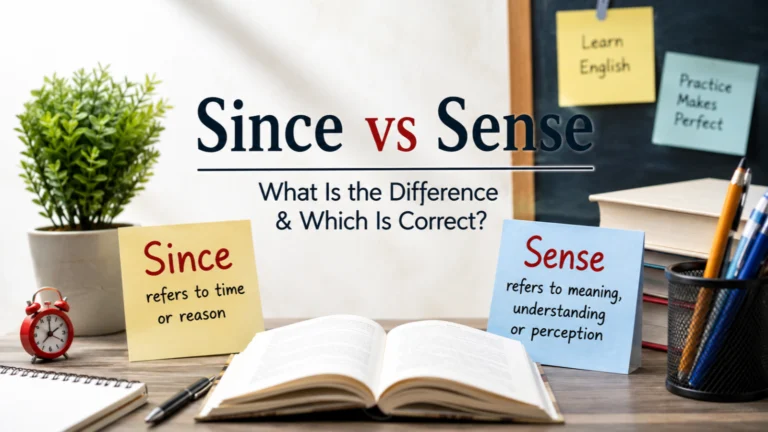
Since vs Sense is a common source of confusion for English learners because the two words sound similar but have completely different meanings and uses. Understanding Since vs Sense is important for improving your grammar, writing, and everyday communication. Since is usually used to talk about time or to give a reason, while sense refers to understanding, meaning, or one of the five physical senses. Mixing them up can change the meaning of a sentence and make your writing unclear. In this guide, you’ll learn the differences through simple explanations, easy examples, and practical tips. By the end, Since vs Sense will no longer be confusing, and you’ll feel more confident using both words correctly in speaking and writing.
Why “Since” and “Sense” Are Confusing
Many learners accidentally confuse since and sense because they are pronounced similarly, especially in fast conversations. Although their meanings are completely different, their sound often leads to spelling mistakes.
Similar pronunciation
Both words sound very similar in many English accents, making it difficult for learners to hear the difference.
Similar spelling
The words differ by only one letter:
- Since
- Sense
Because they look alike, writers sometimes type one when they mean the other.
Context confusion
Both words appear frequently in everyday English. Learners may know both words individually but struggle to decide which one fits a sentence.
Common learner mistakes
Common errors include:
- Writing sense I was young instead of since I was young.
- Writing common since instead of common sense.
- Using since when talking about feelings or understanding.
Understanding each word’s purpose solves these problems.
Since vs. Sense Explained Simply
Since means “from a particular time until now” or “because,” while sense means “understanding, meaning, or one of the human abilities like sight, hearing, or smell.”
One-line distinction
Since relates to time or reason, while sense relates to understanding or perception.
Example sentences
Since
- I have lived here since 2019.
- Since it was raining, we stayed home.
Sense
- That explanation makes perfect sense.
- Dogs have an excellent sense of smell.
Understanding Homophones in English
What Are Homophones?
Homophones are words that sound the same or nearly the same but have different meanings and spellings.
Example:
- Flower
- Flour
Although they sound alike, they mean different things.
Why Homophones Cause Confusion
When people hear words instead of seeing them written, they may choose the wrong spelling.
For example:
“I have lived here since 2020.”
Some learners mistakenly write:
“I have lived here sense 2020.”
This changes the sentence from correct to incorrect.
What Does “Since” Mean?
Definition and Core Meaning
Since is mainly used as a preposition, conjunction, or adverb.
It usually refers to:
- Time
- A starting point
- A reason
Origin and Historical Use
The word since comes from Middle English and Old English expressions meaning “after that time.” Over centuries, it developed into the modern meaning of “from then until now” and “because.”
Modern Usage and Synonyms
Depending on context, synonyms include:
- From
- After
- Because
- As
Uses of “Since”
- Indicates a starting point in time.
- Gives a reason.
- Shows a continuing action.
Example sentences
- She has worked here since Monday.
- We have been friends since childhood.
- Since you are ready, let’s begin.
- I haven’t seen him since last year.
What Does “Sense” Mean?
Definition and Core Meaning
Sense refers to understanding, meaning, awareness, judgment, or one of the five physical senses.
It can also mean a reasonable way of thinking.
Origin and Historical Context
The word comes from Latin sensus, meaning “feeling” or “perception.” It entered English through French and has been used for hundreds of years.
Modern Usage and Synonyms
Common synonyms include:
- Meaning
- Understanding
- Awareness
- Perception
- Judgment
- Feeling
Uses of “Sense”
- Refers to understanding.
- Describes human perception.
- Means practical judgment.
- Refers to one of the five senses.
Example sentences
- That doesn’t make any sense.
- She has a great sense of humor.
- My sense of hearing is excellent.
- He showed good sense during the emergency.
Since vs. Sense: Key Differences at a Glance
| Word | Part of Speech | Meaning | Example Context |
|---|---|---|---|
| Since | Preposition, conjunction, adverb | From a time in the past until now; because | I have studied English since 2022. |
| Sense | Noun, verb | Understanding, meaning, perception, judgment | That explanation makes sense. |
How to Remember the Difference Between Since and Sense
Learning small memory tricks makes these words much easier to remember.
Easy memory tricks
- Since contains the idea of starting time.
- Sense relates to your senses like sight and hearing.
Association techniques
Think of this:
- Since = Time or Reason
- Sense = Understanding or Feeling
One memorable example
“I’ve loved music since childhood because it gives me a sense of peace.”
The first word talks about time.
The second talks about a feeling.
Common Mistakes and Confusions
Wrong
I have lived here sense 2018.
Correct
I have lived here since 2018.
Explanation: Time expressions require since.
Wrong
That doesn’t make since.
Correct
That doesn’t make sense.
Explanation: Understanding requires sense.
Wrong
She has good common since.
Correct
She has good common sense.
Explanation: The correct expression is common sense.
Wrong
Sense it was late, we left.
Correct
Since it was late, we left.
Explanation: Here the word means because.
Examples Section: Correct and Incorrect Usage
Example 1
✔ Correct: I have known her since high school.
✘ Incorrect: I have known her sense high school.
Example 2
✔ Correct: Your explanation makes perfect sense.
✘ Incorrect: Your explanation makes perfect since.
Example 3
✔ Correct: Since it was cold, we stayed indoors.
✘ Incorrect: Sense it was cold, we stayed indoors.
Example 4
✔ Correct: Cats have an excellent sense of balance.
✘ Incorrect: Cats have an excellent since of balance.
Example 5
✔ Correct: I haven’t eaten since breakfast.
✘ Incorrect: I haven’t eaten sense breakfast.
Example 6
✔ Correct: She has a strong sense of responsibility.
✘ Incorrect: She has a strong since of responsibility.
Self Assessment: Test Your Knowledge
1.
I have lived in this city _______ 2018.
2.
That explanation makes perfect _______.
3.
_______ you finished your homework, you can watch television.
4.
Birds have an amazing _______ of direction.
Self Assessment Answers
- since
- sense
- Since
- sense
FAQs About “Since” and “Sense”
1. Are “since” and “sense” homophones?
They are considered near-homophones because many English speakers pronounce them very similarly.
2. Is “since” used for time?
Yes. It often shows a starting point in time, such as since Monday or since 2020.
3. Can “since” mean “because”?
Yes. It can introduce a reason.
Example: Since you’re here, let’s begin.
4. What does “sense” mean?
It means understanding, meaning, judgment, awareness, or one of the five human senses.
5. What is “common sense”?
Common sense means practical judgment and the ability to make reasonable decisions.
6. How can I remember the difference?
Remember:
- Since = Time or Reason
- Sense = Understanding or Feeling
7. Which word is correct in “That makes ____”?
The correct word is sense.
Final Conclusion: Using “Since” and “Sense” Correctly
Although since and sense sound very similar, they serve completely different purposes in English. Since is used to talk about time or to introduce a reason, making it an essential word when describing events that began in the past or explaining why something happened. Sense, on the other hand, refers to understanding, meaning, judgment, awareness, or physical perception. It appears in everyday expressions such as make sense, common sense, and sense of humor. A simple way to remember the difference is to connect since with time or because, and sense with understanding or the five senses. Reading authentic English texts, listening to native speakers, and practicing with your own sentences will help these meanings become natural. If you accidentally mix them up, don’t worry—this is a very common mistake among English learners. With regular practice and by paying attention to context, you’ll quickly recognize which word belongs in each sentence. Keep reviewing examples, test yourself often, and use these words in conversations and writing. Every small improvement strengthens your vocabulary and builds your confidence, bringing you one step closer to speaking and writing clear, accurate English every day.

