
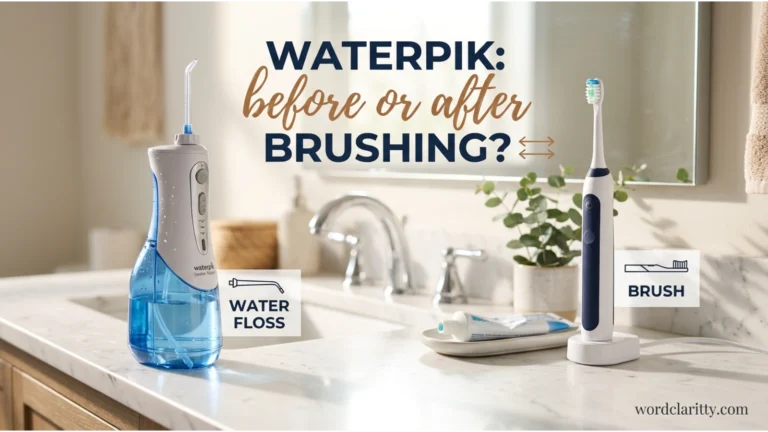
Should you use a Waterpik before or after brushing your teeth? This is a common question among people who want to improve their daily oral hygiene routine. Both methods can help clean your mouth, but they serve slightly different purposes. Using a Waterpik before brushing may help remove trapped food and loosen debris, while using it after brushing can help wash away remaining particles.
Many people become confused because dental advice can vary depending on individual needs. Understanding the difference can help you make better decisions about your dental care. This guide explains both approaches, their benefits, common mistakes, and practical tips for keeping your teeth and gums healthy.
Why “Waterpik Before Brushing” and “Waterpik After Brushing” Are Confusing
Many people wonder whether they should use a Waterpik before or after brushing because both methods sound reasonable. The confusion comes from different oral care recommendations, personal preferences, and uncertainty about how water flossing works.
1. Similar Pronunciation
The expressions “Waterpik before brushing” and “Waterpik after brushing” are not homophones. However, they sound similar because most of their words are identical.
The main difference is between the words:
- Before: At an earlier time.
- After: At a later time.
For example:
“I use my Waterpik before brushing.”
This means water flossing happens first.
“I use my Waterpik after brushing.”
This means brushing happens first.
Understanding these simple time expressions helps learners recognize the difference.
2. Similar Spelling
Both expressions contain the words “Waterpik” and “brushing.” Only the timing word changes.
This makes them easy to mix up when reading dental advice quickly.
However, the words “before” and “after” have opposite meanings, so they describe two different oral hygiene routines.
3. Context Confusion
The biggest source of confusion is that both methods can be reasonable.
Some people prefer water flossing first because it removes food particles before they brush. Others prefer brushing first because they want to clean their tooth surfaces before using a water flosser.
Neither order is automatically wrong for everyone.
What matters most is brushing properly with fluoride toothpaste and cleaning between your teeth regularly.
4. Common Learner Mistakes
People often make these mistakes:
- Assuming water flossing must always happen before brushing.
- Believing that using a Waterpik after brushing is harmful.
- Thinking a Waterpik completely replaces toothbrushing.
- Using water flossing as a substitute for fluoride toothpaste.
- Rinsing away toothpaste immediately after brushing.
- Assuming every person needs the same oral care routine.
Understanding the purpose of each step can help you avoid these misunderstandings.
Waterpik Before vs After Brushing Explained Simply
The difference between using a Waterpik before brushing and after brushing is the order of your dental cleaning routine.
Waterpik before brushing means cleaning between your teeth with a water flosser first, while Waterpik after brushing means brushing your teeth before using the water flosser.
Simple Explanation
Waterpik Before Brushing
You use the water flosser first to help remove food particles and loose debris from between your teeth and around your gums. Then, you brush with fluoride toothpaste.
Waterpik After Brushing
You brush your teeth first and then use the water flosser to clean between your teeth and along the gumline.
Both approaches can contribute to good oral hygiene when performed correctly.
One-Line Distinction
Waterpik before brushing focuses on interdental cleaning first, while Waterpik after brushing places toothbrushing first.
Two Example Sentences
Example 1:
“I use my Waterpik before brushing because I like removing trapped food before applying toothpaste.”
Example 2:
“My brother uses his Waterpik after brushing because that order fits his evening routine.”
Both sentences describe valid personal preferences. However, using a Waterpik before brushing can make it easier to finish with fluoride toothpaste without immediately washing it away.
Understanding Homophones in English
Although this topic mainly concerns dental care, the expressions “before brushing” and “after brushing” also provide an opportunity to understand how timing words affect sentence meaning.
What Are Homophones?
Homophones are words that sound the same but have different meanings and often different spellings.
For example:
- To: Indicates direction or purpose.
- Too: Means “also” or “excessively.”
- Two: Refers to the number 2.
Consider these sentences:
“I need to brush my teeth.”
“I want to use my Waterpik too.”
“I brush my teeth two times a day.”
The words sound alike, but their meanings are different.
Why Homophones Cause Confusion
Homophones can make English difficult because pronunciation does not always reveal the correct spelling or meaning.
For example:
“I can hear the water running.”
“Please put the Waterpik here.”
The words “hear” and “here” sound the same but have different meanings.
However, “before” and “after” are not homophones. They are opposite time expressions.
The confusion in this article is therefore about the order of dental care activities, not identical pronunciation.
Learning the difference between these time expressions also helps English learners follow instructions more accurately.
What Does “Waterpik Before Brushing” Mean?
Definition and Core Meaning
Using a Waterpik before brushing means cleaning between your teeth with a water flosser before using a toothbrush and toothpaste.
A Waterpik is a brand of oral irrigator that uses a controlled stream of water to help remove food debris and plaque from areas that may be difficult to reach with a toothbrush.
The process usually involves:
- Filling the water flosser reservoir with lukewarm water.
- Choosing an appropriate pressure setting.
- Directing the water stream along the gumline and between the teeth.
- Allowing the water to drain into the sink.
- Brushing afterward with fluoride toothpaste.
This routine allows you to complete interdental cleaning before brushing.
Origin and Historical Use
Water flossing became more widely known after oral irrigators were developed during the twentieth century. Waterpik, a well-known oral care brand, introduced its first oral irrigator in the early 1960s.
These devices were designed to help clean areas around teeth and gums using water pressure.
Over time, water flossers became popular among people with braces, dental bridges, implants, and other dental appliances that can make cleaning between teeth more challenging.
The idea of water flossing before brushing comes from the general practice of cleaning between teeth before completing toothbrushing.
However, there is no universal rule requiring everyone to use a water flosser first.
Modern Usage and Benefits
Today, many people choose to use a Waterpik before brushing because it fits naturally into their oral hygiene routine.
Potential benefits include:
- Removing trapped food: Water can help dislodge food particles between teeth.
- Cleaning around appliances: A water flosser can be useful around braces, bridges, and certain dental restorations.
- Supporting gum health: Regular water flossing may help reduce gingival inflammation and bleeding.
- Preparing for brushing: Removing loose debris first can make the mouth feel cleaner before brushing.
- Keeping fluoride as the final step: Brushing afterward allows you to spit out excess toothpaste without immediately rinsing with a water flosser.
Water flossing should complement, rather than replace, brushing with fluoride toothpaste.
Example Sentences
- “I use my Waterpik before brushing every evening.”
- “Water flossing before brushing helps me remove food trapped between my teeth.”
- “My dentist suggested cleaning between my teeth before brushing.”
- “I prefer using my Waterpik first and finishing with fluoride toothpaste.”
- “Using a Waterpik before brushing is part of my daily oral care routine.”
These examples describe water flossing as the first cleaning step.
What Does “Waterpik After Brushing” Mean?
Definition and Core Meaning
Using a Waterpik after brushing means cleaning your teeth with a toothbrush and toothpaste first, then using a water flosser to clean between the teeth and around the gumline.
This method reverses the order of the previous routine.
The steps usually include:
- Brushing your teeth with fluoride toothpaste.
- Spitting out excess toothpaste.
- Filling the Waterpik reservoir.
- Cleaning between the teeth and along the gumline.
- Finishing the routine without aggressive rinsing or unnecessary additional brushing.
However, using a water flosser immediately after brushing may wash away some of the concentrated fluoride left behind by toothpaste.
For this reason, people who prefer this order may benefit from using the Waterpik at a different time or asking their dentist how best to preserve fluoride protection.
Origin and Historical Context
The practice of cleaning between teeth after brushing developed as part of broader oral hygiene habits.
Many people learn to brush their teeth first and then use floss or another interdental cleaning tool.
As water flossers became more common, some users naturally followed the same sequence.
However, modern dental guidance generally emphasizes regular, effective brushing and interdental cleaning rather than requiring one exact sequence for every person.
The ideal routine can depend on dental health, personal comfort, and professional advice.
Modern Usage and Benefits
Some people prefer using a Waterpik after brushing because they like to finish by cleaning between their teeth.
Possible advantages include:
- Removing remaining debris: Water flossing may dislodge particles that brushing did not remove.
- Cleaning difficult areas: The water stream can reach around certain appliances and along the gumline.
- Supporting consistency: A comfortable routine may encourage regular interdental cleaning.
- Providing a fresh feeling: Some users enjoy the sensation of water flossing after brushing.
However, the order has one important consideration.
If you use fluoride toothpaste, immediately following brushing with water flossing may reduce the amount of fluoride that remains on your teeth.
Therefore, brushing last may be preferable when your goal is to leave fluoride toothpaste on your teeth.
Example Sentences
- “I use my Waterpik after brushing because I prefer that order.”
- “She brushes first and then cleans between her teeth with a water flosser.”
- “My dentist helped me choose an oral care routine that works for my braces.”
- “Water flossing after brushing can remove remaining food particles.”
- “I avoid rinsing immediately after brushing because I want fluoride to remain on my teeth.”
These examples show how brushing first can fit into a dental hygiene routine, while highlighting the importance of fluoride protection.
Waterpik Before vs After Brushing: Key Differences at a Glance
The following comparison table summarizes the differences between both approaches.
| Word or Expression | Part of Speech | Meaning | Example Context |
|---|---|---|---|
| Waterpik before brushing | Noun phrase with time expression | Using a water flosser before toothbrushing | “I water floss first, then brush.” |
| Waterpik after brushing | Noun phrase with time expression | Using a water flosser after toothbrushing | “I brush first, then water floss.” |
| Before | Preposition or adverb | Earlier than a particular action | “Clean between your teeth before brushing.” |
| After | Preposition or adverb | Later than a particular action | “Use the water flosser after brushing.” |
Which Method Is Better?
For many people, using a Waterpik before brushing is a practical choice because it allows them to remove debris first and finish with fluoride toothpaste.
However, both orders can provide cleaning benefits, and there is not enough evidence to claim that one sequence is always superior for everyone.
The most important habits are:
- Brush twice daily for two minutes with fluoride toothpaste.
- Clean between your teeth regularly using an appropriate method.
- Use your Waterpik according to the manufacturer’s instructions.
- Spit out excess toothpaste rather than immediately rinsing it away.
- Follow your dentist’s recommendations for your individual dental needs.
How to Remember the Difference Between Waterpik Before and After Brushing
Understanding the difference becomes easier when you connect each method with the order of its steps.
1. Remember “Before” Means First
The word “before” tells you that an action happens earlier.
For example:
“I wash my hands before eating.”
Similarly:
“I use my Waterpik before brushing.”
This means the Waterpik comes first.
2. Remember “After” Means Later
The word “after” indicates that something happens later.
For example:
“I drink water after exercising.”
Similarly:
“I use my Waterpik after brushing.”
This means brushing comes first.
3. Use the “Clean, Then Protect” Memory Trick
A useful way to remember a Waterpik-first routine is:
Water floss → Brush with fluoride toothpaste → Spit, don’t rinse.
Think of water flossing as cleaning between the teeth and brushing as the final fluoride step.
This sequence is easy to remember and helps avoid immediately washing away the toothpaste left on your teeth.
4. Associate Each Method with a Simple Routine
Before brushing:
“Water first, toothpaste last.”
After brushing:
“Toothpaste first, water last.”
Both phrases explain the sequence clearly, although finishing with toothpaste may be more suitable for preserving fluoride exposure.
5. One Memorable Example
Imagine preparing for bed.
You use your Waterpik to remove food particles, brush your teeth for two minutes with fluoride toothpaste, and spit out the excess toothpaste.
This simple routine can help you remember why some people prefer water flossing before brushing.
Common Mistakes and Confusions
People often misunderstand the purpose of water flossing or assume that the order is more important than cleaning technique.
Mistake 1: Thinking Waterpik Replaces Brushing
✘ Incorrect: “I use a Waterpik, so I don’t need to brush.”
✔ Correct: “I use a Waterpik to clean between my teeth and brush twice daily with fluoride toothpaste.”
Explanation: Water flossing does not replace brushing. Both methods clean different areas of the mouth.
Mistake 2: Believing Waterpik Must Always Come After Brushing
✘ Incorrect: “Using a Waterpik before brushing is always wrong.”
✔ Correct: “Using a Waterpik before brushing is a reasonable oral care routine.”
Explanation: There is no universal rule requiring water flossing after brushing.
Mistake 3: Assuming Higher Pressure Means Better Cleaning
✘ Incorrect: “I should always use the highest pressure setting.”
✔ Correct: “I should use a comfortable pressure setting and follow the device instructions.”
Explanation: Excessive pressure can cause discomfort and may irritate sensitive gums.
Mistake 4: Rinsing Immediately After Fluoride Toothpaste
✘ Incorrect advice: “Always rinse thoroughly with water immediately after brushing.”
✔ Correct advice: “Spit out excess toothpaste and avoid rinsing immediately afterward.”
Explanation: Leaving fluoride from toothpaste on the teeth can support protection against tooth decay.
Mistake 5: Assuming Water Flossing Removes All Plaque
✘ Incorrect: “A Waterpik removes all plaque, so no other cleaning is needed.”
✔ Correct: “A Waterpik can support plaque control, but brushing and appropriate interdental cleaning remain important.”
Explanation: No single cleaning device guarantees complete plaque removal.
Examples Section: Correct and Incorrect Usage
The following examples demonstrate proper oral hygiene advice and correct English usage.
Example 1: Using Waterpik First
✔ Correct: “I use my Waterpik before brushing to remove trapped food.”
✘ Incorrect: “Using a Waterpik before brushing always damages your gums.”
Why? Water flossing before brushing is generally acceptable when the device is used properly.
Example 2: Brushing First
✔ Correct: “Some people prefer using a Waterpik after brushing.”
✘ Incorrect: “Everyone must use a Waterpik after brushing.”
Why? The best order can vary depending on individual needs and professional recommendations.
Example 3: Fluoride Protection
✔ Correct: “I spit out excess toothpaste instead of rinsing immediately.”
✘ Incorrect: “I must rinse away all the toothpaste immediately after brushing.”
Why? Avoiding immediate rinsing helps maintain fluoride contact with the teeth.
Example 4: Daily Dental Care
✔ Correct: “I brush twice daily and clean between my teeth regularly.”
✘ Incorrect: “Water flossing means I never need to use a toothbrush.”
Why? Water flossing complements brushing rather than replacing it.
Example 5: Using Appropriate Pressure
✔ Correct: “I start with a low Waterpik pressure setting.”
✘ Incorrect: “The strongest pressure is always the safest choice.”
Why? A comfortable setting is important for avoiding unnecessary gum irritation.
Example 6: Following Dental Advice
✔ Correct: “I follow my dentist’s instructions for cleaning around my braces.”
✘ Incorrect: “Everyone with braces must follow exactly the same Waterpik routine.”
Why? Dental appliances and individual oral health conditions may require personalized care.
Self-Assessment: Test Your Knowledge
Choose the correct answer to complete each sentence.
Question 1: If you want to finish your routine with fluoride toothpaste, you can use your Waterpik ___ brushing.
a) Before
b) After
Question 2: Using a Waterpik does not replace brushing your teeth with ___ toothpaste.
a) Fluoride
b) Sugar
Question 3: If you brush first and water floss second, you are using your Waterpik ___ brushing.
a) Before
b) After
Question 4: After brushing with fluoride toothpaste, it is generally better to spit out the excess toothpaste rather than immediately ___ with water.
a) Rinse
b) Smile
Self-Assessment Answers
Answer 1: a) Before
Using your Waterpik before brushing allows you to finish with fluoride toothpaste.
Answer 2: a) Fluoride
Fluoride toothpaste helps protect teeth against decay and is an important part of daily oral hygiene.
Answer 3: b) After
If brushing happens first, water flossing takes place afterward.
Answer 4: a) Rinse
Avoiding immediate rinsing helps fluoride remain on the teeth for longer.
How Did You Do?
- 4 correct: Excellent! You understand the difference.
- 3 correct: Very good. Review the question you missed.
- 1–2 correct: Review the order of brushing and water flossing.
- 0 correct: Remember the simple rule: before means first, and after means later.
FAQs:
1. Should You Use a Waterpik Before or After Brushing?
Both orders can be acceptable. However, using a Waterpik before brushing is a practical option because you can remove debris first and finish with fluoride toothpaste without immediately washing it away.
2. Is It Better to Water Floss Before Brushing?
Water flossing before brushing may be preferable for people who want to finish their routine with fluoride toothpaste. However, there is no universal evidence-based rule that this order is best for everyone.
3. Can I Use a Waterpik After Brushing My Teeth?
Yes. You can use a Waterpik after brushing. However, using it immediately after fluoride toothpaste may wash away some residual fluoride. Consider water flossing first or asking your dentist about your preferred routine.
4. Does a Waterpik Replace Regular Flossing?
A water flosser can be an effective interdental cleaning option, particularly for some people with braces or dental appliances. However, it may not replace every benefit of string floss or interdental brushes for every person. Your dentist can recommend the most suitable method.
5. How Often Should You Use a Waterpik?
Many people use a Waterpik once daily as part of their interdental cleaning routine. Follow the device instructions and your dental professional’s advice.
6. Can a Waterpik Help with Bleeding Gums?
Regular water flossing may help reduce gum inflammation and bleeding associated with gingivitis. However, persistent or heavy bleeding should be assessed by a dental professional rather than ignored.
7. What Is the Best Daily Oral Hygiene Routine?
A good routine includes brushing twice daily for two minutes with fluoride toothpaste, cleaning between your teeth regularly, avoiding immediate rinsing after brushing, and attending recommended dental checkups. The exact cleaning method can be adjusted to your needs.
Conclusion:
Deciding whether to use a Waterpik before or after brushing depends on your personal preferences, dental needs, and the routine recommended by your dentist. Both approaches can help support oral hygiene when used correctly, but they differ in the order of cleaning. Using a Waterpik before brushing allows you to remove trapped food and loose debris first, then finish with fluoride toothpaste. Using it after brushing can help clean between your teeth once the tooth surfaces have been brushed, although immediate water flossing may wash away some of the fluoride left behind by toothpaste.
For many people, a practical routine is to water floss first, brush for two minutes with fluoride toothpaste, and spit out the excess toothpaste without immediately rinsing. This approach combines interdental cleaning with the benefit of leaving fluoride on the teeth. However, the order is less important than consistently cleaning your teeth and gums using appropriate techniques.Remember the simple memory trick: “Water first, toothpaste last.” It can help you maintain an easy daily routine while protecting your teeth.
Most importantly, a Waterpik should complement brushing rather than replace it. Use a comfortable pressure setting, follow the manufacturer’s instructions, and ask your dentist for personalized advice if you have braces, implants, sensitive gums, or ongoing bleeding. With consistent care and good habits, you can build an oral hygiene routine that supports healthier teeth, cleaner gums, and a more confident smile.

