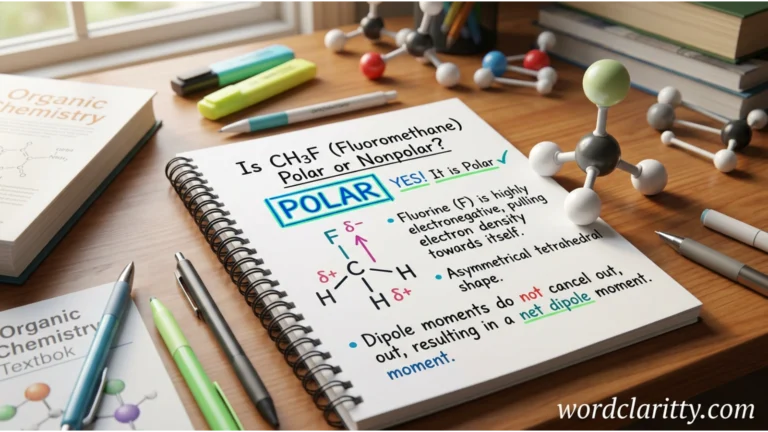
Is CH3F polar or nonpolar? This is a common chemistry question that can confuse students and English learners studying scientific vocabulary. The words “polar” and “nonpolar” sound similar, but they describe different ways electric charge is distributed within molecules.
Understanding the difference is important when learning about chemical bonds, molecular geometry, electronegativity, and dipole moments. CH3F, also called fluoromethane or methyl fluoride, is an excellent example because its molecular structure makes the answer easier to understand.
In this guide, you will learn why CH3F is polar, how its bonds affect its overall polarity, and how to recognize polar and nonpolar molecules using simple explanations and practical examples.
Why “Polar” and “Nonpolar” Are Confusing
The terms “polar” and “nonpolar” are often confusing because they are closely related and appear in the same chemistry lessons. However, they describe different patterns of electrical charge within chemical bonds and molecules.
1. Similar Pronunciation
The words share the same root, “polar.”
- Polar: /ˈpoʊlər/ in American English.
- Nonpolar: /ˌnɑːnˈpoʊlər/ in American English.
The prefix “non-” changes the meaning of the word to its opposite.
Although these terms are not pronounced identically, their shared sounds may cause confusion for learners who are unfamiliar with scientific English.
2. Similar Spelling
The difference in spelling is simple:
- Polar
- Nonpolar
The word “nonpolar” contains the prefix “non-,” which means “not.”
Therefore, “nonpolar” means “not polar.”
This spelling pattern appears in many other English words, such as “nonmetal,” “nonverbal,” and “nonessential.”
3. Context Confusion
In chemistry, the word “polar” can describe an individual bond or an entire molecule.
This distinction is important because a molecule can contain polar bonds and still be nonpolar overall.
For example, carbon dioxide (CO2) contains polar carbon–oxygen bonds, but the molecule is nonpolar because its linear structure causes the bond dipoles to cancel.
CH3F is different. Its molecular structure does not allow the bond dipoles to cancel completely, so the molecule is polar.
4. Common Learner Mistakes
Students often make these mistakes:
- Assuming that every molecule with polar bonds must be polar.
- Believing that a tetrahedral molecule is always nonpolar.
- Ignoring differences in electronegativity.
- Confusing bond polarity with molecular polarity.
- Assuming that CH3F is nonpolar because it contains three hydrogen atoms.
- Forgetting to consider molecular geometry.
Understanding the relationship between bond polarity and molecular shape helps prevent these errors.
Polar vs Nonpolar Explained Simply
The main difference between polar and nonpolar molecules is how their electrical charge is distributed.
A polar molecule has an uneven distribution of electrical charge and a net dipole moment, while a nonpolar molecule has no permanent net dipole moment.
Simple Explanation
Polar: A molecule in which electrical charge is distributed unevenly, producing a positive side and a negative side.
Nonpolar: A molecule in which the bond dipoles cancel or there are no significant bond dipoles, resulting in no permanent net dipole moment.
One-Line Distinction
Polar means uneven charge distribution with a net molecular dipole, while nonpolar means no net molecular dipole.
Two Example Sentences
Example 1: Polar
“CH3F is a polar molecule because its carbon–fluorine bond creates a strong dipole that is not canceled by the other bonds.”
Example 2: Nonpolar
“CH4 is a nonpolar molecule because its symmetrical tetrahedral structure causes the bond dipoles to cancel.”
These examples demonstrate that molecular shape and the types of atoms present both influence polarity.
Is CH3F Polar or Nonpolar?
CH3F is polar.
Fluoromethane contains one carbon atom, three hydrogen atoms, and one fluorine atom.
Fluorine is significantly more electronegative than carbon, so the carbon–fluorine bond is strongly polar.
Because the molecule has a tetrahedral shape with three hydrogen atoms and one fluorine atom, the individual bond dipoles do not cancel.
As a result, CH3F has a permanent molecular dipole moment and is classified as a polar molecule.
Understanding Homophones in English
Scientific vocabulary becomes easier to understand when learners recognize how English words are formed and pronounced.
What Are Homophones?
Homophones are words that sound the same but have different meanings and often different spellings.
For example, “pair” and “pear” are homophones.
- Pair: Two things that belong together.
- Pear: A type of fruit.
Example sentences:
- “I bought a pair of shoes.”
- “She ate a ripe pear.”
Both words sound alike but have different meanings.
Other examples include “right” and “write,” “sea” and “see,” and “hear” and “here.”
However, “polar” and “nonpolar” are not homophones. They are related scientific terms with opposite meanings.
Why Homophones Cause Confusion
Homophones can make English difficult because pronunciation alone does not always reveal the intended meaning.
For example:
“The scientist will write the right answer.”
The words “write” and “right” sound alike but perform different functions.
With “polar” and “nonpolar,” the difficulty is not identical pronunciation. Instead, learners must understand the meaning of the prefix “non-” and the scientific concepts behind both terms.
Recognizing this difference can improve both English vocabulary and chemistry comprehension.
What Does “Polar” Mean?
Definition and Core Meaning
In chemistry, polar is an adjective describing a bond or molecule with an uneven distribution of electrical charge.
A polar covalent bond forms when two bonded atoms attract shared electrons with different strengths.
The atom that attracts electrons more strongly develops a partial negative charge, while the other develops a partial positive charge.
These are written as:
- δ−: Partial negative charge.
- δ+: Partial positive charge.
In a polar molecule, the individual bond dipoles combine to produce a net molecular dipole.
For example, CH3F is polar because fluorine attracts bonding electrons much more strongly than carbon does.
Origin and Historical Use
The word “polar” comes from “pole,” which ultimately derives from Latin polus and Greek polos, referring to an axis or pivot.
Originally, the concept of poles was associated with geography, astronomy, and magnetism.
As scientific understanding developed, the idea of opposite poles became useful in electricity and chemistry.
Chemists began using polarity to describe unequal electrical charge distributions in chemical bonds and molecules.
Today, molecular polarity is an important concept in chemical bonding, molecular interactions, and the physical properties of substances.
Modern Usage and Synonyms
In chemistry, “polar” describes bonds and molecules with electrical charge separation.
Related expressions include:
- Polar bond: A bond with unequal sharing of electrons.
- Polar molecule: A molecule with a permanent net dipole moment.
- Dipole: A separation of positive and negative charge.
- Electronegativity: An atom’s tendency to attract shared electrons.
- Charge separation: Unequal distribution of electrical charge.
These terms are related, but they are not exact synonyms.
Example Sentences
- “Water is a polar molecule because its bent shape produces a net dipole.”
- “CH3F is polar because its bond dipoles do not cancel.”
- “The carbon–fluorine bond is strongly polar.”
- “Polar molecules often interact through dipole–dipole forces.”
- “Molecular geometry helps determine whether a molecule is polar.”
Why CH3F Is Polar
To understand CH3F polarity, consider its structure.
The central carbon atom forms four single covalent bonds:
- Three carbon–hydrogen (C–H) bonds.
- One carbon–fluorine (C–F) bond.
Fluorine has an electronegativity of approximately 3.98 on the Pauling scale, while carbon has a value of approximately 2.55.
The electronegativity difference is:
3.98 − 2.55 = 1.43
This difference makes the C–F bond strongly polar.
Fluorine attracts the shared electrons more strongly, producing a partial negative charge near fluorine and a partial positive contribution near carbon.
Because the C–F bond is different from the three C–H bonds, their dipoles do not cancel.
Therefore, the overall CH3F molecule is polar.
What Does “Nonpolar” Mean?
Definition and Core Meaning
In chemistry, nonpolar is an adjective describing a bond with little or no charge separation or a molecule with no permanent net dipole moment.
A nonpolar covalent bond occurs when electrons are shared equally or nearly equally between bonded atoms.
A nonpolar molecule may contain nonpolar bonds, or it may contain polar bonds arranged so that their dipoles cancel.
For example, methane (CH4) is nonpolar because its symmetrical tetrahedral geometry produces no net molecular dipole.
Origin and Historical Context
The term “nonpolar” combines the prefix “non-,” meaning “not,” with the word “polar.”
As scientists developed models of chemical bonding and molecular structure, they needed language to distinguish molecules with permanent dipole moments from those without them.
The terms “polar” and “nonpolar” became useful for explaining chemical behaviour, molecular attractions, and differences in solubility.
Today, both terms are widely used in chemistry, biology, and materials science.
Modern Usage and Synonyms
Nonpolar substances are often discussed when studying molecular interactions, solvents, and solubility.
Related terms include:
- Nonpolar bond: A bond with little or no electrical charge separation.
- Nonpolar molecule: A molecule with no permanent net dipole moment.
- Symmetrical molecule: A molecule whose geometry may allow bond dipoles to cancel.
- Hydrophobic: Describes substances or groups that tend to avoid interaction with water.
- Zero net dipole: A molecular condition in which individual dipoles cancel.
Not every symmetrical molecule is nonpolar, and “hydrophobic” is not an exact synonym for “nonpolar.” The terms must be interpreted in their proper scientific contexts.
Example Sentences
- “Methane is a nonpolar molecule.”
- “Carbon dioxide is nonpolar despite having polar bonds.”
- “Oxygen gas is nonpolar because its two atoms have equal electronegativity.”
- “Many hydrocarbons are nonpolar substances.”
- “The bond dipoles in carbon tetrachloride cancel because of its symmetrical structure.”
Why CH3F Is Not Nonpolar
CH3F is not nonpolar because its molecular dipoles do not cancel.
Although the carbon atom has a tetrahedral arrangement of bonds, the surrounding atoms are not identical.
Three positions contain hydrogen atoms, while the fourth contains fluorine.
The strong carbon–fluorine bond dipole creates an uneven distribution of charge across the molecule.
Therefore, CH3F has a permanent net dipole moment and cannot be classified as nonpolar.
Polar vs Nonpolar: Key Differences at a Glance
The following table compares polar and nonpolar molecules and explains where CH3F belongs.
| Word | Part of Speech | Meaning | Example Context |
|---|---|---|---|
| Polar | Adjective | Describes a molecule with a permanent net dipole moment | “CH3F is polar.” |
| Nonpolar | Adjective | Describes a molecule with no permanent net dipole moment | “CH4 is nonpolar.” |
| Polar bond | Noun phrase | A covalent bond with unequal electron sharing | “The C–F bond is polar.” |
| Nonpolar bond | Noun phrase | A covalent bond with equal or nearly equal electron sharing | “The O–O bond is nonpolar.” |
CH3F Molecular Properties
| Property | CH3F |
|---|---|
| Chemical name | Fluoromethane |
| Common alternative name | Methyl fluoride |
| Molecular formula | CH3F |
| Central atom | Carbon |
| Molecular geometry | Tetrahedral |
| Electron geometry | Tetrahedral |
| Approximate bond angles | Near 109.5° |
| Number of bonds around carbon | 4 |
| Lone pairs on central carbon | 0 |
| Hybridization of carbon | sp³ |
| C–F bond | Polar covalent |
| Overall molecular polarity | Polar |
| Net dipole moment | Approximately 1.85 D |
The bond angles are close to the ideal tetrahedral value, although the different surrounding atoms cause small deviations.
Why Molecular Geometry Matters
Molecular geometry describes the three-dimensional arrangement of atoms.
CH3F has a tetrahedral structure because carbon forms four sigma bonds and has no lone pairs.
However, tetrahedral geometry does not automatically make a molecule nonpolar.
For example:
- CH4: Nonpolar because all four surrounding atoms are identical and the dipoles cancel.
- CH3F: Polar because fluorine differs from hydrogen and the dipoles do not cancel.
- CF4: Nonpolar because four identical C–F bond dipoles cancel in a symmetrical tetrahedral arrangement.
This comparison shows why both bond polarity and molecular geometry must be considered.
How to Remember the Difference Between Polar and Nonpolar
Understanding molecular polarity becomes easier when you connect the scientific terms with simple ideas.
1. Polar Means Uneven
Think of a polar molecule as having an uneven distribution of electrical charge.
Memory trick: Polar → Uneven charge → Net dipole
For example, CH3F has a strong C–F bond dipole that contributes to the molecule’s overall polarity.
2. Nonpolar Means No Net Dipole
The prefix “non-” means “not.”
Therefore, nonpolar means the molecule has no permanent net dipole moment.
Memory trick: Nonpolar → No net molecular dipole
For example, CH4 is nonpolar because its bond dipoles cancel.
3. Remember the Fluorine Atom
Fluorine is the most electronegative element on the Pauling scale.
In CH3F, fluorine attracts bonding electrons strongly.
Because only one fluorine atom is attached to carbon, the molecule has an uneven charge distribution.
Remember:
CH3F → One strongly electronegative fluorine → Uneven charge distribution → Polar
4. Compare CH3F with CH4
Imagine two tetrahedral molecules.
The first is CH4, with four hydrogen atoms surrounding carbon.
The second is CH3F, with three hydrogen atoms and one fluorine atom.
CH4 is symmetrical in both shape and surrounding atoms, so it is nonpolar.
CH3F has different surrounding atoms, producing a net dipole.
This comparison is one of the easiest ways to remember why CH3F is polar.
Common Mistakes and Confusions
Students often make errors when identifying molecular polarity because they focus on only one property.
Mistake 1: Assuming CH3F Is Nonpolar Because It Is Tetrahedral
✘ Incorrect: “CH3F is nonpolar because it has tetrahedral geometry.”
✔ Correct: “CH3F is polar because its bond dipoles do not cancel.”
Explanation: Tetrahedral geometry alone does not determine polarity. The surrounding atoms and bond dipoles also matter.
Mistake 2: Ignoring Electronegativity
✘ Incorrect: “Carbon and fluorine attract electrons equally.”
✔ Correct: “Fluorine attracts shared electrons more strongly than carbon.”
Explanation: Fluorine’s greater electronegativity creates a polar C–F bond.
Mistake 3: Confusing Bond Polarity with Molecular Polarity
✘ Incorrect: “Every molecule containing polar bonds must be polar.”
✔ Correct: “A molecule containing polar bonds can be nonpolar if the bond dipoles cancel.”
Explanation: Carbon dioxide and carbon tetrachloride are examples of molecules with polar bonds but no permanent net dipole moment.
Mistake 4: Assuming Hydrogen Makes CH3F Nonpolar
✘ Incorrect: “CH3F is nonpolar because it contains three hydrogen atoms.”
✔ Correct: “CH3F is polar because the overall distribution of charge is uneven.”
Explanation: The strong C–F bond dipole is not canceled by the remaining bonds.
Mistake 5: Ignoring Molecular Shape
✘ Incorrect: “Electronegativity difference alone determines whether a molecule is polar.”
✔ Correct: “Molecular polarity depends on bond dipoles and their three-dimensional arrangement.”
Explanation: The vector sum of the individual bond dipoles determines the overall molecular dipole moment.
Examples Section: Correct and Incorrect Usage
The following examples help explain how to identify polar and nonpolar molecules.
Example 1: CH3F Polarity
✔ Correct: “CH3F is a polar molecule because it has a permanent net dipole moment.”
✘ Incorrect: “CH3F is nonpolar because all its bond dipoles cancel.”
Why? The C–F bond contributes strongly to an overall dipole that does not cancel.
Example 2: Methane Polarity
✔ Correct: “CH4 is nonpolar because its tetrahedral structure is symmetrical.”
✘ Incorrect: “CH4 is polar because carbon forms four bonds.”
Why? The number of bonds alone does not determine polarity. The arrangement and cancellation of bond dipoles matter.
Example 3: Carbon Dioxide
✔ Correct: “CO2 is nonpolar because its two C–O bond dipoles cancel.”
✘ Incorrect: “CO2 is polar because it contains polar bonds.”
Why? CO2 has a linear molecular structure, so its equal and opposite bond dipoles cancel.
Example 4: Carbon–Fluorine Bond
✔ Correct: “The carbon–fluorine bond in CH3F is polar covalent.”
✘ Incorrect: “The carbon–fluorine bond in CH3F is nonpolar because both atoms share electrons.”
Why? Sharing electrons does not always mean sharing them equally.
Example 5: Molecular Geometry
✔ Correct: “CH3F has tetrahedral molecular geometry.”
✘ Incorrect: “CH3F has linear molecular geometry.”
Why? The central carbon atom forms four bonds arranged approximately tetrahedrally.
Example 6: Overall Molecular Dipole
✔ Correct: “CH3F has a nonzero molecular dipole moment.”
✘ Incorrect: “CH3F has a zero molecular dipole moment.”
Why? The uneven distribution of electrical charge creates a permanent molecular dipole.
Self-Assessment: Test Your Knowledge
Choose the correct word or phrase to complete each sentence.
Question 1: CH3F is a ___ molecule because its bond dipoles do not cancel.
a) Polar
b) Nonpolar
Question 2: The molecular geometry of CH3F is ___.
a) Linear
b) Tetrahedral
Question 3: CH4 is considered ___ because its bond dipoles cancel in a symmetrical structure.
a) Polar
b) Nonpolar
Question 4: The carbon–fluorine bond in CH3F is ___ because fluorine attracts shared electrons more strongly than carbon.
a) Polar
b) Nonpolar
Self-Assessment Answers
Answer 1: Polar
CH3F is polar because its overall electrical charge distribution is uneven, producing a net molecular dipole.
Answer 2: Tetrahedral
The central carbon atom forms four single bonds, producing a tetrahedral molecular geometry.
Answer 3: Nonpolar
CH4 is nonpolar because its symmetrical arrangement causes the bond dipoles to cancel.
Answer 4: Polar
The C–F bond is polar because fluorine has a higher electronegativity than carbon.
How Did You Do?
- 4 correct: Excellent! You understand CH3F polarity.
- 3 correct: Very good. Review the concept you missed.
- 1–2 correct: Practise identifying bond dipoles and molecular geometry.
- 0 correct: Start with the basic rule: molecular polarity depends on whether the bond dipoles cancel.
FAQs:
1. Is CH3F Polar or Nonpolar?
CH3F is polar. The carbon–fluorine bond is strongly polar, and the molecule’s tetrahedral structure does not allow the individual bond dipoles to cancel completely. Therefore, CH3F has a permanent net dipole moment.
2. Why Is CH3F Polar?
CH3F is polar because fluorine is significantly more electronegative than carbon. This creates a strong C–F bond dipole. The molecule contains three hydrogen atoms and one fluorine atom around carbon, resulting in an uneven distribution of charge.
3. What Is the Molecular Geometry of CH3F?
CH3F has tetrahedral molecular geometry. The central carbon atom forms four single bonds and has no lone pairs, producing an arrangement with bond angles close to 109.5 degrees.
4. Does CH3F Have a Dipole Moment?
Yes. CH3F has a permanent dipole moment of approximately 1.85 Debye (D). This nonzero dipole moment confirms that fluoromethane is a polar molecule.
5. Is the C–F Bond in CH3F Polar or Nonpolar?
The carbon–fluorine bond is polar covalent. Fluorine attracts the shared electrons more strongly than carbon because of its higher electronegativity.
6. Why Is CH4 Nonpolar but CH3F Polar?
CH4 is nonpolar because its four C–H bonds are arranged symmetrically and their dipoles cancel. CH3F is polar because one hydrogen is replaced by fluorine, creating an uneven distribution of bond dipoles.
7. Can a Tetrahedral Molecule Be Polar?
Yes. A tetrahedral molecule can be polar if its bond dipoles do not cancel. CH3F is an example. In contrast, CH4 and CF4 are nonpolar because their symmetrical arrangements produce no net molecular dipole.
Conclusion:
Understanding whether CH3F is polar or nonpolar becomes much easier when you examine its chemical bonds, electronegativity differences, and molecular geometry. The correct answer is that CH3F is a polar molecule. Fluoromethane contains one carbon atom bonded to three hydrogen atoms and one fluorine atom. Because fluorine is much more electronegative than carbon, the C–F bond has a strong dipole. The tetrahedral arrangement does not allow all the bond dipoles to cancel, resulting in a permanent molecular dipole moment.
The difference between polar and nonpolar molecules is based on their overall electrical charge distribution. Polar molecules have a nonzero net dipole moment, while nonpolar molecules have no permanent net dipole moment. This distinction is important when studying chemical bonding, intermolecular forces, solubility, and molecular properties. For example, CH3F is polar, while CH4 is nonpolar despite having a similar tetrahedral shape.
To remember the difference, associate polar with uneven charge distribution and nonpolar with no net molecular dipole. Also remember that molecular geometry matters just as much as bond polarity. Comparing CH3F with CH4 is a simple way to reinforce this concept.
As you continue learning chemistry and scientific English, practise identifying electronegativity differences, drawing molecular structures, and examining how bond dipoles combine. With regular practice, you will become more confident in explaining why molecules such as CH3F are polar and why others are nonpolar.