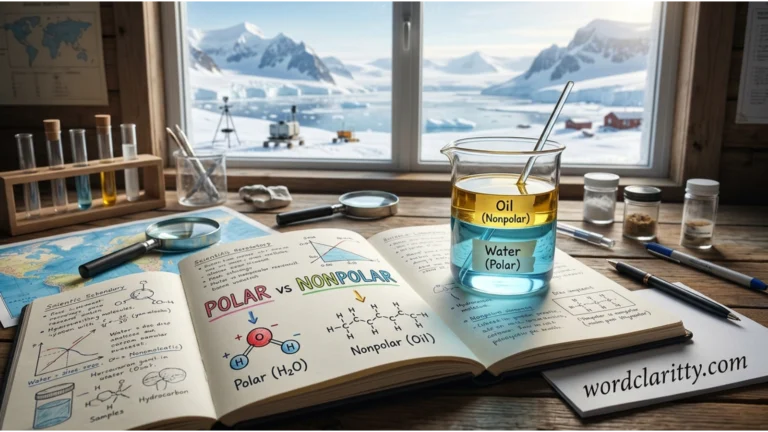
Have you ever wondered whether to use polar or nonpolar when describing a molecule, chemical bond, or substance? These two scientific terms often confuse English learners and chemistry students because they look similar but describe different properties. Both words are correct, yet choosing the right one depends on how electrical charge is distributed within a bond or molecule.
Understanding the difference helps explain why water and oil do not mix easily, how substances dissolve, and why some molecules behave differently from others. In this guide, you will learn the meanings, pronunciation, origins, examples, and simple memory tricks that make polar and nonpolar easier to understand and use correctly.
Why “Polar” and “Nonpolar” Are Confusing
The words “polar” and “nonpolar” frequently appear together in chemistry lessons, science textbooks, and discussions about molecular structure. Although their meanings are opposite in an important way, they are closely connected.
1. Similar Pronunciation
The two terms share the same basic sound because “nonpolar” contains the entire word “polar.”
Their approximate pronunciations are:
- Polar: POH-ler
- Nonpolar: non-POH-ler
The additional “non” at the beginning changes the meaning.
However, the words are not pronounced identically, so they are not homophones.
2. Similar Spelling
The spelling difference is small:
- Polar
- Nonpolar
The prefix non- means “not” or “without.”
Therefore, “nonpolar” literally means “not polar.”
This simple prefix changes how the word describes a bond, molecule, or substance.
3. Context Confusion
Both words describe chemical bonds and molecules.
For example:
“Water is polar, while methane is nonpolar.”
Students sometimes confuse these terms because both involve electrons and the distribution of electrical charge.
The key is understanding whether the distribution produces an overall separation of positive and negative charge.
4. Common Learner Mistakes
Common mistakes include:
- Assuming all molecules with polar bonds are polar molecules.
- Believing that nonpolar molecules contain no electrons.
- Thinking that polar molecules must have a full positive and negative electrical charge.
- Confusing bond polarity with overall molecular polarity.
- Assuming that every substance dissolves equally well in water.
These misunderstandings become easier to avoid once you understand the basic scientific definitions.
Polar vs Nonpolar Explained Simply
Polar means having an uneven distribution of electrical charge, while nonpolar means having no significant overall separation of charge.
In chemistry, these terms can describe either individual chemical bonds or entire molecules.
Simple Explanation
Polar: A bond or molecule with an uneven distribution of electron density that produces positive and negative regions.
Nonpolar: A bond with equal or nearly equal sharing of electrons, or a molecule whose overall charge distribution has no permanent dipole.
A dipole is a separation of positive and negative charge.
One-Line Distinction
Polar means an uneven charge distribution that creates a dipole; nonpolar means no significant permanent dipole overall.
Two Example Sentences
Example 1:
“Water is a polar molecule because its shape and electron distribution create a positive side and a negative side.”
Example 2:
“Methane is a nonpolar molecule because its symmetrical shape makes its bond dipoles cancel.”
Both terms are correct, but they describe different molecular properties.
Which Word Is Correct?
Neither word is universally better.
Use “polar” when the bond or molecule has the relevant separation of charge.
Use “nonpolar” when that separation is absent or cancels out overall.
Understanding Homophones in English
English learners sometimes confuse scientific vocabulary with ordinary words that sound similar. Learning about homophones can help improve general language skills.
What Are Homophones?
Homophones are words that have the same pronunciation but different meanings and often different spellings.
For example:
- Sea: A large body of salt water.
- See: To notice something with your eyes.
Consider these sentences:
“We crossed the sea.”
“I can see the mountains.”
The words sound alike but have different meanings.
Other common homophones include:
- Hear and here
- Right and write
- Sun and son
- Flour and flower
However, polar and nonpolar are not homophones because their pronunciations are different.
Why Homophones Cause Confusion
Homophones cause confusion because listeners must rely on context to identify the intended meaning.
For example:
“The scientist can see the sea.”
The words “see” and “sea” sound identical, but their meanings are different.
The confusion between “polar” and “nonpolar” comes mainly from their related spelling and opposite scientific meanings.
The prefix “non-” is especially important because it reverses the basic description.
Understanding prefixes can help learners recognize many other English word pairs, including:
- Toxic and nontoxic
- Verbal and nonverbal
- Metallic and nonmetallic
What Does “Polar” Mean?
Definition and Core Meaning
The word “polar” is an adjective with several meanings.
In chemistry, it describes a bond or molecule with an uneven distribution of electron density.
In a polar covalent bond, one atom attracts the shared electrons more strongly than the other. This creates partial electrical charges.
The atom attracting the electrons more strongly develops a partial negative charge, while the other develops a partial positive charge.
Important characteristics of polar bonds and molecules include:
- Uneven electron distribution
- Partial positive and negative regions
- A bond dipole or overall molecular dipole
- Possible attractions between polar molecules
- Often good interactions with polar solvents
Not every polar substance dissolves easily in water, but polarity is an important factor in solubility.
Origin and Historical Use
The word “polar” comes from “pole,” which ultimately developed from Latin polus and Greek polos, meaning an axis or pivot.
Originally, the word was associated with geographical and astronomical poles.
For example, the North Pole and South Pole are opposite ends of Earth’s rotational axis.
Later, scientific language expanded the term to describe opposite ends or regions of a system.
In chemistry, “polar” became useful for explaining how positive and negative electrical regions can exist within bonds and molecules.
Modern Usage and Synonyms
Today, “polar” appears in chemistry, geography, physics, and everyday English.
Common uses include:
- Polar molecule: A molecule with a permanent electric dipole.
- Polar bond: A bond with unequal electron sharing.
- Polar region: An area near Earth’s North or South Pole.
- Polar climate: A climate associated with extremely cold regions.
- Polar opposite: Something completely different or opposite.
Related scientific expressions include:
- Dipolar
- Charge-separated
- Unevenly distributed electron density
- Electrically asymmetric
These expressions are related but are not interchangeable in every context.
Example Sentences
- “Water is a polar molecule.”
- “The oxygen–hydrogen bonds in water are polar.”
- “Polar molecules have an uneven distribution of electrical charge.”
- “Ethanol contains a polar hydroxyl group.”
- “The scientist studied interactions between polar molecules.”
- “Polar bears live in Arctic regions.”
The final example uses the geographical meaning rather than the chemical meaning.
What Does “Nonpolar” Mean?
Definition and Core Meaning
The word “nonpolar” is an adjective describing something that does not have significant polarity.
In chemistry, a nonpolar covalent bond has equal or nearly equal sharing of electrons.
A nonpolar molecule has no permanent overall electric dipole, even if some of its individual bonds are polar.
Important characteristics include:
- No significant permanent molecular dipole
- Symmetrical charge distribution in many examples
- Equal or nearly equal electron sharing in nonpolar bonds
- Often limited solubility in water
- Common compatibility with nonpolar solvents
Examples of nonpolar molecules include methane, oxygen, and carbon dioxide.
Carbon dioxide is particularly interesting because it contains polar bonds but is nonpolar overall.
Origin and Historical Context
The word “nonpolar” combines the prefix “non-” with the adjective “polar.”
The prefix comes from Latin non, meaning “not.”
In scientific English, this prefix is commonly used to describe the absence of a particular characteristic.
As chemists developed a better understanding of chemical bonding and molecular structure, “nonpolar” became an important term for distinguishing molecules without a permanent overall dipole from polar molecules.
The distinction helps explain molecular interactions, solubility, and many physical properties.
Modern Usage and Synonyms
“Nonpolar” is widely used in chemistry, biology, materials science, and laboratory work.
Related expressions include:
- Without a permanent dipole: A molecule with no lasting overall charge separation.
- Electrically symmetrical: A description that may apply to many nonpolar molecules.
- Hydrophobic: Describes substances or molecular regions that do not interact favourably with water.
- Water-insoluble: Describes substances that do not dissolve significantly in water.
However, these expressions are not exact synonyms. For example, a substance can have low water solubility for reasons beyond molecular polarity.
Example Sentences
- “Methane is a nonpolar molecule.”
- “Oxygen gas contains a nonpolar covalent bond.”
- “Carbon dioxide is nonpolar overall despite having polar bonds.”
- “Many oils contain mostly nonpolar molecules.”
- “Nonpolar substances often dissolve better in nonpolar solvents.”
- “The teacher explained why nonpolar molecules interact differently with water.”
These examples show how the term is used in scientific writing.
Polar vs Nonpolar: Key Differences at a Glance
The following table summarizes the main differences.
| Word | Part of Speech | Meaning | Example Context |
|---|---|---|---|
| Polar | Adjective | Having an uneven distribution of charge that creates a dipole | “Water is polar.” |
| Nonpolar | Adjective | Having no significant permanent overall dipole | “Methane is nonpolar.” |
| Polar bond | Adjective + noun | A chemical bond with unequal electron sharing | “The O–H bond is polar.” |
| Nonpolar bond | Adjective + noun | A covalent bond with equal or nearly equal electron sharing | “The O=O bond is nonpolar.” |
Comparison of Polar and Nonpolar Molecules
| Feature | Polar Molecules | Nonpolar Molecules |
|---|---|---|
| Overall charge distribution | Uneven | No permanent overall dipole |
| Permanent molecular dipole | Present | Absent |
| Molecular shape | Shape produces a net dipole | Shape may cause bond dipoles to cancel |
| Interaction with water | Often favourable | Often less favourable |
| Common examples | Water, ammonia | Methane, carbon dioxide |
| Typical intermolecular forces | Dipole–dipole and London dispersion forces | London dispersion forces |
All molecules experience London dispersion forces. Polar molecules may also experience dipole–dipole attractions, and some can form hydrogen bonds.
How to Identify a Polar or Nonpolar Molecule
To determine molecular polarity, consider two main factors:
- Bond polarity: Are electrons shared unequally between bonded atoms?
- Molecular shape: Do the bond dipoles reinforce one another or cancel out?
For example, carbon dioxide contains polar carbon–oxygen bonds. However, its linear shape allows the two bond dipoles to cancel.
Therefore, carbon dioxide is nonpolar overall.
Water also contains polar bonds, but its bent shape prevents the dipoles from cancelling.
Therefore, water is polar.
How to Remember the Difference Between Polar and Nonpolar
Simple associations can make these chemistry terms easier to remember.
1. Polar Means Two Different Sides
Think of a magnet with two poles.
A polar molecule also has positive and negative regions, although molecular polarity and magnetism are different physical phenomena.
Memory trick: Polar → Poles → Positive and Negative Regions
For example:
“Water is polar because its electrical charge is distributed unevenly.”
2. Nonpolar Means No Overall Dipole
Remember that “non-” means “not.”
Memory trick: Nonpolar → Non = Not → No Permanent Overall Dipole
For example:
“Methane is nonpolar because its bond dipoles cancel.”
3. Associate Polar with Water
Water is one of the most familiar examples of a polar molecule.
Think:
Water → Polar
This association can help you remember that polar molecules often interact well with water.
4. Associate Nonpolar with Oil
Many common oils consist mainly of nonpolar molecules.
Think:
Oil → Mostly Nonpolar
This helps explain why oil and water tend to separate rather than mix uniformly.
5. One Memorable Example
Imagine pouring cooking oil into a glass of water.
The water is polar, while the oil is mostly nonpolar.
Instead of mixing evenly, the two liquids form separate layers.
This familiar observation provides a useful reminder of how differences in molecular polarity influence mixing.
Common Mistakes and Confusions
Mistake 1: Assuming Polar Means Fully Charged
✘ Incorrect: “A polar molecule must have a full positive charge on one side and a full negative charge on the other.”
✔ Correct: “A polar molecule has an uneven distribution of charge, creating partial positive and negative regions.”
Explanation: Polar molecules are generally electrically neutral overall.
Mistake 2: Assuming Nonpolar Means No Electrons
✘ Incorrect: “Nonpolar molecules contain no electrons.”
✔ Correct: “Nonpolar molecules contain electrons but have no permanent overall dipole.”
Explanation: Polarity concerns how charge is distributed, not whether electrons exist.
Mistake 3: Confusing Bond Polarity with Molecular Polarity
✘ Incorrect: “Carbon dioxide is polar because it contains polar bonds.”
✔ Correct: “Carbon dioxide has polar bonds but is nonpolar overall because its bond dipoles cancel.”
Explanation: Molecular geometry matters when determining overall polarity.
Mistake 4: Assuming All Nonpolar Substances Are Completely Insoluble
✘ Incorrect: “No nonpolar substance can dissolve in water.”
✔ Correct: “Many nonpolar substances have low water solubility, but some can dissolve to a limited extent.”
Explanation: Solubility depends on several factors, including molecular interactions, temperature, and structure.
Mistake 5: Ignoring Molecular Shape
✘ Incorrect: “Bond polarity alone determines whether a molecule is polar.”
✔ Correct: “Both bond polarity and molecular shape help determine overall molecular polarity.”
Explanation: Symmetrical arrangements can cause bond dipoles to cancel.
Examples Section: Correct and Incorrect Usage
Example 1: Water
✔ Correct: “Water is a polar molecule.”
✘ Incorrect: “Water is nonpolar because it has no overall electrical charge.”
Why? A molecule can be electrically neutral overall and still have a permanent dipole.
Example 2: Methane
✔ Correct: “Methane is nonpolar.”
✘ Incorrect: “Methane is strongly polar because it contains four hydrogen atoms.”
Why? Methane has a symmetrical tetrahedral structure, and its bond dipoles cancel overall.
Example 3: Carbon Dioxide
✔ Correct: “Carbon dioxide is nonpolar overall.”
✘ Incorrect: “Carbon dioxide must be polar because its carbon–oxygen bonds are polar.”
Why? Its linear geometry causes the bond dipoles to cancel.
Example 4: Ammonia
✔ Correct: “Ammonia is a polar molecule.”
✘ Incorrect: “Ammonia is nonpolar because it contains only nitrogen and hydrogen.”
Why? Ammonia has a trigonal pyramidal shape and a permanent molecular dipole.
Example 5: Oxygen Gas
✔ Correct: “Oxygen gas contains a nonpolar covalent bond.”
✘ Incorrect: “The bond in oxygen gas is polar because oxygen attracts electrons strongly.”
Why? The two oxygen atoms have the same electronegativity, so they share electrons equally.
Example 6: Oil and Water
✔ Correct: “Water is polar, while many components of cooking oil are nonpolar.”
✘ Incorrect: “Oil and water separate because both are strongly polar.”
Why? Their different molecular interactions help explain why they do not mix easily.
Self-Assessment: Test Your Knowledge
Choose the correct word to complete each sentence.
Question 1: Water is a ___ molecule because it has an uneven distribution of electrical charge.
a) Polar
b) Nonpolar
Question 2: Methane is ___ because its symmetrical structure causes its bond dipoles to cancel.
a) Polar
b) Nonpolar
Question 3: A molecule with a permanent overall electric dipole is described as ___.
a) Polar
b) Nonpolar
Question 4: Carbon dioxide is ___ overall, even though its carbon–oxygen bonds are polar.
a) Polar
b) Nonpolar
Self-Assessment Answers
Answer 1: a) Polar
Water has a bent molecular shape and an uneven distribution of electron density, creating a permanent dipole.
Answer 2: b) Nonpolar
Methane has a symmetrical tetrahedral shape, so its bond dipoles cancel.
Answer 3: a) Polar
A permanent overall electric dipole is a defining characteristic of a polar molecule.
Answer 4: b) Nonpolar
Carbon dioxide has a linear structure, and its bond dipoles cancel each other.
How Did You Do?
- 4 correct: Excellent! You understand the basic difference.
- 3 correct: Great work. Review the example you missed.
- 1–2 correct: Practise identifying bond polarity and molecular shape.
- 0 correct: Remember: polar means a permanent dipole; nonpolar means no permanent overall dipole.
FAQs:
1. What Is the Main Difference Between Polar and Nonpolar?
Polar molecules have an uneven charge distribution that creates a permanent electric dipole. Nonpolar molecules have no permanent overall dipole.
2. Is Water Polar or Nonpolar?
Water is polar. Its oxygen–hydrogen bonds are polar, and its bent molecular shape creates an uneven distribution of electrical charge.
3. Is CO₂ Polar or Nonpolar?
Carbon dioxide (CO₂) is nonpolar overall. Although its carbon–oxygen bonds are polar, the molecule is linear, so the bond dipoles cancel.
4. How Can You Tell Whether a Molecule Is Polar or Nonpolar?
Examine the polarity of its bonds and its molecular geometry. If the bond dipoles combine to create a net dipole, the molecule is polar. If they cancel, it is nonpolar.
5. Why Do Polar and Nonpolar Substances Often Not Mix?
Polar and nonpolar substances have different intermolecular interactions. Mixing may be unfavourable when the new interactions do not adequately replace the interactions present in the separate substances.
6. Is Oil Polar or Nonpolar?
Most common cooking oils are made mainly of molecules with large nonpolar hydrocarbon regions. As a result, they behave predominantly as nonpolar substances and do not mix readily with water.
7. Can a Molecule Have Polar Bonds but Be Nonpolar Overall?
Yes. Carbon dioxide is a common example. Its polar bonds are arranged symmetrically, causing their dipoles to cancel.
Conclusion:
Understanding the difference between polar and nonpolar is essential for learning chemistry and using scientific English accurately. Although the two terms look similar, they describe different electrical properties of chemical bonds and molecules. Polar refers to an uneven distribution of electrical charge that creates a dipole, while nonpolar describes a bond with little or no polarity or a molecule without a permanent overall dipole. Both words are correct, but the right choice depends on the structure and charge distribution of the substance being discussed.
In real-world chemistry, polarity helps explain how molecules interact, why some substances dissolve in water, and why liquids such as oil and water tend to separate.