
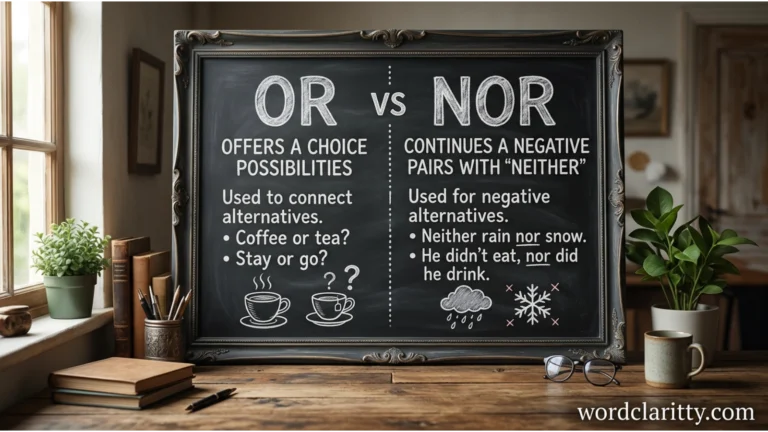
Have you ever stopped while writing a sentence because you were unsure whether to use “or” or “nor”? You are not alone. These two small English words often confuse learners because they look similar and both connect ideas, choices, or possibilities. However, their grammatical uses are different. “Or” usually introduces alternatives, while “nor” connects negative ideas or continues a negative statement.
Choosing the wrong word can make a sentence sound unnatural or change its meaning. Understanding the difference is especially important for clear writing, everyday conversations, and English grammar tests. This guide explains their meanings, grammar rules, examples, common mistakes, and easy memory tricks.
Why “Or” vs “Nor” Are Confusing
The words “or” vs “nor” can be confusing because they are short conjunctions that connect words, phrases, and clauses. Although they sometimes appear in similar sentence structures, they do not always communicate the same meaning.
1. Similar Pronunciation
“Or” and “nor” have similar sounds, but they are not pronounced identically.
Their common pronunciations are:
- Or: /ɔːr/ in many American accents, or /ɔː/ in non-rhotic British pronunciation.
- Nor: /nɔːr/ in many American accents, or /nɔː/ in non-rhotic British pronunciation.
The main difference is the initial n sound in “nor.”
Because the words are short and may be spoken quickly, learners sometimes have difficulty distinguishing them in conversation.
2. Similar Spelling
The spelling difference is only one letter.
- Or: Two letters.
- Nor: Three letters, beginning with “n.”
This small difference makes the words easy to mix up, especially when writing quickly.
However, the extra letter is a useful reminder that “nor” commonly connects negative ideas.
3. Context Confusion
Both words can connect alternatives, but their grammatical environments are different.
For example:
“Would you like tea or coffee?”
This sentence presents two choices.
Now consider:
“She likes neither tea nor coffee.”
This sentence rejects both options.
The first sentence uses “or” to introduce alternatives, while the second uses “nor” as part of the negative structure “neither…nor.”
4. Common Learner Mistakes
English learners often make these mistakes:
- Using “nor” instead of “or” in ordinary questions.
- Using “or” instead of “nor” after “neither.”
- Assuming “nor” must follow every negative word.
- Forgetting subject-verb inversion when “nor” begins a new negative clause.
- Confusing “either…or” with “neither…nor.”
Understanding the basic rules helps prevent these errors.
Or vs Nor Explained Simply
The difference between “or” and “nor” is mainly about alternatives and negative connections.
Simple Explanation
Or: A conjunction used to present choices, alternatives, possibilities, or consequences.
Nor: A conjunction used to connect negative alternatives or add another negative statement.
One-Line Distinction
“Or” introduces alternatives, while “nor” commonly connects negative alternatives, especially after “neither.”
Two Example Sentences
Example 1: Or
“Would you like pizza or pasta for dinner?”
The speaker is offering two alternatives.
Example 2: Nor
“He speaks neither French nor Spanish.”
The sentence means he does not speak French and does not speak Spanish.
Which One Is Correct?
Both words are grammatically correct, but their use depends on the sentence.
Use or when offering alternatives:
“You can walk or take the bus.”
Use nor when connecting negative alternatives:
“She neither called nor sent a message.”
Remember that “or” can also appear after a negative word:
“I don’t want tea or coffee.”
This sentence is correct and natural. Therefore, the presence of a negative word does not automatically require “nor.”
Understanding Homophones in English
English contains many words that sound alike but have different meanings. These words are called homophones.
Although “or” vs “nor” are not homophones, understanding this concept can help learners recognize different types of confusing words.
What Are Homophones?
Homophones are words that have the same pronunciation but different meanings and often different spellings.
For example, “right” and “write” are homophones.
- Right: Correct or opposite to left.
- Write: To form words using letters or symbols.
Example sentences:
“You gave the right answer.”
“Please write your answer clearly.”
The two words sound the same, but their meanings are different.
Other common homophones include:
- Hear and here
- Sea and see
- Sun and son
- Flour and flower
- One and won
However, “or” vs “nor” are not homophones because “nor” begins with an additional consonant sound.
Why Homophones Cause Confusion
Homophones can confuse learners because pronunciation alone does not always reveal the intended spelling.
For example:
“I can hear the birds.”
“The birds are here.”
The words “hear” and “here” sound identical in many English accents, but their meanings are different.
With “or” vs “nor,” the challenge is mainly grammatical rather than phonetic. Learners must understand whether the sentence introduces ordinary alternatives or connects negative ideas.
What Does “Or” Mean?
Definition and Core Meaning
“Or” is a coordinating conjunction used to connect alternatives, choices, possibilities, or different outcomes.
It is one of the most common conjunctions in English.
The word can connect individual words, phrases, and complete clauses.
For example:
“Would you prefer water or juice?”
The speaker is asking someone to choose between two drinks.
Common uses of “or” include:
- Offering choices: “Tea or coffee?”
- Presenting alternatives: “You can call or email me.”
- Showing possible outcomes: “Hurry up, or you will miss the bus.”
- Expressing uncertainty: “He may arrive today or tomorrow.”
- Clarifying information: “The meeting starts at noon, or 12 p.m.”
These examples show that “or” is useful in many everyday situations.
Origin and Historical Use
The word “or” developed from Old English forms used to express alternatives.
Over time, it became a common conjunction in English grammar, connecting different possibilities and choices.
Its basic function has remained consistent: presenting alternatives or indicating that one possibility may apply instead of another.
Today, “or” is widely used in both spoken and written English.
It appears in casual conversations, instructions, academic writing, business communication, and legal documents.
Modern Usage and Synonyms
In modern English, “or” is used whenever a sentence presents alternatives.
Related expressions include:
- Alternatively: Introduces another possibility.
- Otherwise: Introduces a consequence or different outcome.
- Either…or: Presents alternatives using a paired structure.
- Instead: Indicates a replacement or different choice.
- Or else: Introduces a possible consequence.
These expressions are related but cannot always replace “or” directly.
For example:
“You can stay here or leave.”
A similar idea could be expressed as:
“You can stay here. Alternatively, you can leave.”
Example Sentences
- “Would you like tea or coffee?”
- “You can study in the morning or evening.”
- “Is your brother a doctor or an engineer?”
- “We can watch a movie or play a game.”
- “Hurry up, or we will be late.”
- “She may visit us on Saturday or Sunday.”
In each example, “or” introduces alternatives, possibilities, or outcomes.
What Does “Nor” Mean?
Definition and Core Meaning
“Nor” is a conjunction used to connect negative alternatives or introduce an additional negative statement.
It is particularly common in the structure “neither…nor.”
For example:
“She likes neither apples nor oranges.”
This means she does not like apples and does not like oranges.
The word “nor” can also introduce another negative clause:
“He didn’t apologize, nor did he explain his behaviour.”
This sentence means he did not apologize and also did not explain his behaviour.
Common uses include:
- Neither…nor: “Neither Tom nor Sarah attended.”
- Adding a negative statement: “She didn’t complain, nor did she argue.”
- Connecting negative actions: “He neither smiled nor spoke.”
- Formal negative continuation: “The company did not respond, nor did it provide an explanation.”
Origin and Historical Context
The word “nor” developed from older English negative constructions combining a negative element with the idea of an alternative.
Historically, English used several negative conjunctions and particles to connect statements.
Over time, “nor” became established as a conjunction for linking negative alternatives.
The paired structure “neither…nor” has remained particularly important in English grammar.
Today, “nor” is common in formal writing, literature, speeches, and carefully structured sentences. It also appears in everyday conversation, especially with “neither.”
Modern Usage and Synonyms
In modern English, “nor” helps connect negative ideas without repeating the same negative structure unnecessarily.
Related expressions include:
- Neither…nor: Connects two negative alternatives.
- And not: Adds another negative idea.
- Not…either: A common conversational alternative.
- Also not: Adds a further negative statement.
- Neither did: Introduces a negative agreement or continuation.
For example:
“She didn’t call, nor did she text.”
A more conversational version is:
“She didn’t call, and she didn’t text either.”
Both sentences communicate a similar meaning.
Example Sentences
- “Neither the teacher nor the students were late.”
- “He neither eats meat nor drinks milk.”
- “She didn’t smile, nor did she speak.”
- “Neither rain nor snow stopped the travellers.”
- “The manager did not approve the plan, nor did she suggest an alternative.”
- “I have neither the time nor the money to travel.”
Notice that “nor” often follows “neither” or introduces a second negative clause.
Or vs Nor: Key Differences at a Glance
The following comparison table summarizes the most important differences between “or” vs “nor.”
| Word | Part of Speech | Meaning | Example Context |
|---|---|---|---|
| Or | Coordinating conjunction | Introduces alternatives or choices | “Tea or coffee?” |
| Or | Coordinating conjunction | Introduces a possible consequence | “Hurry, or you’ll be late.” |
| Or | Coordinating conjunction | Connects alternatives under a negative statement | “I don’t want tea or coffee.” |
| Nor | Coordinating conjunction | Connects negative alternatives | “Neither tea nor coffee.” |
| Nor | Coordinating conjunction | Adds another negative statement | “She didn’t call, nor did she write.” |
The Main Grammar Rule
Use either…or when presenting alternatives:
“Either John or Mary will attend.”
Use neither…nor when rejecting both alternatives:
“Neither John nor Mary will attend.”
The meanings are different.
The first sentence says that at least one of the two people is expected to attend.
The second says that both people will be absent.
Can “Or” Be Used in Negative Sentences?
Yes.
For example:
“I don’t like tea or coffee.”
This is natural English and usually means that the speaker likes neither drink.
However, if you use “neither,” the matching conjunction is “nor”:
“I like neither tea nor coffee.”
Both sentences express a similar meaning, but their grammatical structures are different.
How to Remember the Difference Between Or vs Nor
Remembering the difference becomes easier when you connect each word with a simple idea.
1. Or Means Options
Think of the letter O in “or” as standing for “options.”
When you are choosing between possibilities, use “or.”
Memory trick: Or → Options → Choices
Example:
“Would you like rice or noodles?”
2. Nor Means Negative Alternatives
The word “nor” begins with the letter N, which can remind you of “negative.”
Memory trick: Nor → Negative → Neither
Example:
“She likes neither rice nor noodles.”
This association is especially useful for remembering the paired conjunction “neither…nor.”
However, remember that ordinary negative sentences can still use “or.”
3. Remember the Two Common Pairs
Learn these expressions together:
- Either…or: Presents alternatives.
- Neither…nor: Rejects both alternatives.
Examples:
“Either my sister or my brother will drive.”
“Neither my sister nor my brother can drive.”
These paired conjunctions are among the easiest ways to remember the distinction.
4. One Memorable Example
Imagine that a waiter asks:
“Would you like tea or coffee?”
You reply:
“Neither tea nor coffee. I’ll have water, please.”
The waiter uses or to offer choices.
You use neither…nor to reject both choices.
This simple restaurant conversation shows how the two conjunctions work differently.
Common Mistakes and Confusions
English learners sometimes choose the wrong conjunction because they focus only on whether the sentence contains a negative word.
Mistake 1: Using “Nor” in an Ordinary Choice
✘ Incorrect: “Would you like tea nor coffee?”
✔ Correct: “Would you like tea or coffee?”
Explanation: Ordinary alternatives are connected with “or.”
Mistake 2: Using “Or” After “Neither”
✘ Incorrect: “Neither John or Sarah attended the meeting.”
✔ Correct: “Neither John nor Sarah attended the meeting.”
Explanation: The standard paired structure is “neither…nor.”
Mistake 3: Using “Nor” After “Either”
✘ Incorrect: “Either you nor your brother must attend.”
✔ Correct: “Either you or your brother must attend.”
Explanation: The correct pair is “either…or.”
Mistake 4: Forgetting Inversion After “Nor”
✘ Incorrect: “She didn’t call, nor she sent a message.”
✔ Correct: “She didn’t call, nor did she send a message.”
Explanation: When “nor” introduces a separate negative clause, formal English normally uses auxiliary-subject inversion.
The auxiliary verb comes before the subject:
“Nor did she send a message.”
Mistake 5: Thinking Every Negative Sentence Requires “Nor”
✘ Incorrect: “I don’t want tea nor coffee.”
✔ Correct: “I don’t want tea or coffee.”
Explanation: In ordinary negative sentences, “or” is often the natural choice.
You can also say:
“I want neither tea nor coffee.”
The important point is to use the correct structure rather than replacing every “or” vs “nor” after a negative word.
Examples Section: Correct and Incorrect Usage
Example 1: Offering a Choice
✔ Correct: “Would you prefer coffee or tea?”
✘ Incorrect: “Would you prefer coffee nor tea?”
Why? The sentence offers alternatives, so “or” is correct.
Example 2: Using Neither…Nor
✔ Correct: “Neither Anna nor David was available.”
✘ Incorrect: “Neither Anna or David was available.”
Why? “Neither” pairs with “nor” in standard English.
Example 3: Using Either…Or
✔ Correct: “You can either walk or take a taxi.”
✘ Incorrect: “You can either walk nor take a taxi.”
Why? “Either” pairs with “or.”
Example 4: Adding a Negative Clause
✔ Correct: “He didn’t apologize, nor did he explain.”
✘ Incorrect: “He didn’t apologize, nor he explained.”
Why? A separate clause introduced by “nor” normally requires auxiliary-subject inversion.
Example 5: Negative Alternatives
✔ Correct: “I don’t need a pen or a pencil.”
✘ Incorrect: “I don’t need a pen nor a pencil.”
Why? “Or” is the usual conjunction for alternatives within this ordinary negative structure.
Example 6: Connecting Two Negative Actions
✔ Correct: “She neither laughed nor smiled.”
✘ Incorrect: “She neither laughed or smiled.”
Why? The correct paired conjunction is “neither…nor.”
Self-Assessment: Test Your Knowledge
Choose the correct word to complete each sentence.
Question 1: Would you like pizza ___ pasta for dinner?
a) Or
b) Nor
Question 2: Neither the manager ___ the employees knew about the change.
a) Or
b) Nor
Question 3: You can either stay here ___ come with us.
a) Or
b) Nor
Question 4: She didn’t answer the phone, ___ did she reply to the message.
a) Or
b) Nor
Self-Assessment Answers
Answer 1: a) Or
“Would you like pizza or pasta for dinner?”
The sentence offers two alternatives.
Answer 2: b) Nor
“Neither the manager nor the employees knew about the change.”
The conjunction “nor” completes the structure “neither…nor.”
Answer 3: a) Or
“You can either stay here or come with us.”
The standard pair is “either…or.”
Answer 4: b) Nor
“She didn’t answer the phone, nor did she reply to the message.”
The word “nor” introduces an additional negative statement.
How Did You Do?
- 4 correct: Excellent! You understand the difference.
- 3 correct: Very good. Review the question you missed.
- 1–2 correct: Practise the pairs “either…or” and “neither…nor.”
- 0 correct: Remember the basic rule: “or” introduces alternatives, while “nor” connects negative alternatives.
FAQs:
1. What Is the Main Difference Between Or vs Nor?
“Or” introduces alternatives, choices, or possibilities. “Nor” connects negative alternatives or adds another negative statement, especially in the structure “neither…nor.”
2. When Should I Use Nor Instead of Or?
Use “nor” after “neither” or when adding another negative clause in a suitable grammatical structure. For example: “Neither Tom nor Sarah attended” and “He didn’t speak, nor did he smile.”
3. Is It Correct to Say Neither Or?
In standard English, the correct paired conjunction is “neither…nor,” not “neither…or.” For example, write “Neither tea nor coffee is available.”
4. Can Or Be Used in a Negative Sentence?
Yes. “Or” is common in negative sentences. For example, “I don’t want tea or coffee” is grammatically correct and natural.
5. Can a Sentence Begin with Nor?
Yes. “Nor” can begin a sentence that continues a negative idea. For example: “She didn’t complain. Nor did she ask for help.” Notice the inverted word order.
6. What Is the Difference Between Either…Or vs Nor?
“Either…or” presents alternatives, while “neither…nor” rejects both alternatives. For example, “Either Jack or Emma will come” differs from “Neither Jack nor Emma will come.”
7. Is Nor More Formal Than Or?
“Nor” often sounds more formal when it introduces an additional negative clause. However, it is also common in everyday English with “neither.” “Or” is widely used in both formal and informal communication.
Conclusion:
Understanding the difference between “or” vs “nor” is an important part of improving your English grammar and writing skills. Although these two conjunctions look similar and both connect ideas, they serve different purposes. “Or” introduces choices, alternatives, possibilities, or consequences, while “nor” connects negative alternatives or adds another negative statement. Knowing this distinction helps you build clearer sentences and avoid common grammatical mistakes.
In everyday conversations, “or” is especially useful when asking questions, offering choices, and discussing possibilities. For example, you might ask, “Would you like tea or coffee?” Meanwhile, “nor” is commonly used with “neither,” as in “I like neither tea nor coffee.” It can also introduce an additional negative clause, such as “She didn’t call, nor did she send a message.”
One useful memory trick is to associate “or” with options and “nor” with negative alternatives. Remember the standard pairs “either…or” vs nor.” However, do not assume that every negative sentence requires “nor,” because “or” is also natural in sentences such as “I don’t want tea or coffee.”
The best way to master these conjunctions is to practise them in different contexts. Read example sentences, write your own questions, and pay attention to how negative statements are formed. With regular practice, choosing between “or” vs “nor” will become easier, helping you communicate more accurately and confidently in English.

