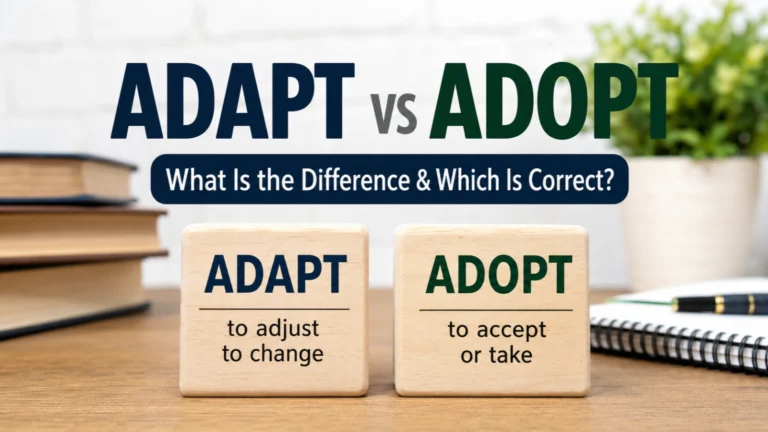
Adapt vs Adopt is a common grammar topic that often confuses English learners because the two words look and sound similar but have very different meanings.
Understanding adapt vs adopt is important for speaking and writing clearly in everyday English. Adapt means to change or adjust something so it fits a new situation, while adopt means to accept, choose, or take something as your own.
Mixing these words can change the meaning of a sentence and lead to misunderstandings. In this guide, you’ll learn the key differences between adapt vs adopt, their meanings, pronunciation, examples, and simple tips to remember which word to use correctly.
By the end, you’ll feel more confident using both words in the right context.
Why “Adapt” and “Adopt” Are Confusing
Many learners accidentally confuse adapt and adopt because they share several similarities.
Similar Pronunciation
Both words begin with “ad-“ and have two syllables, making them sound somewhat alike, especially for non-native speakers.
Similar Spelling
Only one letter changes between the two words:
- Adapt
- Adopt
This small spelling difference often leads to typing and writing mistakes.
Context Confusion
Both words describe some form of change, but they describe different kinds of change.
- Adapt means changing yourself or something to fit a new situation.
- Adopt means choosing, accepting, or taking something as your own.
Common Learner Mistakes
Learners often write:
- “The company adapted a new policy.” ❌
- “She adopted to the weather.” ❌
These mistakes happen because both words involve change, but they are used differently.
Adapt vs Adopt Explained Simply
Adapt means to change or adjust to fit a new situation, while adopt means to choose, accept, or legally take something as your own.
One-Line Distinction
Adapt = change to fit.
Adopt = accept or take.
Examples
Adapt
- She adapted quickly to her new school.
- The novel was adapted into a movie.
Adopt
- The company adopted a flexible work policy.
- They decided to adopt a puppy.
Understanding Homophones in English
What Are Homophones?
Homophones are words that sound the same or nearly the same but have different meanings and spellings.
Example:
- Pair
- Pear
Although adapt and adopt are not true homophones, they are commonly confused because of their similar pronunciation.
Why Homophones Cause Confusion
Words that sound alike often cause learners to guess the wrong spelling or meaning.
For example:
- Their
- There
- They’re
Similarly, learners may confuse adapt and adopt because both are associated with change.
What Does “Adapt” Mean?
Definition and Core Meaning
Adapt means to change, adjust, or modify yourself or something else so it works better in a new situation.
It usually involves responding to change.
Origin and Historical Use
The word adapt comes from the Latin word adaptare, meaning to fit or adjust. It entered English during the 17th century and has long been used to describe adjustment and modification.
Modern Usage and Synonyms
Today, adapt is commonly used in education, science, business, technology, and everyday conversations.
Synonyms
- Adjust
- Modify
- Alter
- Accommodate
- Customize
- Change
Common Uses
- Adapt to change
- Adapt a book into a film
- Adapt your behavior
- Adapt your teaching style
- Adapt equipment
Example Sentences
- Students must adapt to online learning.
- The writer adapted the novel for television.
- Animals adapt to different climates.
- We adapted our plans because of the rain.
What Does “Adopt” Mean?
Definition and Core Meaning
Adopt means to accept, choose, begin using, or legally take something or someone as your own.
Unlike adapt, it is about acceptance rather than adjustment.
Origin and Historical Context
The word comes from the Latin adoptare, meaning to choose for oneself. It has been used in English since the Middle Ages, especially in legal and social contexts.
Modern Usage and Synonyms
Today, adopt is used in many situations.
Synonyms
- Accept
- Choose
- Embrace
- Take on
- Begin using
- Assume
Common Uses
- Adopt a child
- Adopt a policy
- Adopt a new method
- Adopt healthy habits
- Adopt technology
Example Sentences
- They adopted a little girl.
- Our school adopted a new grading system.
- She adopted healthier eating habits.
- The committee adopted the proposal.
Adapt vs Adopt: Key Differences at a Glance
| Word | Part of Speech | Meaning | Example Context |
|---|---|---|---|
| Adapt | Verb | To adjust or change to fit a situation | She adapted to college life. |
| Adopt | Verb | To accept, choose, or legally take something | The family adopted a child. |
How to Remember the Difference Between Adapt and Adopt
Learning memory tricks makes these words much easier to remember.
Easy Memory Tricks
- Adapt = Adjust
- Both words contain the letter A, reminding you that adapt means adjust.
- Adopt = Own
- Think of adopting something and making it your own.
Association Techniques
Imagine moving to another country.
You adapt to the language and culture.
You might also adopt local traditions because you choose to follow them.
One Memorable Example
You adapt yourself to change, but you adopt choices into your life.
Common Mistakes and Confusions
Wrong Example
❌ She adopted to the cold weather.
✔ She adapted to the cold weather.
Explanation: You adjust to weather, so adapt is correct.
Wrong Example
❌ The company adapted a new policy.
✔ The company adopted a new policy.
Explanation: A policy is accepted, so adopt is correct.
Wrong Example
❌ They adapted a baby.
✔ They adopted a baby.
Explanation: Children are adopted, not adapted.
Wrong Example
❌ We adopted the software to our needs.
✔ We adapted the software to our needs.
Explanation: Software is modified, so adapt is correct.
Examples Section: Correct and Incorrect Usage
Example 1
✔ Correct: She adapted to her new job within a month.
✘ Incorrect: She adopted to her new job within a month.
Example 2
✔ Correct: The city adopted a recycling program.
✘ Incorrect: The city adapted a recycling program.
Example 3
✔ Correct: This movie was adapted from a famous novel.
✘ Incorrect: This movie was adopted from a famous novel.
Example 4
✔ Correct: They adopted a rescue dog last year.
✘ Incorrect: They adapted a rescue dog last year.
Self Assessment: Test Your Knowledge
Fill in the blanks with adapt or adopt.
- Animals must ________ to changing environments.
- The family decided to ________ a child.
- Our office will ________ a new work policy next month.
- Good teachers ________ their lessons to students’ needs.
Self Assessment Answers
- Adapt
- Adopt
- Adopt
- Adapt
FAQs About “Adapt and Adopt”
1. What is the main difference between adapt and adopt?
Adapt means to adjust or change, while adopt means to accept, choose, or legally take something as your own.
2. Can you adapt a child?
No. You adopt a child. Adapt is never used in this context.
3. Do you adapt or adopt a new policy?
You adopt a new policy because you officially accept it.
4. Do people adapt to new environments?
Yes. People adapt to new places, cultures, jobs, and lifestyles.
5. Can a book be adapted into a movie?
Yes. Books are often adapted into films, television series, or plays.
6. Is adopt only used for children?
No. You can adopt children, pets, ideas, methods, technologies, habits, and policies.
7. How can I remember the difference easily?
Remember this simple rule:
- Adapt = Adjust
- Adopt = Accept
This quick reminder helps you choose the correct word in most situations.
Final Conclusion: Using “Adapt” and “Adopt” Correctly
Although adapt and adopt may appear similar at first glance, they serve very different purposes in English.
Adapt is all about changing or adjusting to suit a new situation. Whether you’re adapting to a new job, adapting your study habits, or adapting a novel into a movie, the focus is on modification and flexibility. Adopt, in contrast, means accepting, choosing, or taking something as your own.
Each mistake is an opportunity to improve. Keep reading, writing, and speaking English regularly, and soon you’ll be able to use adapt and adopt accurately and confidently in conversations, exams, emails, and professional writing. Small improvements like this make a big difference in becoming a fluent and effective English communicator.