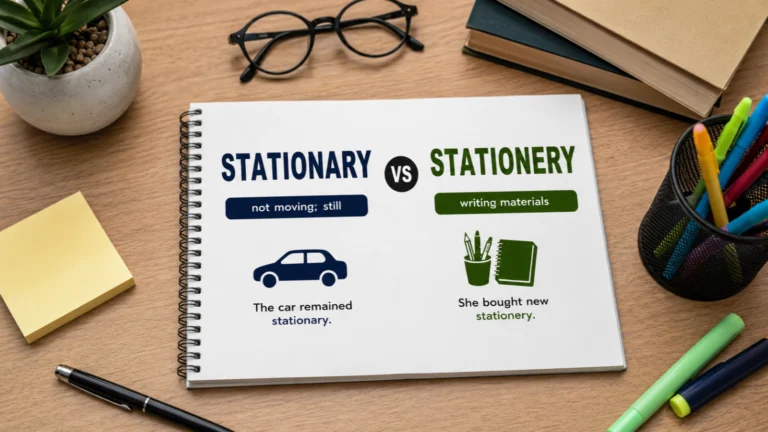
Stationary vs Stationery is one of the most commonly confused word pairs in English because the two words look almost identical but have completely different meanings. Many learners and even native speakers accidentally use one in place of the other, leading to spelling mistakes in emails, assignments, business writing, and everyday communication. Understanding the difference is simple once you know that stationary vs stationery is about distinguishing between something that does not move and writing materials like paper, pens, and envelopes. In this guide, you’ll learn the meanings, correct usage, pronunciation, examples, and easy memory tricks to avoid confusion. By the end, stationary vs stationery will be a distinction you can remember and use confidently in any situation.
Why “Stationary” and “Stationery” Are Confusing
Many people confuse stationary and stationery because they are homophones, meaning they are pronounced the same but have different meanings and spellings.
Here are the main reasons learners mix them up:
Similar Pronunciation
Both words are pronounced as /ˈsteɪʃəneri/. Since they sound identical, it is impossible to know which one is correct by listening alone.
Similar Spelling
The words differ by only one letter:
- Stationary ends with -ary
- Stationery ends with -ery
This small spelling difference makes typing mistakes very common.
Context Confusion
People often write about schools, offices, travel, or business. Since both words may appear in these situations, writers sometimes choose the wrong spelling.
Common Learner Mistakes
Some frequent errors include:
- Writing stationary shop instead of stationery shop
- Saying a notebook is stationary
- Using stationery when talking about a vehicle that is not moving
The key is remembering that one word describes movement, while the other refers to writing materials.
Stationary vs Stationery Explained Simply
Stationary means not moving or staying in one place, while stationery means writing materials such as paper, pens, envelopes, and notebooks.
One-line Distinction
Stationary = not moving.
Stationery = paper and office supplies.
Example Sentences
Stationary
- The train remained stationary for twenty minutes.
- Please keep the ladder stationary while I climb.
Stationery
- She bought colorful stationery for writing letters.
- The office ordered new stationery for all employees.
Understanding Homophones in English
What Are Homophones?
Homophones are words that sound the same but have different spellings and meanings.
Example:
- Flower
- Flour
Although they sound alike, one is a plant and the other is used for baking.
Why Homophones Cause Confusion
Homophones can easily confuse English learners because pronunciation does not reveal the correct spelling.
For example:
“I need new stationery.”
“I stayed stationary.”
Both sentences sound almost identical when spoken, but the meanings are completely different.
What Does “Stationary” Mean?
Definition and Core Meaning
Stationary is an adjective that means not moving, remaining still, or fixed in one place.
It describes people, vehicles, objects, or situations that are not changing position.
Origin and Historical Use
The word stationary comes from the Latin word stationarius, meaning “standing still” or “belonging to a station.” It entered English several centuries ago and has consistently referred to something that does not move.
Modern Usage and Synonyms
Today, stationary is commonly used in transportation, science, engineering, sports, and everyday conversation.
Synonyms
- Still
- Motionless
- Fixed
- Immobile
- Unmoving
Example Sentences
- The police car remained stationary during the inspection.
- Keep the camera stationary for a sharper picture.
- The balloon appeared stationary because the wind was calm.
- The machine stayed stationary while repairs were completed.
What Does “Stationery” Mean?
Definition and Core Meaning
Stationery is a noun that refers to writing materials and office supplies, such as paper, envelopes, notebooks, pens, folders, greeting cards, and letterheads.
Origin and Historical Context
The word stationery comes from the Medieval Latin word related to stationers, who were booksellers and sellers of writing materials. Over time, the meaning shifted to describe the writing supplies themselves.
Modern Usage and Synonyms
Today, stationery is widely used in schools, offices, businesses, and homes.
Synonyms
- Writing supplies
- Office supplies
- Paper products
- Letter-writing materials
- Writing materials
Example Sentences
- The company ordered branded stationery for its employees.
- She loves collecting beautiful stationery from different countries.
- I bought pens and notebooks from the stationery store.
- Elegant wedding stationery makes invitations look professional.
Stationary vs Stationery: Key Differences at a Glance
| Word | Part of Speech | Meaning | Example Context |
|---|---|---|---|
| Stationary | Adjective | Not moving; staying still | The car remained stationary. |
| Stationery | Noun | Writing materials and office supplies | She bought stationery for school. |
How to Remember the Difference Between Stationary and Stationery
Fortunately, there are several easy ways to remember which spelling is correct.
Easy Memory Tricks
- Stationery has an “e” for envelope.
- Stationery has an “e” for email and envelope.
- Stationary has an “a” for at rest.
Association Techniques
Imagine opening an Envelope full of paper and pens.
Both Envelope and Stationery contain the letter E, making the connection easy to remember.
One Memorable Example
“I bought stationery inside the shop, then my car stayed stationary outside.”
This sentence uses both words correctly and helps reinforce their meanings.
Common Mistakes and Confusions
Below are some mistakes that learners often make.
Wrong
“I bought beautiful stationary for school.”
Correct
“I bought beautiful stationery for school.”
Explanation: Pens and notebooks are stationery, not stationary.
Wrong
“The bicycle remained stationery.”
Correct
“The bicycle remained stationary.”
Explanation: The bicycle is not moving.
Wrong
“The office ordered new stationary.”
Correct
“The office ordered new stationery.”
Explanation: Office supplies are stationery.
Wrong
“The bus stayed stationery at the station.”
Correct
“The bus stayed stationary at the station.”
Explanation: A bus can be stationary because it is not moving.
Examples Section: Correct and Incorrect Usage
Example 1
✔ Correct: The truck remained stationary during the traffic jam.
✘ Incorrect: The truck remained stationery during the traffic jam.
Example 2
✔ Correct: Our school provides free stationery to students.
✘ Incorrect: Our school provides free stationary to students.
Example 3
✔ Correct: The helicopter appeared stationary in the sky.
✘ Incorrect: The helicopter appeared stationery in the sky.
Example 4
✔ Correct: She bought colorful stationery for her journal.
✘ Incorrect: She bought colorful stationary for her journal.
Self Assessment: Test Your Knowledge
Fill in the blanks with stationary or stationery.
- The train remained __________ for five minutes.
- I need new __________ for writing letters.
- The car stayed __________ at the traffic signal.
- She purchased beautiful __________ for her office desk.
Self Assessment Answers
- stationary
- stationery
- stationary
- stationery
FAQs About “Stationary and Stationery”
1. What is the main difference between stationary and stationery?
Stationary means not moving, while stationery refers to writing materials and office supplies.
2. Are stationary and stationery pronounced the same?
Yes. They are homophones and have the same pronunciation but different meanings and spellings.
3. Is a notebook considered stationery?
Yes. A notebook is a type of stationery.
4. Can a vehicle be stationery?
No. A vehicle can be stationary, not stationery, because it is describing movement.
5. How can I remember the correct spelling?
Remember that stationery contains the letter E, just like envelope, which is a type of stationery.
6. Is stationery singular or plural?
Stationery is an uncountable noun. We usually say:
- Some stationery
- Office stationery
We do not normally say “stationeries.”
7. Why do so many people confuse these words?
Because they sound identical, look very similar, and are often encountered in everyday writing, making spelling mistakes common.
Final Conclusion: Using “Stationary” and “Stationery” Correctly
Understanding the difference between stationary and stationery is easier once you focus on what each word actually describes. Stationary is an adjective that means something is not moving or is remaining in one place. You might use it to describe a parked car, a waiting train, or a camera that should stay still for a clear photograph. Stationery, on the other hand, is a noun that refers to writing materials and office supplies, including paper, notebooks, envelopes, pens, pencils, and greeting cards. Although these words sound exactly the same, they serve completely different purposes in English.
A simple memory trick can help you avoid mistakes every time: stationery has an “E” for envelope, and envelopes are part of your writing supplies. Meanwhile, think of stationary as meaning at rest or not in motion. Reading examples, practicing with sentences, and paying attention to context will quickly make the difference feel natural. As with many English homophones, repeated exposure is the key to mastering correct usage.
The next time you write about office supplies, choose stationery. When describing something that is not moving, choose stationary. With a little practice and the memory tips from this guide, you’ll be able to use both words confidently and accurately in everyday conversations, academic writing, and professional communication.