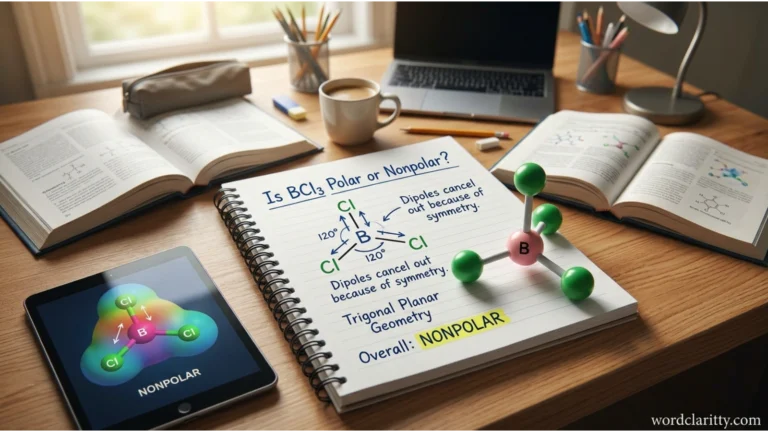
Is BCl3 polar or nonpolar? This is a common chemistry question that can confuse students and English learners studying scientific vocabulary. Boron trichloride (BCl3) contains three polar bonds, yet the molecule itself is nonpolar. That may sound surprising, especially if you have learned that differences in electronegativity create polar bonds. The key to understanding the answer is molecular geometry and how bond dipoles interact.
Learning the difference between polar and nonpolar molecules will help you understand chemical bonding, molecular shapes, and dipole moments. In this guide, you will discover why BCl3 is nonpolar, how its structure affects polarity, and how to explain the answer correctly in simple English.
Why “Polar” and “Nonpolar” Are Confusing
The terms “polar” and “nonpolar” can be confusing because they describe related but opposite chemical properties. Students sometimes assume that a molecule with polar bonds must also be polar.
However, molecular polarity depends on both bond polarity and molecular geometry.
1. Similar Pronunciation
The words “polar” and “nonpolar” sound similar because “nonpolar” contains the complete word “polar.”
Their approximate pronunciations are:
- Polar: POH-ler
- Nonpolar: non-POH-ler
The prefix “non-” changes the meaning to its opposite.
Although these words are not homophones, their similar sounds can cause confusion when students hear them in chemistry lessons.
2. Similar Spelling
The words share almost identical spelling.
- Polar: Describes an unequal distribution of electrical charge.
- Nonpolar: Describes a molecule with no permanent overall separation of positive and negative charge.
The only difference is the prefix “non-,” which means “not.”
This small addition creates an important scientific distinction.
3. Context Confusion
The greatest confusion occurs when students discuss polar bonds and polar molecules.
For example, BCl3 contains three polar B–Cl bonds because chlorine attracts shared electrons more strongly than boron.
However, BCl3 has a symmetrical trigonal planar structure.
Because its three bond dipoles cancel one another, the molecule has no permanent net dipole moment.
Therefore, BCl3 is nonpolar overall.
4. Common Learner Mistakes
Students frequently make these mistakes:
- Assuming every molecule containing polar bonds must be polar.
- Ignoring molecular shape when determining polarity.
- Confusing bond polarity with molecular polarity.
- Believing that BCl3 has a trigonal pyramidal structure.
- Assuming that boron’s incomplete octet makes BCl3 polar.
- Forgetting that dipole moments are directional quantities.
Understanding molecular geometry helps prevent these errors.
BCl3: Polar vs Nonpolar Explained Simply
BCl3 is a nonpolar molecule because it has a symmetrical trigonal planar shape, causing its three polar B–Cl bond dipoles to cancel.
Simple Explanation
Polar: A molecule is polar when its positive and negative charge distributions are uneven, producing a permanent net dipole moment.
Nonpolar: A molecule is nonpolar when it has no permanent net dipole moment.
BCl3 contains one boron atom bonded to three chlorine atoms.
Each B–Cl bond is polar because chlorine is more electronegative than boron.
However, the three bonds are arranged symmetrically around the central boron atom at approximately 120-degree angles.
Their dipole moments cancel, making the entire molecule nonpolar.
One-Line Distinction
Polar molecules have a permanent net dipole moment, while nonpolar molecules do not; BCl3 is nonpolar because its symmetrical bond dipoles cancel.
Two Example Sentences
Example 1:
“BCl3 is nonpolar because its trigonal planar structure allows the three bond dipoles to cancel.”
Example 2:
“Water is polar because its bent molecular shape prevents its bond dipoles from cancelling completely.”
These examples show why molecular shape matters when determining polarity.
Quick Answer: Is BCl3 Polar or Nonpolar?
- Molecular formula: BCl3
- Chemical name: Boron trichloride
- Molecular geometry: Trigonal planar
- Bond angle: Approximately 120°
- B–Cl bonds: Polar covalent
- Net dipole moment: Zero
- Overall molecular polarity: Nonpolar
Understanding Homophones in English
Chemistry students often encounter scientific words that look or sound similar. Understanding basic language differences can help prevent confusion when learning new terminology.
What Are Homophones?
Homophones are words that sound the same but have different meanings and often different spellings.
For example:
- Pair: Two things considered together.
- Pear: A type of fruit.
Consider these sentences:
“The scientist compared a pair of molecules.”
“She ate a pear after lunch.”
The words sound identical but have different meanings.
Other common homophones include:
- Hear and here
- Right and write
- Sea and see
- One and won
However, “polar” and “nonpolar” are not homophones because they have different pronunciations.
Why Homophones Cause Confusion
Homophones can confuse English learners because pronunciation alone may not reveal which word is intended.
For example:
“The students will write the answer.”
“The students found the right answer.”
Although “write” and “right” sound the same, they have different meanings.
The confusion between “polar” and “nonpolar” is different. These are opposite scientific terms formed using the negative prefix “non-.”
Recognizing this prefix makes their meanings easier to understand.
What Does “Polar” Mean?
Definition and Core Meaning
In chemistry, polar describes a bond or molecule with an unequal distribution of electrical charge.
A polar covalent bond forms when two bonded atoms attract shared electrons with different strengths.
This difference is related to electronegativity, which describes an atom’s tendency to attract electrons in a chemical bond.
When electrons are shared unequally, one end of the bond becomes partially negative and the other partially positive.
These partial charges are represented by:
- δ−: Partial negative charge.
- δ+: Partial positive charge.
For example, in a B–Cl bond, chlorine attracts shared electrons more strongly than boron.
Therefore:
- Boron has a partial positive charge.
- Chlorine has a partial negative charge.
- The B–Cl bond is polar.
However, the polarity of an individual bond does not automatically determine the polarity of the entire molecule.
Origin and Historical Use
The word “polar” is related to “pole,” which comes through Latin polus from Greek polos, meaning an axis or pivot.
In science, the idea of poles became important in describing magnets, electricity, and opposite ends of systems.
Chemists later applied the concept to electrical charge distribution in chemical bonds and molecules.
As atomic theory and chemical bonding models developed, scientists used dipole moments to describe the separation of positive and negative charge.
Today, molecular polarity is an important concept in chemistry because it helps explain intermolecular forces, solubility, and other physical properties.
Modern Usage and Synonyms
In modern chemistry, “polar” is commonly used in discussions of molecular structure and chemical bonding.
Related terms include:
- Polar covalent bond: A bond with unequal electron sharing.
- Dipole: A separation of positive and negative charge.
- Electronegativity difference: A factor that helps determine bond polarity.
- Partial charge: A small positive or negative charge associated with unequal electron distribution.
- Polar molecule: A molecule with a permanent net dipole moment.
These terms are related but are not exact synonyms.
Example Sentences
- “Water is a polar molecule because it has a bent shape.”
- “The B–Cl bonds in BCl3 are polar covalent bonds.”
- “A polar bond forms when electrons are shared unequally.”
- “Hydrogen chloride is a polar molecule.”
- “Molecular geometry helps determine whether a molecule is polar.”
What Does “Nonpolar” Mean?
Definition and Core Meaning
In chemistry, nonpolar describes a molecule that does not have a permanent overall separation of positive and negative charge.
A molecule may be nonpolar because its bonds are nonpolar or because its polar bond dipoles cancel through a symmetrical arrangement.
BCl3 is an example of the second situation.
It contains polar B–Cl bonds, but its trigonal planar geometry produces a zero net dipole moment.
Important characteristics of nonpolar molecules include:
- No permanent overall molecular dipole moment.
- A balanced overall charge distribution.
- Possible symmetrical arrangements of polar bonds.
- Molecular polarity that depends on geometry as well as bond polarity.
- Dispersion forces as an important type of intermolecular attraction.
Nonpolar molecules can still experience temporary fluctuations in electron distribution, which produce temporary dipoles.
Origin and Historical Context
The term “nonpolar” combines the prefix “non-,” meaning “not,” with the word “polar.”
As chemistry developed more detailed explanations of molecular bonding, scientists needed language to distinguish molecules with permanent dipole moments from those without them.
The distinction became especially useful when explaining molecular interactions, solubility, and chemical behaviour.
Modern chemistry uses electronegativity, molecular geometry, and dipole moments to determine whether a molecule is polar or nonpolar.
Modern Usage and Synonyms
Common terms related to nonpolar molecules include:
- Nonpolar molecule: A molecule with no permanent net dipole moment.
- Zero net dipole: A situation in which molecular dipoles cancel.
- Symmetrical molecule: A molecule with a balanced geometric arrangement, although symmetry alone does not always establish nonpolarity.
- Nonpolar covalent bond: A bond in which electrons are shared equally or nearly equally.
- Dipole cancellation: The balancing of bond dipoles so that the total is zero.
Example Sentences
- “BCl3 is nonpolar because its bond dipoles cancel.”
- “Carbon dioxide is nonpolar despite having polar C=O bonds.”
- “Methane is nonpolar because of its symmetrical tetrahedral geometry.”
- “A nonpolar molecule has no permanent net dipole moment.”
- “The trigonal planar shape makes BCl3 nonpolar overall.”
Polar vs Nonpolar: Key Differences at a Glance
The following table compares polar and nonpolar molecules.
| Word | Part of Speech | Meaning | Example Context |
|---|---|---|---|
| Polar | Adjective | Describes a bond or molecule with an unequal charge distribution | “Water is polar.” |
| Nonpolar | Adjective | Describes a molecule with no permanent net dipole moment | “BCl3 is nonpolar.” |
| Polar bond | Noun phrase | A bond with unequal electron sharing | “Each B–Cl bond is polar.” |
| Nonpolar molecule | Noun phrase | A molecule whose overall dipole moment is zero | “CO2 is a nonpolar molecule.” |
BCl3 Molecular Geometry and Polarity
| Property | BCl3 |
|---|---|
| Central atom | Boron |
| Surrounding atoms | Three chlorine atoms |
| Valence electrons | 24 |
| Electron-domain geometry | Trigonal planar |
| Molecular geometry | Trigonal planar |
| Bond angle | Approximately 120° |
| Lone pairs on central boron | Zero |
| Polar bonds | Yes |
| Bond dipole cancellation | Complete |
| Overall polarity | Nonpolar |
Why Is BCl3 Nonpolar?
BCl3 is nonpolar because its three identical B–Cl bonds are arranged symmetrically around the central boron atom.
Each bond has a dipole pointing toward chlorine.
However, the three dipoles are separated by approximately 120 degrees.
Because dipole moments are vectors, their directions matter.
In a symmetrical trigonal planar arrangement, the three bond dipole vectors add to zero.
Therefore, BCl3 has no permanent net molecular dipole moment.
How to Remember the Difference Between Polar and Nonpolar
A few simple memory tricks can help you identify molecular polarity more confidently.
1. Remember That “Non-” Means “Not”
The prefix “non-” means “not.”
Therefore:
- Polar: Has a permanent separation of charge.
- Nonpolar: Does not have a permanent net separation of charge.
This language trick helps you remember the basic definitions.
2. Think About Molecular Shape
Imagine three people pulling equally on an object from three directions separated by 120 degrees.
If their forces are balanced, the object experiences no overall pull.
Similarly, the three equal B–Cl bond dipoles in BCl3 cancel because of their symmetrical arrangement.
Memory trick: Symmetrical BCl3 → Balanced dipoles → Nonpolar molecule.
3. Remember the BCl3 Shape
BCl3 has a trigonal planar structure.
This means:
- Three chlorine atoms surround boron.
- All three atoms lie in the same plane as boron.
- The bond angles are approximately 120 degrees.
- The arrangement is symmetrical.
This symmetry is the main reason BCl3 is nonpolar.
4. One Memorable Example
Compare BCl3 with water.
BCl3 has a symmetrical trigonal planar structure, so its bond dipoles cancel.
Water has a bent structure, so its bond dipoles do not cancel.
Therefore:
BCl3 = Nonpolar
H2O = Polar
Remembering these two molecules provides a useful starting point for understanding molecular polarity.
Common Mistakes and Confusions
Mistake 1: Assuming Polar Bonds Always Create Polar Molecules
✘ Incorrect: “BCl3 is polar because its B–Cl bonds are polar.”
✔ Correct: “BCl3 is nonpolar because its polar bond dipoles cancel.”
Explanation: Bond polarity and molecular polarity are related but different concepts.
Mistake 2: Identifying the Wrong Molecular Shape
✘ Incorrect: “BCl3 has a trigonal pyramidal molecular shape.”
✔ Correct: “BCl3 has a trigonal planar molecular shape.”
Explanation: Boron has three bonding regions and no lone pairs in the standard Lewis structure of BCl3.
Mistake 3: Ignoring Dipole Direction
✘ Incorrect: “Three polar bonds must produce a large molecular dipole.”
✔ Correct: “Three polar bonds can cancel when arranged symmetrically.”
Explanation: Dipole moments are vectors, so their directions must be considered.
Mistake 4: Confusing BCl3 with NH3
✘ Incorrect: “BCl3 is polar because it has the same shape as NH3.”
✔ Correct: “BCl3 is trigonal planar and nonpolar, while NH3 is trigonal pyramidal and polar.”
Explanation: NH3 has a lone pair on nitrogen that affects its molecular geometry.
Mistake 5: Assuming an Incomplete Octet Causes Polarity
✘ Incorrect: “BCl3 must be polar because boron has only six electrons around it.”
✔ Correct: “BCl3 is nonpolar because its symmetrical bond dipoles cancel.”
Explanation: An incomplete octet does not automatically create a permanent molecular dipole.
Examples Section: Correct and Incorrect Usage
Example 1: Molecular Polarity
✔ Correct: “BCl3 is a nonpolar molecule.”
✘ Incorrect: “BCl3 is a polar molecule.”
Why? Its trigonal planar geometry causes complete cancellation of the bond dipoles.
Example 2: Bond Polarity
✔ Correct: “Each B–Cl bond in BCl3 is polar.”
✘ Incorrect: “Each B–Cl bond in BCl3 is nonpolar.”
Why? Chlorine is more electronegative than boron, producing unequal electron sharing.
Example 3: Molecular Geometry
✔ Correct: “BCl3 has a trigonal planar molecular geometry.”
✘ Incorrect: “BCl3 has a bent molecular geometry.”
Why? Boron forms three bonds with no lone pairs in the standard Lewis structure.
Example 4: Dipole Moment
✔ Correct: “The net dipole moment of BCl3 is zero.”
✘ Incorrect: “BCl3 has a permanent net dipole moment because it contains chlorine.”
Why? The three bond dipoles cancel because of molecular symmetry.
Example 5: Comparison with Water
✔ Correct: “Water is polar, while BCl3 is nonpolar.”
✘ Incorrect: “Water and BCl3 are both nonpolar because they contain covalent bonds.”
Why? Covalent bonding alone does not determine overall molecular polarity.
Example 6: Comparison with BF3
✔ Correct: “BF3 and BCl3 are both nonpolar molecules with trigonal planar geometry.”
✘ Incorrect: “BF3 and BCl3 must be polar because fluorine and chlorine are electronegative.”
Why? Their symmetrical molecular structures cause the bond dipoles to cancel.
Self-Assessment: Test Your Knowledge
Choose the correct answer for each question.
Question 1: BCl3 is a ___ molecule because its bond dipoles cancel.
a) Polar
b) Nonpolar
Question 2: The molecular geometry of BCl3 is ___.
a) Trigonal planar
b) Trigonal pyramidal
Question 3: Each B–Cl bond in BCl3 is ___ because chlorine attracts shared electrons more strongly than boron.
a) Polar
b) Nonpolar
Question 4: The net dipole moment of BCl3 is ___.
a) Zero
b) Nonzero
Self-Assessment Answers
Answer 1: b) Nonpolar
BCl3 is nonpolar because its symmetrical arrangement causes the bond dipoles to cancel.
Answer 2: a) Trigonal planar
BCl3 contains three bonding regions around boron and no lone pairs on the central atom.
Answer 3: a) Polar
Each B–Cl bond is polar because boron and chlorine have different electronegativities.
Answer 4: a) Zero
The three bond dipole vectors cancel, producing a zero net dipole moment.
How Did You Do?
- 4 correct: Excellent! You understand BCl3 polarity.
- 3 correct: Very good. Review the question you missed.
- 1–2 correct: Practise identifying molecular shapes and bond dipoles.
- 0 correct: Remember the key rule: BCl3 has polar bonds but is nonpolar overall.
FAQs:
1. Is BCl3 Polar or Nonpolar?
BCl3 is nonpolar. Although its three B–Cl bonds are polar, the molecule has a symmetrical trigonal planar structure that causes the bond dipoles to cancel.
2. Why Is BCl3 Nonpolar Despite Having Polar Bonds?
BCl3 is nonpolar because its three identical B–Cl bonds are arranged at approximately 120-degree angles. Their dipole moments cancel, producing no permanent net molecular dipole moment.
3. What Is the Molecular Geometry of BCl3?
BCl3 has a trigonal planar molecular geometry. The central boron atom is bonded to three chlorine atoms, with bond angles of approximately 120 degrees.
4. Does BCl3 Have a Dipole Moment?
BCl3 has individual bond dipole moments, but its overall permanent molecular dipole moment is zero because the three bond dipoles cancel.
5. Is BCl3 Ionic or Covalent?
BCl3 is a covalent molecular compound. Its B–Cl bonds involve shared electrons, although the electrons are shared unequally because chlorine is more electronegative than boron.
6. Why Is BCl3 Nonpolar but NH3 Polar?
BCl3 has a symmetrical trigonal planar structure, so its bond dipoles cancel. NH3 has a trigonal pyramidal shape because nitrogen has a lone pair, and its bond dipoles do not cancel.
7. Is BCl3 Symmetrical or Asymmetrical?
BCl3 is symmetrical. Its three chlorine atoms are arranged evenly around the central boron atom in a trigonal planar structure, producing a zero net dipole moment.
Conclusion:
Understanding whether BCl3 is polar or nonpolar becomes much easier when you examine both chemical bonding and molecular geometry. The correct answer is that boron trichloride (BCl3) is a nonpolar molecule, even though it contains three polar B–Cl bonds. This happens because chlorine attracts shared electrons more strongly than boron, creating individual bond dipoles. However, the molecule has a symmetrical trigonal planar shape, with the three bonds arranged approximately 120 degrees apart. As a result, their dipole moments cancel, leaving no permanent net molecular dipole moment.
The most important lesson is that polar bonds do not always make an entire molecule polar. A polar molecule has an uneven overall charge distribution and a permanent net dipole moment, while a nonpolar molecule has no permanent net dipole moment. Molecular geometry determines whether individual bond dipoles reinforce one another or cancel.
To remember the difference, associate polar with an unbalanced overall charge distribution and nonpolar with no permanent net dipole. For BCl3, imagine three equal arrows pointing outward in a symmetrical arrangement. Their effects balance, producing a nonpolar molecule.
This concept is useful when studying Lewis structures, VSEPR theory, intermolecular forces, chemical bonding, and molecular properties. With regular practice, identifying molecular polarity will become easier. Keep comparing molecular shapes, checking electronegativity differences, and examining dipole directions, and you will build a stronger understanding of chemistry with greater confidence.

Bilal Hassan is a Master’s graduate, content writer, and author at WordClaritty.com. He specializes in creating clear, informative, and reader-friendly content focused on language, word meanings, and educational topics. With a passion for accuracy and simplicity, he helps readers expand their knowledge through engaging and easy-to-understand articles.