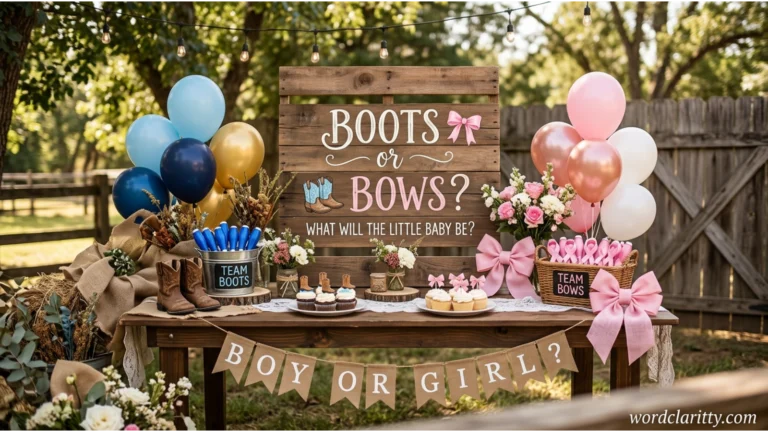
Have you seen the phrase “Boots or Bows” gender reveal on a party invitation, social media post, or baby shower decoration? If you are learning English, you might wonder what these words mean and why people use them together.
“Boots” and “bows” are different objects, but they create a popular theme for celebrating the expected arrival of a baby. In this theme, boots traditionally represent a boy, while bows represent a girl.
Understanding these words helps you recognize party expressions, choose the correct spelling, and communicate naturally. This guide explains their meanings, pronunciation, history, examples, and common mistakes in simple English.
Why “Boots” and “Bows” Are Confusing
The words “boots” and “bows” may confuse English learners because they are frequently paired in gender reveal decorations and invitations. Although their meanings are different, the phrase makes them appear closely related.
1. Similar Pronunciation
“Boots” and “bows” both begin with the letter B, but they do not have the same pronunciation.
- Boots: /buːts/ — sounds like “boots,” rhyming with “roots.”
- Bows: /boʊz/ in American English or /bəʊz/ in British English when referring to decorative ribbons — rhymes with “shows.”
Both words are short, one-syllable words. However, their vowel and ending sounds are different.
The similar initial sound makes them catchy when used together in a party slogan, but they are not homophones.
2. Similar Spelling
The words share some spelling features:
- Both begin with B.
- Both end with S.
- Both are plural nouns in the gender reveal expression.
However, they refer to completely different objects.
“Boots” contains five letters, while “bows” contains four.
Their similar appearance may make the phrase easy to remember, but it does not mean the words are interchangeable.
3. Context Confusion
The phrase “Boots or Bows?” is commonly used as a question on gender reveal invitations.
For example:
“Boots or Bows? Come celebrate our little one!”
A learner might think the invitation is asking guests to choose between footwear and hair accessories.
In reality, the phrase uses those objects as symbols in a traditional boy-or-girl gender reveal theme.
The meaning comes from the party context rather than the literal definitions alone.
4. Common Learner Mistakes
Common mistakes include:
- Thinking “boots” and “bows” mean the same thing.
- Assuming the words are homophones.
- Confusing decorative bows with the verb “bow.”
- Using “boot” instead of “boots” in the established party phrase.
- Believing that boots can only be worn by boys or bows only by girls.
- Misspelling “gender reveal” as “gender revealr.”
The standard phrase is “Boots or Bows Gender Reveal.”
Boots vs Bows Explained Simply
The difference between “boots” and “bows” is easy to understand when you look at their everyday meanings.
Boots are a type of footwear, while bows are decorative loops of ribbon or fabric.
In a traditional gender reveal theme, boots are used to suggest a boy, and bows are used to suggest a girl.
Simple Explanation
Boots: Shoes that cover the feet and usually extend above the ankles. In this party theme, cowboy boots often represent a boy.
Bows: Decorative shapes made from ribbon or fabric, often used on clothing, gifts, and hair accessories. In this theme, bows often represent a girl.
These associations are party traditions, not rules about who can wear either item.
One-Line Distinction
“Boots” means footwear, while “bows” means decorative ribbon shapes; in a Boots or Bows gender reveal, they traditionally symbolize a boy and a girl.
Two Example Sentences
Example 1: Boots
“The parents decorated one side of the party table with tiny cowboy boots.”
Here, “boots” refers to footwear used as part of the decorations.
Example 2: Bows
“The other side of the table featured pink bows and matching ribbons.”
Here, “bows” refers to decorative ribbon shapes.
Together, these objects create a recognizable gender reveal theme.
Understanding Homophones in English
Homophones are an important part of English vocabulary. Learning about them can help you recognize differences between words that sound alike.
What Are Homophones?
Homophones are words that have the same pronunciation but different meanings and often different spellings.
For example, “flower” and “flour” are homophones.
- Flower: The colourful part of a plant.
- Flour: A powder used in baking.
Consider these sentences:
- “She placed a flower in her hair.”
- “He added flour to the cake mixture.”
The words sound the same, but their meanings are different.
Other common homophones include:
- Sea and see
- Hear and here
- Right and write
- Sun and son
- One and won
However, “boots” and “bows” are not homophones because their pronunciations are different.
Why Homophones Cause Confusion
Homophones can confuse learners because pronunciation alone does not always reveal the correct spelling.
For example:
“She tied a bow.”
“He took a bow.”
Interestingly, the word “bow” itself has different pronunciations depending on its meaning.
- Bow /boʊ/: A decorative ribbon or a weapon used to shoot arrows.
- Bow /baʊ/: To bend the head or upper body as a sign of respect.
These are examples of heteronyms: words with the same spelling but different pronunciations and meanings.
In the phrase “Boots or Bows,” the word “bows” refers to decorative ribbons and is pronounced to rhyme with “shows.”
Understanding this distinction helps learners pronounce the party theme correctly.
What Does “Boots” Mean?
Definition and Core Meaning
“Boots” is the plural form of “boot,” a noun referring to footwear that covers the foot and usually extends above the ankle.
Boots are commonly worn for protection, comfort, work, fashion, and outdoor activities.
Different types include:
- Cowboy boots: Footwear traditionally associated with Western clothing.
- Rain boots: Waterproof footwear worn in wet weather.
- Winter boots: Footwear designed for cold conditions.
- Hiking boots: Strong footwear used for walking on rough ground.
- Baby boots or booties: Small footwear made for infants.
In the Boots or Bows gender reveal theme, cowboy boots are especially popular because they fit the Western or country-style decoration theme.
Origin and Historical Use
The English word “boot” developed through earlier forms influenced by Old French, including bote, referring to footwear.
Boots have been used for centuries by soldiers, riders, farmers, workers, and travellers.
Over time, different styles developed for different purposes. Cowboy boots became especially associated with Western riding culture and later became popular fashion items.
In modern party decorations, small cowboy boots are sometimes used as symbols of a baby boy in traditional gender reveal themes.
This symbolism is cultural rather than a fixed meaning of the word.
Modern Usage and Synonyms
Today, “boots” appears in everyday conversations about clothing, weather, work, sports, and fashion.
Related words include:
- Footwear: A general word for shoes and boots.
- Shoes: A broad category of footwear.
- Booties: Small or soft boots, often for babies.
- Wellies: A British informal word for Wellington boots.
- Cowboy boots: Western-style footwear.
These terms are related but are not exact synonyms in every situation.
Example Sentences
- “The baby wore tiny boots for the family photograph.”
- “She bought new boots for the winter season.”
- “The farmer wore strong boots while working outside.”
- “The gender reveal decorations included blue cowboy boots.”
- “The invitation featured a picture of boots beside a pink bow.”
- “Both boys and girls can wear cowboy boots.”
The final example is important because footwear does not determine someone’s gender.
What Does “Bows” Mean?
Definition and Core Meaning
“Bows” is the plural form of “bow.” In the Boots or Bows gender reveal theme, it refers to decorative loops made from ribbon, fabric, or similar materials.
Bows are commonly used to decorate gifts, clothing, hair accessories, and party spaces.
Examples include:
- Hair bows: Decorative ribbons worn in the hair.
- Gift bows: Ribbon decorations placed on presents.
- Baby bows: Small decorative accessories designed for babies.
- Party bows: Ribbons used in event decorations.
- Clothing bows: Decorative details attached to dresses, shirts, or other garments.
In a traditional Boots or Bows party, bows are often used to represent a girl.
However, bows are decorative accessories that anyone can use or wear.
Origin and Historical Context
The English word “bow,” when referring to a curved object or decorative loop, has roots in Old English boga, associated with bending or curved shapes.
Over time, the word developed several meanings, including an archery bow and a decorative ribbon tied into loops.
Decorative bows became popular in clothing, gift wrapping, and fashion accessories.
In modern celebrations, bows are often associated with baby clothing and party decorations.
The Boots or Bows gender reveal theme combines this familiar decorative symbol with cowboy boots to create a simple, memorable contrast.
Modern Usage and Synonyms
Today, bows are used in fashion, celebrations, gift wrapping, and interior decoration.
Related terms include:
- Ribbon: A narrow strip of fabric used for decoration.
- Hair accessory: An item worn to decorate or hold hair.
- Gift decoration: An ornament attached to a present.
- Ribbon knot: A ribbon tied into a decorative shape.
- Ornament: An object used to make something more attractive.
Not all ribbons are bows, but bows are often made from ribbon.
Example Sentences
- “The gift boxes were decorated with colourful bows.”
- “She wore two small bows in her hair.”
- “The parents chose pink bows for the party decorations.”
- “The invitation showed cowboy boots and ribbon bows.”
- “The baby wore a soft headband with a small bow.”
- “The guests decorated the table with bows and flowers.”
These examples show how “bows” can be used in everyday English and celebration-related vocabulary.
Boots vs Bows: Key Differences at a Glance
The following table explains the main differences between these two words.
| Word | Part of Speech | Meaning | Example Context |
|---|---|---|---|
| Boots | Plural noun | Footwear that covers the feet and ankles | “The cowboy wore leather boots.” |
| Boot | Singular noun | One item of this type of footwear | “The baby lost one boot.” |
| Bows | Plural noun | Decorative ribbon loops | “The gifts had pink bows.” |
| Bow | Singular noun | One decorative ribbon shape | “She tied a bow.” |
| Boots | Symbolic noun in the party theme | Traditionally represents a boy | “Boots or Bows?” |
| Bows | Symbolic noun in the party theme | Traditionally represents a girl | “The bows decorated the girl’s side of the display.” |
Which Word Is Correct?
Both “boots” and “bows” are correct English words.
The correct choice depends on what you want to describe.
- Use boots when talking about footwear.
- Use bows when talking about decorative ribbons.
- Use Boots or Bows? when referring to the traditional gender reveal theme.
The phrase works because it presents two different symbols as part of a playful party question.
How to Remember the Difference Between Boots and Bows
You can remember the meanings of these words by connecting them with simple pictures and everyday objects.
1. Boots Go on Your Feet
Think of a pair of cowboy boots.
Memory trick: Boots → Feet → Footwear
If the object is something a person wears on their feet, the correct word is “boots.”
Example:
“The cowboy wore brown boots.”
2. Bows Are Made from Ribbon
Imagine a colourful ribbon tied around a birthday present.
Memory trick: Bows → Ribbon → Decoration
If the object is a decorative loop of fabric or ribbon, the correct word is “bows.”
Example:
“The presents were decorated with bows.”
3. Connect the Words to the Party Theme
In the traditional gender reveal slogan:
- Boots often represent a boy.
- Bows often represent a girl.
This association helps explain the theme, but remember that neither object belongs exclusively to one gender.
4. One Memorable Example
Imagine a party invitation showing a pair of tiny cowboy boots on one side and a large ribbon bow on the other.
The invitation reads:
“Boots or Bows? What Will Our Little One Be?”
This picture helps you remember both the literal meanings and the symbolic use of the words.
Common Mistakes and Confusions
Several mistakes can occur when learners use “boots” and “bows,” especially in party invitations and social media captions.
Mistake 1: Confusing Footwear with Decorations
✘ Incorrect: “She tied her hair with a pair of boots.”
✔ Correct: “She tied her hair with a bow.”
Explanation: A bow can be used as a hair accessory, while boots are footwear.
Mistake 2: Using “Bows” for Shoes
✘ Incorrect: “He wore leather bows while riding his horse.”
✔ Correct: “He wore leather boots while riding his horse.”
Explanation: Cowboy boots are a type of footwear commonly associated with horse riding.
Mistake 3: Misspelling the Theme
✘ Incorrect: “Boots or Bows Gender Revealr”
✔ Correct: “Boots or Bows Gender Reveal”
Explanation: “Reveal” is the correct word for an announcement or event that makes information known. “Revealr” is not the standard spelling.
Mistake 4: Using the Wrong Pronunciation of “Bows”
✘ Incorrect for this meaning: Pronouncing “bows” like “boughs” when referring to decorative ribbons.
✔ Correct: Pronouncing “bows” to rhyme with “shows.”
Explanation: The pronunciation depends on the meaning. Decorative bows use the long “o” sound.
Mistake 5: Treating the Symbols as Rules
✘ Incorrect assumption: “Only boys can wear boots, and only girls can wear bows.”
✔ Correct understanding: “Boots and bows are objects that can be used or worn by anyone.”
Explanation: The gender reveal theme uses traditional associations, not universal rules about clothing or identity.
Examples Section: Correct and Incorrect Usage
The following examples show how to use these words correctly in different situations.
Example 1: Describing Footwear
✔ Correct: “The baby wore tiny brown boots.”
✘ Incorrect: “The baby wore tiny brown bows on his feet.”
Why? Boots are footwear, while bows are decorative accessories.
Example 2: Describing Hair Accessories
✔ Correct: “The girl wore colourful bows in her hair.”
✘ Incorrect: “The girl wore colourful boots in her hair.”
Why? Bows can decorate hair, but boots are worn on the feet.
Example 3: Writing a Gender Reveal Invitation
✔ Correct: “Boots or Bows? Join Us for Our Gender Reveal!”
✘ Incorrect: “Boots or Bows? Join Us for Our Gender Revealr!”
Why? “Gender reveal” is the correct spelling of the event name.
Example 4: Talking About Party Decorations
✔ Correct: “The table was decorated with cowboy boots and pink bows.”
✘ Incorrect: “The table was decorated with cowboy bows and pink boots,” if the intended decorations were cowboy boots and ribbon bows.
Why? The second sentence changes the objects being described. It is not automatically ungrammatical, but it does not match the intended decorations.
Example 5: Using the Singular Form
✔ Correct: “She placed a small bow on the gift.”
✘ Incorrect: “She placed a small bows on the gift.”
Why? The article “a” requires the singular noun “bow.”
Example 6: Using the Plural Form
✔ Correct: “The children wore matching boots.”
✘ Incorrect: “The children wore matching boot,” when referring to several boots.
Why? The plural noun “boots” is needed when referring to more than one boot.
Self-Assessment: Test Your Knowledge
Choose the correct word or phrase to complete each sentence.
Question 1: The cowboy wore brown leather ___ while riding his horse.
a) Boots
b) Bows
Question 2: The gift box was decorated with beautiful pink ___.
a) Boots
b) Bows
Question 3: The party invitation said, “___ or Bows? Join Us for the Big Reveal!”
a) Boots
b) Boot
Question 4: In the traditional gender reveal theme, decorative ___ are often used to represent a girl.
a) Boots
b) Bows
Self-Assessment Answers
Answer 1: Boots
“The cowboy wore brown leather boots while riding his horse.”
Boots are footwear commonly worn for riding and outdoor activities.
Answer 2: Bows
“The gift box was decorated with beautiful pink bows.”
Bows are decorative loops often made from ribbon.
Answer 3: Boots
“The party invitation said, ‘Boots or Bows? Join Us for the Big Reveal!’”
“Boots or Bows” is the familiar wording of the theme.
Answer 4: Bows
“In the traditional gender reveal theme, decorative bows are often used to represent a girl.”
The expression uses bows as a traditional symbol, not as a rule about what girls must wear.
FAQs:
1. What Does “Boots or Bows” Mean in a Gender Reveal?
“Boots or Bows” is a popular gender reveal party theme. Boots traditionally symbolize a boy, while bows symbolize a girl. The phrase is often used on invitations, banners, cakes, and decorations.
2. Is It “Boots or Bows” or “Boots and Bows”?
Both phrases are grammatically correct, but they serve different purposes. “Boots or Bows?” is commonly used as a playful question about the expected baby’s sex, while “boots and bows” can simply describe both types of decorations together.
3. What Colours Are Used for a Boots or Bows Gender Reveal?
Traditional decorations often use blue for boots and pink for bows. However, many families choose neutral colours such as beige, white, brown, gold, or green, especially for Western-themed celebrations.
4. Are Boots and Bows Homophones?
No. “Boots” and “bows” have different pronunciations and meanings. They share an initial “b” sound but are not pronounced alike.
5. How Do You Pronounce “Bows” in Boots or Bows?
In this theme, “bows” refers to decorative ribbons and is pronounced /boʊz/ in American English, rhyming with “shows” and “knows.”
6. What Are Some Boots or Bows Gender Reveal Ideas?
Common ideas include cowboy-themed invitations, miniature boot decorations, ribbon bows, themed cakes, matching table displays, and a surprise announcement using coloured confetti or balloons.
7. Is “Boots or Bows Gender Reveal” Grammatically Correct?
Yes. “Boots or Bows Gender Reveal” is a natural and understandable name for this party theme. For an invitation, “Boots or Bows? Join Us for a Gender Reveal!” is an especially clear option.
Conclusion:
Understanding the difference between “boots” and “bows” helps English learners improve their vocabulary while also recognizing a familiar celebration theme. Although these words are sometimes used together, they have completely different meanings. Boots are a type of footwear worn on the feet, while bows are decorative loops usually made from ribbon or fabric. Both are correct English words, but they should be used according to the object or situation being described.
In a traditional Boots or Bows gender reveal, cowboy boots are often used to represent a boy, while ribbon bows are used to represent a girl. This creates a playful contrast for party invitations, banners, cakes, and decorations. However, these are cultural symbols rather than fixed rules about gender, and anyone can wear boots or bows.
To remember the difference, use two simple associations: boots belong on feet, and bows are made from ribbon. You can also picture a Western-themed invitation with cowboy boots on one side and decorative bows on the other. This memorable image connects the literal meanings with the party expression.
When writing an invitation or social media caption, remember that the standard spelling is “Boots or Bows Gender Reveal,” not “Gender Revealr.” Pay attention to pronunciation, spelling, and context to make your writing clear and natural. With regular reading and sentence practice, confusing English expressions become much easier to understand. Keep exploring new vocabulary, using examples in everyday conversations, and building your confidence one word at a time.