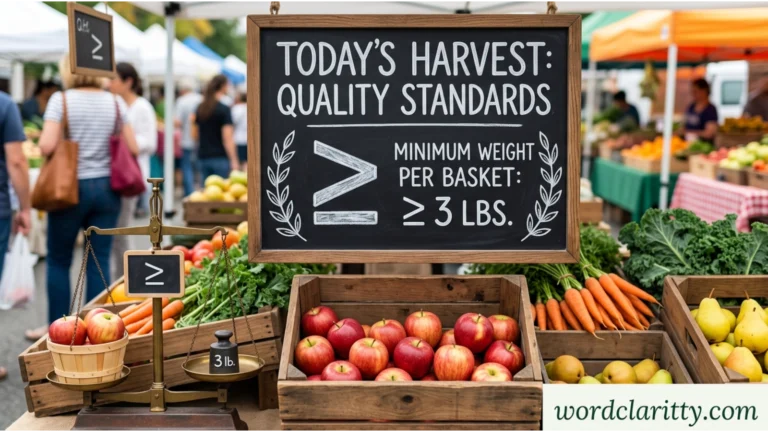
English learners often confuse “than” and “then” because the two words sound very similar in everyday speech. This confusion becomes especially common in mathematical expressions such as “greater than or equal to.” Some people mistakenly write “greater then or equal to,” even though then has a completely different meaning.
Understanding the difference matters because a single word can change the meaning of a sentence. In mathematics, science, education, and everyday English, using than correctly helps you communicate comparisons clearly. The good news is that the rule is simple: use than when comparing things, and use then when talking about time, sequence, or what happens next.
Why “Than” and “Then” Are Confusing
Than and then are frequently mixed up because they look and sound very similar. For English learners, this can make the difference difficult to notice, particularly when speaking.
Here are the main reasons for the confusion:
- Similar pronunciation: In many accents, than and then sound almost identical.
- Similar spelling: Both words begin with th and contain similar letters.
- Context confusion: Learners may remember the sound but forget which spelling belongs to a comparison or a sequence.
- Common learner mistakes: People often write then when they mean than, especially in expressions such as “better than,” “more than,” and “greater than.”
For example:
- Correct: 10 is greater than 5.
- Incorrect: 10 is greater then 5.
The second sentence may be understandable, but then is not grammatically correct in this comparison.
Than vs. Then Explained Simply
The easiest way to understand these words is to focus on their jobs in a sentence.
Than is mainly used to compare two people, things, amounts, or ideas.
Then is mainly used to talk about time, order, or the next action.
One-line distinction
Than = comparison; Then = time or sequence.
Examples
- My car is faster than yours.
- Finish your homework, then watch television.
A useful way to identify the correct word is to ask yourself a question:
- Are you comparing something? → Use than.
- Are you talking about what happens next or when something happens? → Use then.
This simple test works in most everyday situations.
Understanding Homophones in English
What Are Homophones?
Homophones are words that sound the same or very similar but have different meanings and spellings.
For example:
- right — correct or opposite of left
- write — to form words using letters
Another commonly confused pair is than and then. Although their pronunciation is not exactly identical for every English speaker, they can sound extremely similar, making them easy to confuse.
Why Homophones Cause Confusion
When you hear a word, you do not see its spelling. Therefore, if two words have similar pronunciation, it is easy to choose the wrong spelling when writing.
For example, someone may hear:
“The blue car is faster than the red car.”
If the speaker says than quickly, a learner might later write:
“The blue car is faster then the red car.”
The meaning is still understandable, but the spelling and grammar are incorrect because the sentence makes a comparison.
What Does “Than” Mean?
Definition and Core Meaning
Than is a conjunction or preposition commonly used to introduce the second part of a comparison.
It appears after comparative words such as:
- better
- bigger
- smaller
- faster
- slower
- older
- younger
- more
- less
- greater
- fewer
The key idea is comparison.
For example:
Sarah is taller than Maria.
This sentence compares Sarah’s height with Maria’s height.
Origin and Historical Use
The word than has a long history in English. It developed from older forms of English and has traditionally been associated with comparison. Its modern spelling and grammatical function became established over centuries as English changed.
Today, than is one of the most common words used in comparative expressions.
Modern Usage and Synonyms
There is no perfect synonym for than in every sentence because it performs a specific grammatical function. However, comparison can sometimes be expressed with phrases such as compared with, in comparison with, or relative to.
For example:
- This book is cheaper than that one.
- This book is cheaper compared with that one.
The first version is shorter and more natural in ordinary English.
Common uses of “than”
- Use than after comparative adjectives.
- Use than when comparing quantities.
- Use than in mathematical comparisons.
- Use than after words such as more, less, fewer, and greater.
Example Sentences
- My brother is older than me.
- This test is easier than the previous one.
- She earns more than her colleague.
- Five is greater than three.
- The temperature is less than 10 degrees.
- This number is greater than or equal to 20.
The last example is particularly important in mathematics.
“Greater than or equal to” means that a value can either be greater than another value or exactly the same.
For example:
x ≥ 10
This can be read as:
x is greater than or equal to 10.
Therefore, “greater than or equal to” is correct, while “greater then or equal to” is incorrect.
What Does “Then” Mean?
Definition and Core Meaning
Then is an adverb that commonly refers to time, sequence, or a result.
It can mean:
- at that time
- next
- afterward
- in that case
- as a consequence
For example:
First, wash your hands. Then, prepare the food.
Here, then tells us what happens next.
Origin and Historical Context
Then comes from Old English and has been used for centuries to describe a particular time or sequence of events. Its meaning has developed over time, but its connection with time and order remains central to modern English.
Modern Usage and Synonyms
Depending on the context, then can be replaced by words or phrases such as:
- next
- afterward
- later
- at that time
- in that case
For example:
Finish the report, then send it to me.
can also be expressed as:
Finish the report, and afterward send it to me.
However, then is much more natural in many everyday sentences.
Common uses of “then”
- Use then to describe the next step.
- Use then to describe something that happened at a particular time.
- Use then when telling a story in chronological order.
- Use then to introduce a result or consequence.
Example Sentences
- I lived in London then.
- First, we had dinner; then we went home.
- If you are ready, then we can begin.
- She finished her work and then called her friend.
- He was younger then.
Notice that the final example refers to a past time. It does not compare his age with another person’s age.
Than vs. Then: Key Differences at a Glance
| Word | Part of Speech | Meaning | Example Context |
|---|---|---|---|
| Than | Conjunction / preposition | Used for comparison | “Ali is taller than Ahmed.” |
| Then | Adverb | Refers to time, order, or consequence | “Finish your work then take a break.” |
The mathematical expression
The phrase “greater than or equal to” uses than because it describes a comparison.
For example:
x ≥ 5
means:
x is greater than or equal to 5.
Possible values include 5, 6, 7, 8, and so on, depending on the number system being used.
The phrase “greater then or equal to” is not the correct standard English expression.
How to Remember the Difference Between Than and Then
A few memory tricks can make the distinction much easier.
Memory Trick 1: A in “Than” = Comparison
Think:
ThAN → compArison
The letter A can remind you of comparing two things.
Examples:
- bigger than
- smaller than
- faster than
- greater than
Memory Trick 2: E in “Then” = Events
Think of the E in then as standing for event.
When events happen in order, use then:
First → then → next
For example:
First, study. Then take the test.
Memory Trick 3: Look for a Comparative Word
If you see words such as:
- more
- less
- better
- worse
- bigger
- smaller
- greater
- fewer
you will often need than.
For example:
This box is bigger than that box.
One Memorable Example
Remember this pair:
Ali is taller than Ahmed. Then they went home.
The first than compares their heights.
The second then describes what happened afterward.
That single sentence shows the difference clearly.
Common Mistakes and Confusions
Mistake 1: Using “then” in a comparison
Wrong:
My phone is better then yours.
Correct:
My phone is better than yours.
Why?
The sentence compares two phones, so than is required.
Mistake 2: Writing “greater then or equal to”
Wrong:
x is greater then or equal to 10.
Correct:
x is greater than or equal to 10.
Why?
The mathematical phrase describes a comparison between the value of x and 10.
Mistake 3: Using “than” for sequence
Wrong:
First, open the file, than click the button.
Correct:
First, open the file, then click the button.
Why?
The sentence describes two actions in sequence. Nothing is being compared.
Mistake 4: Confusing “then” with a comparative structure
Wrong:
She is more experienced then her manager.
Correct:
She is more experienced than her manager.
The word more signals a comparison, so than is needed.
Examples Section: Correct and Incorrect Usage
Example 1: Comparison
✔ Correct: This building is taller than the one next to it.
✘ Incorrect: This building is taller then the one next to it.
Explanation: The sentence compares the height of two buildings.
Example 2: Mathematical comparison
✔ Correct: A number greater than or equal to 50 satisfies the condition.
✘ Incorrect: A number greater then or equal to 50 satisfies the condition.
Explanation: The phrase greater than or equal to is a comparison used in mathematics.
Example 3: Sequence
✔ Correct: Finish your breakfast, then leave for school.
✘ Incorrect: Finish your breakfast, than leave for school.
Explanation: The sentence tells us what happens next, so then is correct.
Example 4: Time
✔ Correct: I was living in Canada then.
✘ Incorrect: I was living in Canada than.
Explanation: Here, then refers to a particular time in the past.
Example 5: Comparison
✔ Correct: This exercise is easier than the last one.
✘ Incorrect: This exercise is easier then the last one.
Explanation: The two exercises are being compared.
Example 6: Sequence
✔ Correct: First, read the instructions. Then answer the questions.
✘ Incorrect: First, read the instructions. Than answer the questions.
Explanation: The actions happen one after another.
Self Assessment: Test Your Knowledge
Fill in each blank with than or then.
- My sister is younger ______ me.
- First, complete the form; ______ submit it.
- Ten is greater ______ five.
- He lived in Paris ______.
Take a moment to answer each question before checking the solutions.
Self Assessment Answers
- than — The sentence compares the ages of two people.
- then — It describes the next action.
- than — It compares the numbers 10 and 5.
- then — It refers to a particular time in the past.
Quick rule
Comparison = than
Time or sequence = then
FAQs:
1. Is “greater than or equal to” correct?
Yes. “Greater than or equal to” is the correct expression. It is commonly used in mathematics to describe a value that is either larger than another value or exactly equal to it.
2. Is “greater then or equal to” correct?
No. “Greater then or equal to” is incorrect in standard English. The correct phrase is “greater than or equal to.”
3. What is the difference between “than” and “then”?
Than is mainly used for comparisons, while then is mainly used for time, sequence, or consequences.
4. Should I use “than” after “greater”?
Yes. The standard expression is “greater than.”
For example:
8 is greater than 3.
You also use it in:
greater than or equal to
5. How can I remember “than” vs. “then”?
Remember:
Than = comparison
Then = next or at that time
If you are comparing two things, choose than. If you are describing what happens next, choose then.
6. Is “than” a preposition or conjunction?
Than can function as a conjunction or preposition depending on how it is used in a sentence. For English learners, however, the most useful point is that it introduces a comparison.
7. Is “then” only used for time?
No. Although then often refers to time or sequence, it can also mean “in that case.”
For example:
If you don’t want to go, then I will go alone.
Here, then introduces a consequence rather than simply describing time.
Conclusion:
The difference between than and then is small in spelling but important in meaning. Than is used mainly when comparing people, objects, numbers, amounts, or ideas. That is why the correct mathematical expression is “greater than or equal to.” For example, x ≥ 10 means that x can be 10 or any value greater than 10. On the other hand, then is generally used for time, order, sequence, or a consequence. For example, “Finish your homework, then watch TV” tells us what should happen next.
When you are unsure, use the simple rule: comparison = than; time or sequence = then. Words such as greater, better, more, less, faster, and smaller often signal a comparison and therefore take than. Words such as first, next, afterward, or instructions involving steps often point toward then.
Most importantly, remember that “greater then or equal to” is incorrect, while “greater than or equal to” is correct. With a little practice, this common English confusion becomes easy to avoid. Keep looking at the meaning of the sentence rather than relying only on pronunciation, and you will quickly become more confident using than and then correctly.