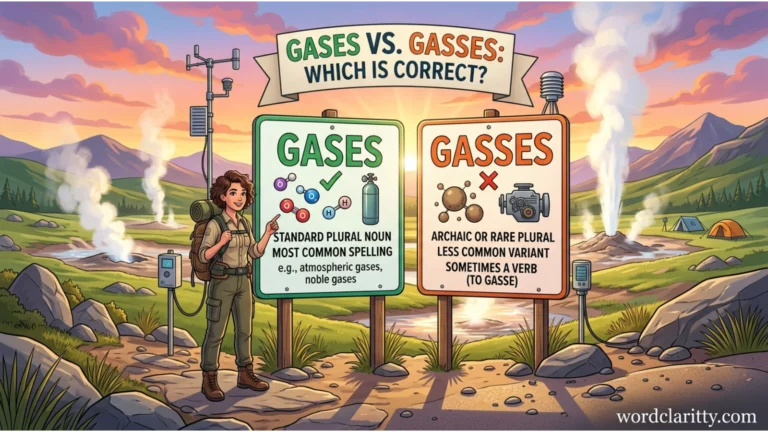
Gases vs Gasses is one of the most confusing spelling questions for English learners because both forms look similar but are used in different contexts. Many students wonder whether ‘gases’ or ‘gasses’ is correct, especially when writing science terms or everyday English. Understanding Gases vs Gasses helps improve spelling accuracy and boosts confidence in writing. In simple terms, ‘gases’ is the standard plural form of gas used in science and general usage, while ‘gasses’ is rarely used and usually appears as a verb form meaning to release gas or behave in a certain way. Gases vs Gasses often appears in exams, articles, and SEO content, making it important to learn the difference clearly. This guide will help you understand both forms with easy explanations and examples.
Why “Gases” and “Gasses” Are Confusing
There are several reasons why English learners mix up gases and gasses.
Similar Pronunciation
Both words are pronounced almost the same in everyday speech. Because of this, many people assume they are simply different spellings of one word.
Similar Spelling
The only visible difference is the extra s in gasses. Such a small spelling change can easily go unnoticed.
Context Confusion
The word gases usually refers to more than one gas, such as oxygen and nitrogen. Meanwhile, gasses is a verb form related to exposing someone to gas or talking excessively in informal English. Since both appear in similar contexts, confusion can occur.
Common Learner Mistakes
Many learners:
- Use gasses as the plural of gas.
- Assume both spellings are equally acceptable.
- Write gasses in scientific or academic contexts where gases is required.
- Misunderstand that one word is usually a noun and the other is often a verb.
Gases vs Gasses Explained Simply
Gases means more than one gas, while gasses is usually a verb meaning “exposes to gas” or “talks excessively.”
One-Line Distinction
Gases = plural noun; Gasses = verb form.
Example Sentences
- The Earth’s atmosphere contains many gases.
- The factory releases harmful gases into the air.
- The soldier gasses the area during training exercises.
- He always gasses on about his latest achievements.
Understanding Homophones in English
What Are Homophones?
Homophones are words that sound the same or nearly the same but have different meanings and spellings.
Example:
- Sea
- See
These words sound alike but have different meanings.
Why Homophones Cause Confusion
English learners often rely on pronunciation when learning vocabulary. As a result, words that sound alike can be mixed up in writing.
For example:
- Their
- There
Although they sound similar, they have different meanings and uses. The same challenge can occur with gases and gasses.
What Does “Gases” Mean?
Definition and Core Meaning
Gases is the plural form of the noun gas.
It refers to two or more substances in a gaseous state, such as oxygen, hydrogen, helium, or carbon dioxide.
Origin and Historical Use
The word gas originated in the 17th century and was introduced by the Flemish chemist Jan Baptist van Helmont. Over time, the regular English plural form gases became the standard way to refer to multiple gases.
Modern Usage and Synonyms
Today, gases is widely used in:
- Science
- Chemistry
- Physics
- Environmental studies
- Everyday conversation
Synonyms and Related Terms
- Vapors
- Fumes
- Emissions
- Airborne substances
Key Points
- It is a plural noun.
- It refers to more than one gas.
- It is the correct form in scientific writing.
- It is much more common than gasses.
Example Sentences
- Greenhouse gases contribute to climate change.
- Several gases were detected during the experiment.
- Noble gases include helium and neon.
- The laboratory stores different gases in separate containers.
What Does “Gasses” Mean?
Definition and Core Meaning
Gasses is generally the third-person singular form of the verb to gas.
It can mean:
- To expose someone or something to gas.
- To kill or harm using gas.
- Informally, to talk excessively or enthusiastically.
Origin and Historical Context
The verb gas developed after the noun became common. It gained various meanings over time, including military, industrial, and informal conversational uses.
In modern English, gasses appears much less frequently than gases.
Modern Usage and Synonyms
Depending on context, synonyms may include:
- Exposes
- Fumigates
- Poisons
- Chats
- Talks
Key Points
- It is usually a verb.
- It is not the standard plural of gas.
- It appears less frequently in writing.
- It often describes an action.
Example Sentences
- The technician gasses the chamber before testing.
- The farmer gasses storage areas to remove pests.
- She gasses on for hours about her travel adventures.
- The system automatically gasses the enclosed area during the procedure.
Gases vs Gasses: Key Differences at a Glance
| Word | Part of Speech | Meaning | Example Context |
|---|---|---|---|
| Gases | Noun (plural) | More than one gas | Greenhouse gases affect the climate. |
| Gasses | Verb | Exposes to gas or talks excessively | He gasses on about sports all day. |
How to Remember the Difference Between Gases and Gasses
Learning a simple memory trick can make this distinction easy.
Easy Memory Tricks
Gases = Things
If you are talking about actual substances such as oxygen, nitrogen, or carbon dioxide, use gases.
Gasses = Action
If someone is doing something, such as exposing an area to gas or talking excessively, use gasses.
Association Technique
Think:
- Gases = Group of gases
- Gasses = Someone does something
The extra s can remind you of an action performed by a single person in the third-person singular form.
Memorable Example
- The scientist studies different gases. ✔
- The technician gasses the container. ✔
One refers to substances; the other refers to an action.
Common Mistakes and Confusions
Mistake 1
❌ The laboratory stores several gasses.
✔ The laboratory stores several gases.
Explanation: The sentence refers to multiple gas substances, so the plural noun gases is required.
Mistake 2
❌ The atmosphere contains many gasses.
✔ The atmosphere contains many gases.
Explanation: This is a scientific context involving multiple gases.
Mistake 3
❌ He gases the chamber before testing.
✔ He gasses the chamber before testing.
Explanation: Here the word functions as a verb, not a plural noun.
Mistake 4
❌ She studies greenhouse gasses.
✔ She studies greenhouse gases.
Explanation: Greenhouse gases are substances, so the noun form is needed.
Examples Section: Correct and Incorrect Usage
Example 1
✔ Correct: Scientists analyzed several gases in the sample.
✘ Incorrect: Scientists analyzed several gasses in the sample.
Example 2
✔ Correct: The machine gasses the container automatically.
✘ Incorrect: The machine gases the container automatically.
Example 3
✔ Correct: Greenhouse gases trap heat in the atmosphere.
✘ Incorrect: Greenhouse gasses trap heat in the atmosphere.
Example 4
✔ Correct: He gasses on endlessly about his favorite team.
✘ Incorrect: He gases on endlessly about his favorite team.
Example 5
✔ Correct: Different gases react differently under pressure.
✘ Incorrect: Different gasses react differently under pressure.
Example 6
✔ Correct: The technician gasses the equipment before use.
✘ Incorrect: The technician gases the equipment before use.
Self Assessment: Test Your Knowledge
Fill in the blanks with gases or gasses.
1.
The atmosphere contains several important ________.
2.
The operator ________ the testing chamber before beginning the experiment.
3.
Scientists measured greenhouse ________ in the region.
4.
He always ________ on about his new business ideas.
Self Assessment Answers
1.
gases
2.
gasses
3.
gases
4.
gasses
FAQs About “Gases and Gasses”
1. Is “gases” or “gasses” the correct plural of gas?
Gases is the correct and standard plural form of gas.
2. Why do some people write “gasses”?
Because gasses is a valid verb form, some writers mistakenly use it as a plural noun.
3. Is “gasses” a real word?
Yes. It is the third-person singular form of the verb gas.
4. Which form is more common in English?
Gases is far more common because it is frequently used in science, education, and everyday communication.
5. Can “gasses” mean talking a lot?
Yes. In informal English, gasses can mean talking excessively or enthusiastically.
6. Is “greenhouse gasses” correct?
No. The correct term is greenhouse gases.
7. Should I use “gases” in academic writing?
Yes. Scientific and academic writing almost always uses gases when referring to multiple gaseous substances.
Final Conclusion: Using “Gases” and “Gasses” Correctly
Understanding the difference between gases and gasses is easier once you know their grammatical roles. Gases is the standard plural noun of gas and refers to multiple gaseous substances such as oxygen, hydrogen, carbon dioxide, and other elements or compounds. It is the form you will encounter most often in science, education, environmental discussions, and everyday writing. Gasses, on the other hand, is usually a verb form that describes the action of exposing something to gas or, in informal speech, talking excessively about a topic.
The simplest way to remember the distinction is to think of gases as “things” and gasses as “actions.” If you are naming substances, choose gases. If someone or something is performing an action involving gas, choose gasses. This small difference can make your writing clearer and more professional.
As you continue learning English, remember that many confusing word pairs become easier with practice and exposure. Reading carefully, noticing context, and reviewing examples will help you build confidence. The more you encounter words like gases and gasses in real-life situations, the more natural the correct choice will become. Keep practicing, stay curious, and enjoy expanding your English vocabulary one word at a time.