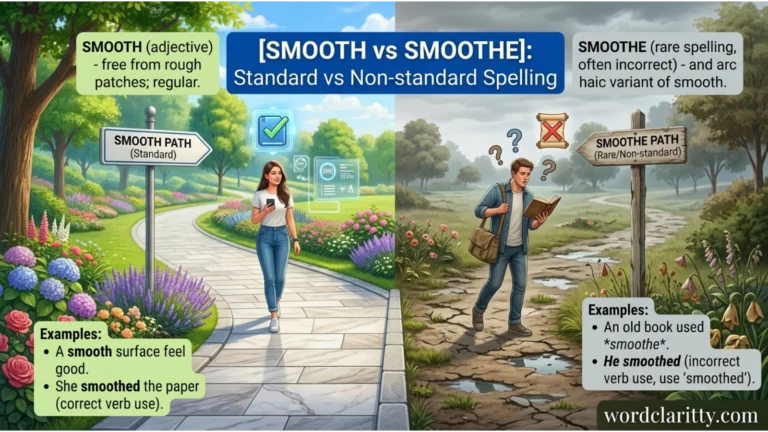
Smoothe vs smooth is a common point of confusion for English learners because the two words look almost identical and are related in meaning. At first glance, many people assume they are simply different spellings of the same word. However, their usage is not exactly the same. Understanding the difference between smoothe and smooth can help you write more accurately and avoid mistakes in formal and everyday English. While one form is widely used in modern English, the other is much less common and often appears in specific contexts. In this guide, you’ll learn the meanings, history, usage, examples, and easy memory tricks to help you use these words correctly every time.
Table of Contents
- Introduction
- Why “Smoothe” and “Smooth” Are Confusing
- Smoothe vs Smooth Explained Simply
- Understanding Homophones in English
- What Are Homophones?
- Why Homophones Cause Confusion
- What Does “Smoothe” Mean?
- What Does “Smooth” Mean?
- Smoothe vs Smooth: Key Differences at a Glance
- How to Remember the Difference Between Smoothe and Smooth
- Common Mistakes and Confusions
- Examples Section: Correct and Incorrect Usage
- Self Assessment: Test Your Knowledge
- Self Assessment Answers
- FAQs About “Smoothe and Smooth”
- Final Conclusion: Using “Smoothe” and “Smooth” Correctly
Why “Smoothe” and “Smooth” Are Confusing
Many English learners mix up smoothe and smooth because they are closely related words.
Similar Pronunciation
Both words are pronounced almost the same way in modern English. This makes it difficult for learners to distinguish them when listening or speaking.
Similar Spelling
The only visible difference is the extra “e” at the end of smoothe. Because of this small spelling variation, many people assume both words can be used interchangeably.
Context Confusion
The word smooth is commonly used as an adjective and sometimes as a verb. Meanwhile, smoothe is an older and less common verb form. Learners often see both forms and become unsure which one is correct.
Common Learner Mistakes
Some frequent errors include:
- Writing smoothe surface instead of smooth surface
- Using smoothe as an adjective
- Assuming smoothe is simply a British spelling of smooth
- Replacing smooth with smoothe in everyday writing
Smoothe vs Smooth Explained Simply
Smooth means free from roughness, even, or flowing easily, while smoothe is a less common verb meaning to make something smooth.
One-Line Distinction
Smooth is the standard modern word, while smoothe is an uncommon verb form meaning “to make smooth.”
Example Sentences
- The table has a smooth surface.
- Her presentation was smooth and professional.
- He used sandpaper to smoothe the wooden edge.
- Workers tried to smoothe the rough concrete.
Understanding Homophones in English
What Are Homophones?
Homophones are words that sound the same but have different meanings or spellings.
Example:
- Flower
- Flour
These words are pronounced similarly but mean different things.
Why Homophones Cause Confusion
When two words sound alike, learners may choose the wrong spelling while writing.
For example:
- Their house is large.
- There is a book on the table.
Although their and there sound similar, they serve different purposes. The same kind of confusion can occur with smoothe and smooth because their pronunciation is nearly identical.
What Does “Smoothe” Mean?
Definition and Core Meaning
Smoothe is a verb that means to make something smooth or smoother.
It is considered an older or less common variant of the verb smooth.
Origin and Historical Use
The word developed from older English forms related to the adjective smooth. Historically, some writers used smoothe as a verb to distinguish the action from the adjective.
Over time, however, the verb smooth became much more common, causing smoothe to fall out of regular use.
Modern Usage and Synonyms
Today, smoothe appears only occasionally in literature, specialized writing, or older texts.
Synonyms:
- Polish
- Refine
- Flatten
- Even out
- Soften
Key Points
- Usually functions as a verb.
- Means “to make smooth.”
- Rare in modern English.
- Often replaced by the verb smooth.
Example Sentences
- The craftsman carefully smoothed the wooden surface.
- She tried to smoothe the wrinkles from the fabric.
- Workers worked to smoothe the road before opening it.
- The editor helped smoothe the transitions between chapters.
What Does “Smooth” Mean?
Definition and Core Meaning
Smooth is the standard modern English word that commonly functions as an adjective.
It describes something that is:
- Even
- Flat
- Not rough
- Easy and effortless
It can also be used as a verb meaning to make smooth.
Origin and Historical Context
The word comes from Old English roots meaning even, gentle, or free from roughness. It has remained a common and important part of English vocabulary for centuries.
Modern Usage and Synonyms
Synonyms as an adjective:
- Even
- Sleek
- Polished
- Soft
- Flat
Synonyms as a verb:
- Flatten
- Polish
- Refine
- Improve
- Ease
Key Points
- Extremely common in modern English.
- Can be an adjective or a verb.
- Preferred spelling in nearly all situations.
- Used in both formal and informal writing.
Example Sentences
- The marble floor feels smooth.
- His voice remained smooth throughout the speech.
- She used a cloth to smooth the paint.
- We need to smooth the rough edges of the project plan.
Smoothe vs Smooth: Key Differences at a Glance
| Word | Part of Speech | Meaning | Example Context |
|---|---|---|---|
| Smoothe | Verb | To make something smooth | They used tools to smoothe the surface. |
| Smooth | Adjective, Verb | Even, not rough; to make smooth | The road is smooth. / Smooth the paper carefully. |
How to Remember the Difference Between Smoothe and Smooth
Here are some simple memory tricks.
Easy Memory Tricks
- Smooth is the everyday word.
- If you’re unsure, choose smooth.
- Extra “e” = extra rarity.
- The extra letter in smoothe reminds you that it is the less common form.
- Think of modern English.
- Modern writers almost always use smooth.
Association Techniques
Associate smooth with common phrases:
- Smooth skin
- Smooth ride
- Smooth conversation
- Smooth surface
These expressions always use smooth, not smoothe.
One Memorable Example
The smooth road gave us a smooth ride.
Since both uses are common and correct, this sentence helps reinforce the standard spelling.
Common Mistakes and Confusions
Wrong Example
❌ The glass has a smoothe finish.
Correct Version
✔ The glass has a smooth finish.
Explanation: Here the word describes a surface, so the adjective smooth is required.
Wrong Example
❌ She has a smoothe voice.
Correct Version
✔ She has a smooth voice.
Explanation: Voice quality is described using the adjective smooth.
Wrong Example
❌ Please smoothe out the wrinkles.
Correct Version
✔ Please smooth out the wrinkles.
Explanation: Modern English usually prefers smooth as the verb.
Wrong Example
❌ The road became smoothe after repairs.
Correct Version
✔ The road became smooth after repairs.
Explanation: The word describes the road, making it an adjective.
Examples Section: Correct and Incorrect Usage
Example 1
✔ Correct: The smooth stone fit comfortably in my hand.
✘ Incorrect: The smoothe stone fit comfortably in my hand.
Example 2
✔ Correct: We need to smooth the rough edges.
✘ Incorrect: We need to smoothe the rough edges. (Rare and generally avoided in modern usage.)
Example 3
✔ Correct: Her speech was smooth and confident.
✘ Incorrect: Her speech was smoothe and confident.
Example 4
✔ Correct: The technician used a machine to smooth the metal.
✘ Incorrect: The technician used a machine to smooth the smooth metal.
Example 5
✔ Correct: The baby has smooth skin.
✘ Incorrect: The baby has smoothe skin.
Example 6
✔ Correct: Try to smooth out the folds in the fabric.
✘ Incorrect: Try to smoothe out the folds in the fabric.
Self Assessment: Test Your Knowledge
Fill in the blanks with smoothe or smooth.
- The lake looked perfectly ______ on a calm morning.
- Please ______ the wrinkles from the paper.
- Her performance was incredibly ______ and professional.
- The workers tried to ______ the rough surface before painting.
Self Assessment Answers
- smooth
- smooth (preferred modern usage)
- smooth
- smooth (preferred modern usage; smoothe is historically possible but uncommon)
FAQs About “Smoothe and Smooth”
1. Is smoothe a real word?
Yes. Smoothe is a real English word, but it is uncommon and mainly used as a verb meaning “to make smooth.”
2. Which spelling is more common: smoothe or smooth?
Smooth is far more common and is the preferred spelling in modern English.
3. Can smooth be used as a verb?
Yes. You can say smooth the surface or smooth out the wrinkles.
4. Is smoothe an adjective?
Generally, no. The adjective form is smooth.
5. Should I use smoothe in modern writing?
In most cases, no. Modern English writers typically use smooth for both adjective and verb forms.
6. Are smoothe and smooth pronounced differently?
Usually, they are pronounced the same or nearly the same.
7. Is smoothe considered incorrect?
Not exactly. It is a valid word, but it is uncommon and often replaced by smooth in contemporary English.
Final Conclusion: Using “Smoothe” and “Smooth” Correctly
Understanding the difference between smoothe and smooth is easier once you know how each word functions in English. The word smooth is the standard and widely accepted form used today. It commonly describes something that is even, polished, gentle, or free from roughness. It can also function as a verb, meaning to make something smoother. In contrast, smoothe is an older and much less common verb form that also means “to make smooth.” While it is not technically wrong, it rarely appears in modern writing and speech.
In real-world English, you will almost always encounter and use smooth. Whether you are talking about a smooth surface, a smooth journey, a smooth voice, or smoothing out problems, this spelling is the one native speakers expect to see. A simple memory trick is to remember that smooth is the everyday word, while smoothe is the rare historical variant with an extra letter.
The more you read, write, and practice English, the easier these distinctions become. Small spelling differences can sometimes create confusion, but learning them helps improve both accuracy and confidence. Keep practicing, pay attention to context, and you’ll soon use smooth and smoothe correctly without even thinking about it.