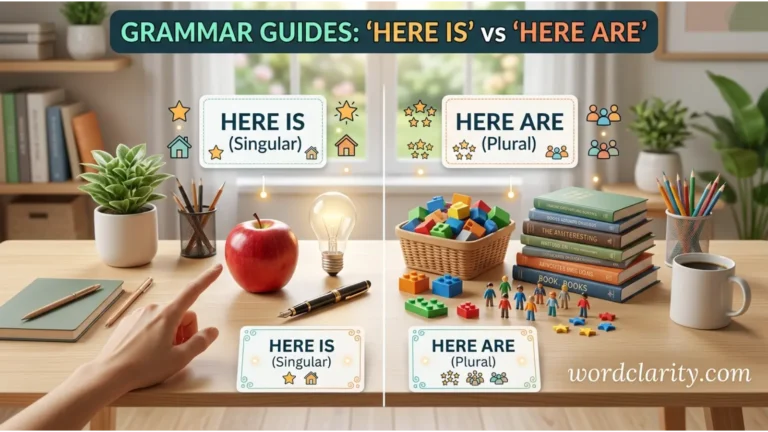
Many English learners wonder whether they should say “here is” or “here are.” At first, these two expressions seem almost identical because they both introduce something or someone. However, choosing the wrong one can make a sentence sound unnatural or grammatically incorrect. The good news is that the difference is simple once you understand the basic rule. Whether you’re speaking, writing emails, or preparing for English exams, using here is and here are correctly will help your English sound more fluent and confident. This guide explains everything in clear, simple language with examples, memory tips, practice questions, and common mistakes to avoid.
Why “Here Is” and “Here Are” Are Confusing
Many learners confuse here is and here are because both expressions have nearly the same purpose. They introduce people, objects, or information that is close to the speaker.
Several factors make them confusing.
Similar Pronunciation
In fast speech, native speakers often shorten here is to here’s. Because here’s is sometimes used even before plural nouns in casual conversation, learners may believe it is always correct.
Example:
- Here’s your book.
- Here’s your keys. (Common in speech but not recommended in formal writing.)
Similar Spelling
Both expressions begin with the word here, making them look nearly identical. The only difference is is and are.
Context Confusion
People often focus on the object rather than its number. They may forget to check whether the noun is singular or plural.
Common Learner Mistakes
Some frequent mistakes include:
- Saying Here is my books.
- Writing Here are the answer.
- Using Here’s before plural nouns in formal writing.
Understanding whether the noun is singular or plural solves most of these problems.
Here Is vs Here Are Explained Simply
The rule is very easy.
Here is is used with one person, one thing, or an uncountable noun, while here are is used with more than one person or thing.
One-line distinction:
“Here is” introduces singular nouns, while “here are” introduces plural nouns.
Examples
- Here is my passport.
- Here is some water.
- Here are my shoes.
- Here are your documents.
Remember:
Here is = Singular
Here are = Plural
Understanding Homophones in English
What Are Homophones?
Homophones are words that sound the same but have different meanings or spellings.
Example:
- Sea
- See
Both are pronounced the same, but one refers to the ocean while the other means to look at something.
Why Homophones Cause Confusion
English contains many words that sound alike. Learners often rely on pronunciation instead of grammar or meaning.
For example:
- Their
- There
- They’re
Although here is and here are are not homophones, learners confuse them because they sound similar and appear in similar situations.
What Does “Here Is” Mean?
Definition and Core Meaning
Here is means “this is located here” or “let me present something that is here.”
It introduces a singular noun or an uncountable noun.
Examples:
- Here is your phone.
- Here is the answer.
- Here is some milk.
Origin and Historical Use
The word here comes from Old English hēr, meaning “in this place.”
The verb is comes from the verb to be, one of the oldest verbs in English.
For centuries, English speakers have combined them to introduce something nearby.
Modern Usage and Synonyms
Depending on the context, here is can mean:
- This is
- Look at this
- Let me show you
- This can be found here
Key Points
- Used with singular nouns
- Used with uncountable nouns
- Common in everyday speech
- Frequently used in presentations and instructions
Example Sentences
- Here is your ticket.
- Here is my sister.
- Here is the information you requested.
- Here is a better solution.
What Does “Here Are” Mean?
Definition and Core Meaning
Here are introduces two or more people or things.
It tells someone that multiple items are present.
Examples:
- Here are your books.
- Here are the students.
- Here are the results.
Origin and Historical Context
Like here is, this phrase combines here with a form of the verb to be.
The difference is that are is the plural form.
English grammar has used this structure for hundreds of years.
Modern Usage and Synonyms
Possible alternatives include:
- These are
- Look at these
- These can be found here
- Let me show you these
Key Points
- Used with plural nouns
- Used when presenting multiple items
- Common in conversations and writing
- Frequently appears in instructions
Example Sentences
- Here are your glasses.
- Here are today’s assignments.
- Here are my friends.
- Here are the documents you wanted.
Here Is vs Here Are: Key Differences at a Glance
| Word | Part of Speech | Meaning | Example Context |
|---|---|---|---|
| Here is | Phrase (adverb + verb) | Introduces one person, one thing, or an uncountable noun | Here is your wallet. |
| Here are | Phrase (adverb + verb) | Introduces more than one person or thing | Here are your keys. |
How to Remember the Difference Between Here Is and Here Are
Learning grammar becomes easier with memory tricks.
Easy Memory Tricks
- IS = Individual (one)
- ARE = A group (many)
Association Techniques
Imagine pointing at one object.
Here is my laptop.
Now imagine pointing at several objects.
Here are my notebooks.
Always look at the noun that follows the phrase.
Ask yourself:
Is it one or many?
That question usually gives you the correct answer immediately.
One Memorable Example
Think of a waiter bringing food.
One plate:
Here is your meal.
Three plates:
Here are your meals.
Common Mistakes and Confusions
Wrong
Here is my shoes.
Correct
Here are my shoes.
Explanation: Shoes is plural.
Wrong
Here are the answer.
Correct
Here is the answer.
Explanation: Answer is singular.
Wrong
Here are some advice.
Correct
Here is some advice.
Explanation: Advice is an uncountable noun.
Wrong
Here is these books.
Correct
Here are these books.
Explanation: Books is plural.
Examples Section: Correct and Incorrect Usage
Example 1
✔ Correct:
Here is my notebook.
✘ Incorrect:
Here are my notebook.
Example 2
✔ Correct:
Here are your pencils.
✘ Incorrect:
Here is your pencils.
Example 3
✔ Correct:
Here is the information.
✘ Incorrect:
Here are the information.
Example 4
✔ Correct:
Here are our new teachers.
✘ Incorrect:
Here is our new teachers.
Example 5
✔ Correct:
Here is a beautiful flower.
✘ Incorrect:
Here are a beautiful flower.
Example 6
✔ Correct:
Here are the meeting notes.
✘ Incorrect:
Here is the meeting notes.
Self Assessment: Test Your Knowledge
Fill in the blanks.
- ______ my new phone.
- ______ your books.
- ______ some milk for your coffee.
- ______ all the students.
Self Assessment Answers
- Here is
- Here are
- Here is
- Here are
FAQs About “Here Is” and “Here Are”
1. When should I use “here is”?
Use here is before singular nouns and uncountable nouns
2. When should I use “here are”?
Use here are before plural nouns.
3. Is “here’s” correct before plural nouns?
In everyday conversation, many native speakers say “Here’s your keys.” However, formal English prefers “Here are your keys.”
4. Can I use “here is” with uncountable nouns?
Yes.
Example:
Here is some water.
5. Is “here are the information” correct?
No.
The correct sentence is:
Here is the information.
6. Why do native speakers sometimes say “here’s” before plural nouns?
It is a common feature of informal spoken English, where here’s is often used as a contraction regardless of the noun. In formal writing, follow the standard grammar rule.
7. What is the easiest way to choose between “here is” and “here are”?
Look at the noun immediately after the phrase.
- One item → Here is
- More than one item → Here are
Final Conclusion: Using “Here Is” and “Here Are” Correctly
Mastering the difference between here is and here are is one of the simplest ways to improve your English grammar. Although these expressions look and sound very similar, the rule is straightforward: use “here is” with singular nouns and uncountable nouns, and use “here are” with plural nouns. This small grammar choice makes your speaking and writing more accurate, whether you’re introducing people, presenting objects, giving directions, or writing formal documents. Whenever you’re unsure, pause for a moment and identify the noun that follows. If there is only one item, choose here is. If there are multiple items, choose here are.
A helpful memory trick is to connect “is” with one individual and “are” with a group. While you may hear native speakers use “here’s” before plural nouns in casual conversation, it is best to follow the standard grammar rule in school, exams, business writing, and professional communication. The more examples you read and practice, the more natural the correct choice will become. Keep reviewing, complete the practice exercises, and pay attention to real-life English conversations. With regular practice, choosing between here is and here are will soon become automatic, helping you communicate clearly and confidently in every situation.

Bilal Hassan is a Master’s graduate, content writer, and author at WordClaritty.com. He specializes in creating clear, informative, and reader-friendly content focused on language, word meanings, and educational topics. With a passion for accuracy and simplicity, he helps readers expand their knowledge through engaging and easy-to-understand articles.