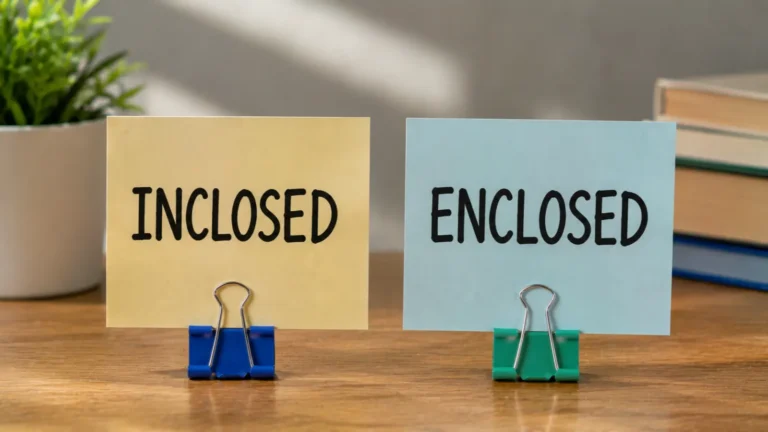
If you have ever wondered whether you should write inclosed or enclosed, you are not alone. These two words look very similar, and many English learners assume they can be used interchangeably. However, modern English strongly prefers one form over the other. Understanding the difference will help you write more naturally in emails, business letters, and everyday communication. In this guide, you’ll learn what each word means, why people confuse them, when to use each one, and easy tricks to remember the correct choice. By the end, you’ll confidently know whether to write inclosed or enclosed in any situation.
Why “Inclosed” and “Enclosed” Are Confusing
Many English learners find inclosed and enclosed confusing because the words look and sound nearly identical. Although both have the same basic meaning, only one is commonly used in modern English.
Similar Pronunciation
Both words are pronounced almost exactly the same. Since there is little difference in how they sound, learners often assume they are equally correct.
Similar Spelling
The only visible difference is the prefix:
- Inclosed
- Enclosed
This small spelling change makes it difficult to know which version is preferred.
Context Confusion
Older books, historical letters, and legal documents sometimes use inclosed, while modern writing almost always uses enclosed. Seeing both forms can confuse readers.
Common Learner Mistakes
Some common mistakes include:
- Writing inclosed in modern business emails.
- Thinking inclosed is more formal.
- Assuming both spellings are equally common today.
In reality, enclosed is the standard choice in contemporary English.
Inclosed vs Enclosed Explained Simply
Simply put:
Inclosed is an old spelling that is rarely used today, while enclosed is the modern and widely accepted spelling.
One-Line Distinction
Inclosed means the same thing as enclosed, but enclosed is the correct choice for modern English.
Examples
Inclosed means “placed inside” or “included,” but it is considered archaic.
- The letter contained an inclosed receipt. (Old-fashioned usage.)
- He referred to the inclosed document in his nineteenth-century letter.
Enclosed means “placed inside,” “surrounded,” or “included.”
- Please find the enclosed invoice.
- I have enclosed a copy of my résumé.
Understanding Homophones in English
What Are Homophones?
Homophones are words that sound the same but have different meanings or spellings.
Example:
- Male
These words sound alike but mean completely different things.
Why Homophones Cause Confusion
Although inclosed and enclosed are not true homophones because they share the same meaning, they demonstrate how similar pronunciation and spelling can confuse learners.
For example:
- Please find the enclosed report.
- Please find the inclosed report.
Both communicate the same idea, but only the first sentence sounds natural in modern English.
What Does “Inclosed” Mean?
Definition and Core Meaning
Inclosed is an old-fashioned spelling of enclosed.
It means:
- Placed inside
- Included with something
- Surrounded or shut in
Today, it is considered archaic and rarely appears outside historical documents.
Origin and Historical Use
The word comes from Middle English and Early Modern English. Several centuries ago, inclosed and enclosed were both acceptable spellings.
As English spelling became standardized, enclosed gradually replaced inclosed.
Today, you’ll mainly encounter inclosed in:
- Historical letters
- Old newspapers
- Classical literature
- Legal archives
Modern Usage and Synonyms
Modern writers rarely use inclosed.
Synonyms include:
- Included
- Inserted
- Contained
- Attached
- Enclosed
Example Sentences
- The king’s letter included an inclosed map.
- An inclosed note explained the shipment.
What Does “Enclosed” Mean?
Definition and Core Meaning
Enclosed means:
- Placed inside something
- Included with a letter or package
- Surrounded by walls, fences, or boundaries
It is the standard spelling in modern English.
Origin and Historical Context
The word comes from the Old French verb enclore, meaning “to shut in” or “surround.”
Over time, enclosed became the accepted spelling in British and American English.
Today, it appears in:
- Business correspondence
- Academic writing
- Emails
- Shipping documents
- Everyday communication
Modern Usage and Synonyms
Common synonyms include:
- Included
- Attached
- Inserted
- Contained
- Surrounded
Example Sentences
- Please see the enclosed application form.
- The garden was enclosed by a wooden fence.
- I have enclosed all supporting documents.
- The playground is fully enclosed for safety.
Inclosed vs Enclosed: Key Differences at a Glance
| Word | Part of Speech | Meaning | Example Context |
|---|---|---|---|
| Inclosed | Adjective / Past participle | Old spelling of enclosed | Historical letters and old books |
| Enclosed | Adjective / Past participle | Included or surrounded | Modern emails, letters, documents, and everyday English |
How to Remember the Difference Between Inclosed and Enclosed
Fortunately, remembering the correct word is easy.
Easy Memory Tricks
- Think of email attachments.
- Every modern business letter uses enclosed, not inclosed.
- If you’re writing today, choose enclosed.
Association Technique
Remember:
Enclosed = English today
The word enclosed begins with “en-“, the spelling you’ll see in modern dictionaries.
Memorable Example
Imagine sending a job application.
You naturally write:
“Please find my enclosed résumé.”
You would never normally write:
“Please find my inclosed résumé.”
This real-life example makes the correct choice easy to remember.
Common Mistakes and Confusions
Mistake 1
✘ Please find the inclosed invoice.
✔ Please find the enclosed invoice.
Explanation: Modern English uses enclosed.
Mistake 2
✘ The inclosed photograph is attached.
✔ The enclosed photograph is attached.
Explanation: Business writing always prefers enclosed.
Mistake 3
✘ I have inclosed my certificate.
✔ I have enclosed my certificate.
Explanation: The verb enclose is the accepted modern form.
Mistake 4
✘ The park is inclosed by walls.
✔ The park is enclosed by walls.
Explanation: Describing something surrounded by boundaries requires enclosed.
Examples Section: Correct and Incorrect Usage
Example 1
✔ Correct: Please review the enclosed contract.
✘ Incorrect: Please review the inclosed contract.
Example 2
✔ Correct: I enclosed the payment receipt with my application.
✘ Incorrect: I inclosed the payment receipt with my application.
Example 3
✔ Correct: The backyard is enclosed by a tall fence.
✘ Incorrect: The backyard is inclosed by a tall fence.
Example 4
✔ Correct: The enclosed brochure contains more information.
✘ Incorrect: The inclosed brochure contains more information.
Self Assessment: Test Your Knowledge
Fill in the blanks with inclosed or enclosed.
- Please find the ________ invoice.
- The garden is ________ by stone walls.
- The nineteenth-century letter referred to an ________ map.
- I have ________ all required documents.
Self Assessment Answers
- enclosed
- enclosed
- inclosed (historical usage)
- enclosed
FAQs About “Inclosed” and “Enclosed”
1. Is “inclosed” a real English word?
Yes. It is an old spelling of enclosed, but it is rarely used in modern English.
2. Which spelling is correct today: inclosed or enclosed?
Enclosed is the correct and preferred spelling in modern English.
3. Can I use “inclosed” in business emails?
No. Modern business writing almost always uses enclosed.
4. Why do old books use “inclosed”?
Earlier forms of English often used different spellings. Over time, enclosed became the standard.
5. Does “enclosed” only mean attached to a letter?
No. It can also describe something surrounded by walls, fences, or other boundaries.
6. Is “enclosed” used as both a verb and an adjective?
Yes. It can describe something that is included or surrounded, and it is also the past tense and past participle of enclose.
7. Should English learners memorize “inclosed”?
It is useful to recognize the word when reading historical texts, but you should use enclosed in everyday writing.
Final Conclusion: Using “Inclosed” and “Enclosed” Correctly
Understanding the difference between inclosed and enclosed is easier than it first appears. Although both words originally shared the same meaning—referring to something placed inside, included, or surrounded—modern English has clearly standardized the spelling enclosed. Today, you’ll see enclosed in emails, business letters, legal documents, academic writing, and everyday communication. By contrast, inclosed survives mainly in historical books, old correspondence, and archived records, making it an interesting word to recognize but not one you should normally use.
A simple way to remember the difference is to associate enclosed with today’s English. Whenever you write “Please find the enclosed document,” “The garden is enclosed by a fence,” or “I have enclosed my application,” you’re using the accepted modern form. If you come across inclosed while reading older texts, you’ll know it is simply an outdated spelling rather than a different word with a different meaning.
Building your vocabulary often means learning small distinctions like this one. Each new word you master makes your writing clearer, more professional, and more natural. Keep practicing with real examples, pay attention to modern usage, and don’t be discouraged by historical spellings. With regular reading and writing, choosing enclosed instead of inclosed will soon become second nature, helping you communicate with confidence in every situation.