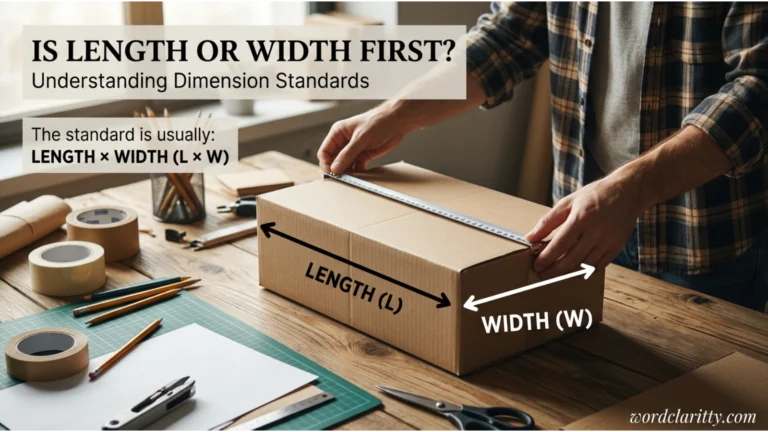
Have you ever measured a table, ordered a picture frame, or checked the size of a box and wondered, “Is length or width first?” This is a common question among English learners and even native speakers.
The confusion happens because dimensions are written differently depending on the object, industry, and situation. Sometimes length comes first, while in other cases, width is listed before length.
Understanding the difference between these measurements helps you describe sizes accurately, read product descriptions, and avoid costly mistakes when shopping or measuring objects. In this guide, you will learn what length and width mean, their usual order, practical examples, and simple tricks to remember them.
Why Length and Width Are Confusing
The words “length” and “width” are common measurement terms, but many English learners find them confusing because they describe different directions and may appear in different orders.
1. Similar Pronunciation
Length and width are not pronounced the same way, but both have short, single-syllable pronunciations that may be challenging for learners.
- Length: /leŋθ/ or /leŋkθ/, depending on accent.
- Width: /wɪdθ/ or /wɪtθ/, depending on accent.
Both words end with a consonant sound involving “th,” which may be unfamiliar to speakers of some languages.
However, they are not homophones because their pronunciations are different.
2. Similar Spelling
Both words end with the letters “th” and describe physical measurements.
They also share a similar grammatical pattern:
- Long → Length
- Wide → Width
These related forms may cause confusion, especially when learners are studying measurement vocabulary for the first time.
3. Context Confusion
The biggest difficulty is deciding which dimension should appear first.
For example:
“A table measures 150 × 80 cm.”
Does 150 cm represent the length or the width?
Without additional information, the answer is not always certain.
In many everyday contexts, dimensions are presented as:
Length × Width × Height (L × W × H)
However, some industries use different orders. For example, picture frames and digital displays commonly use width before height.
4. Common Learner Mistakes
English learners frequently make these mistakes:
- Assuming length always comes first.
- Confusing length with height.
- Believing width always means the shortest side.
- Reading dimensions without checking their labels.
- Using length and width interchangeably.
- Forgetting that measurement conventions vary by product.
Understanding the meaning of each measurement is more useful than memorizing one order for every situation.
Length vs Width Explained Simply
The difference between length and width is based on the direction being measured.
Length generally describes how long something is, often along its longest or main direction, while width describes how wide something is from side to side.
Simple Explanation
Length: The measurement of an object from one end to the other along its main or longest direction.
Width: The measurement of an object from one side to the other, usually across its shorter horizontal direction.
For a rectangular table, length often describes the longer side, while width describes the shorter side.
However, the exact meaning depends on how the object is positioned and described.
One-Line Distinction
Length measures how long an object is, while width measures how wide it is.
Which Comes First?
In many general measurement contexts, length is written before width.
For example:
Length × Width = 200 cm × 100 cm
This means:
- Length = 200 cm
- Width = 100 cm
However, the order is not universal. Product specifications, diagrams, and industry standards may use width first.
Two Example Sentences
Example 1: Length
“The length of the dining table is 180 centimetres.”
This sentence describes the table’s measurement along its longer direction.
Example 2: Width
“The width of the dining table is 90 centimetres.”
This sentence describes the measurement across the table.
Together, these measurements help describe the table’s size accurately.
Understanding Homophones in English
Homophones are an important part of English vocabulary because they can create confusion in both spoken and written communication.
Although “length” and “width” are not homophones, learning about them helps explain why some English words are easy to confuse.
What Are Homophones?
Homophones are words that sound the same but have different meanings and often different spellings.
For example, “right” and “write” are homophones.
- Right: Correct or the opposite of left.
- Write: To form letters or words.
Consider these sentences:
- “You gave the right answer.”
- “Please write your name.”
Both words have the same pronunciation, but their meanings are different.
Other common homophones include:
- Hear and here
- Sea and see
- One and won
- Flour and flower
- Their and there
Length and width do not belong to this category because they sound different.
Why Homophones Cause Confusion
Homophones create confusion because listeners must depend on context to understand the intended meaning.
For example:
“I can see the sea.”
The first word describes vision, while the second refers to a body of water.
The confusion between length and width is different. It comes from their related meanings and the various ways measurements are written.
For example:
“The box is 30 × 20 × 10 cm.”
Without labels, you cannot always know which number represents length, width, or height.
Therefore, learning measurement vocabulary and checking dimension labels are essential for accurate communication.
What Does “Length” Mean?
Definition and Core Meaning
Length is a noun that describes the measurement of something from one end to the other.
It often refers to the longest dimension of an object, although this is not always the case.
For example:
“The length of the rope is five metres.”
Here, length describes the distance from one end of the rope to the other.
Common meanings of length include:
- Physical distance: How long an object is.
- Duration: How long an event continues.
- Distance along a route: The extent of a road, path, or journey.
- Extent of material: A measured piece of cloth, rope, or another material.
- Amount of content: The size of a speech, article, or book.
Origin and Historical Use
The word “length” comes from Old English lengþu, which is related to the adjective “long.”
Historically, the word described physical distance or extent. Over time, its meaning expanded to include duration and other kinds of measurement.
For example:
“The length of the meeting was two hours.”
In this sentence, length refers to time rather than physical distance.
Today, the word is widely used in mathematics, science, construction, engineering, and everyday English.
Modern Usage and Synonyms
Length is commonly used when discussing the dimensions of objects or the duration of events.
Related words and expressions include:
- Distance: The space between two points.
- Extent: The size or range of something.
- Duration: The amount of time something lasts.
- Long side: The longer edge of a rectangular object.
- Measurement: A numerical description of size.
These terms are related but are not always interchangeable.
Example Sentences
- “The length of the swimming pool is 25 metres.”
- “Please measure the length of the wooden board.”
- “The length of the meeting surprised everyone.”
- “The road has a total length of ten kilometres.”
- “The length of the curtain is two metres.”
- “We need to know the length of the table before buying a tablecloth.”
Each example uses “length” to describe distance, extent, or duration.
What Does “Width” Mean?
Definition and Core Meaning
Width is a noun that describes the measurement of something from one side to the other.
It commonly refers to the side-to-side dimension of a surface or object.
For example:
“The width of the door is 90 centimetres.”
This sentence describes how wide the door is.
Common meanings include:
- Side-to-side distance: The measurement across an object.
- Horizontal measurement: The extent of something from left to right in a particular orientation.
- Breadth: The distance across a surface.
- Opening size: How wide a doorway, passage, or space is.
- Display measurement: The horizontal dimension of an image or screen.
Origin and Historical Context
The word “width” developed from the adjective “wide,” with the noun-forming ending “-th.”
It has been used in English to describe the breadth or side-to-side extent of objects and spaces.
As measurement systems became more standardized, width became an important term in mathematics, construction, design, manufacturing, and engineering.
Today, it is commonly used in technical specifications and everyday descriptions.
Modern Usage and Synonyms
Width appears in many practical situations, especially when measuring furniture, rooms, roads, doors, and screens.
Related words include:
- Breadth: The measurement across something.
- Span: The distance between two points.
- Side-to-side distance: A simple description of width.
- Horizontal extent: The distance across an object in a chosen orientation.
- Crosswise measurement: A measurement taken across something.
The best alternative depends on the object and context.
Example Sentences
- “The width of the road is six metres.”
- “Please measure the width of the window.”
- “The width of the table is 80 centimetres.”
- “The designer adjusted the width of the image.”
- “The doorway has enough width for the furniture.”
- “The width of the carpet is three metres.”
In each example, width describes how wide something is.
Length vs Width: Key Differences at a Glance
The following table explains the main differences between length and width.
| Word | Part of Speech | Meaning | Example Context |
|---|---|---|---|
| Length | Noun | Measurement from one end to the other | “The length of the table is 180 cm.” |
| Width | Noun | Measurement from one side to the other | “The width of the table is 90 cm.” |
| Length | Noun | Duration of an event | “The length of the film is two hours.” |
| Width | Noun | Horizontal extent of an image | “The image width is 1920 pixels.” |
| Length | Noun | Distance along a route | “The bridge has a length of 500 metres.” |
| Width | Noun | Distance across a space | “The road has a width of eight metres.” |
Is Length or Width First in Measurements?
There is no single order that applies to every situation.
However, common conventions include:
| Object or Context | Common Dimension Order | Example |
|---|---|---|
| General rectangular objects | Length × Width | 200 × 100 cm |
| Boxes and packages | Length × Width × Height | 40 × 30 × 20 cm |
| Room floor measurements | Length × Width | 5 × 4 m |
| Pictures and digital images | Width × Height | 1920 × 1080 pixels |
| Picture frames | Width × Height is common | 20 × 30 cm |
| Furniture specifications | Varies by manufacturer | W × D × H or L × W × H |
Important: These are common conventions, not universal rules. Always check the labels provided with the measurements.
How to Remember the Difference Between Length and Width
Simple memory tricks can help you remember the meanings and typical uses of these measurement words.
1. Associate Length with “Long”
The word “length” is related to the adjective “long.”
Think:
Long → Length
Imagine a long road stretching into the distance.
The measurement from one end of the road to the other represents its length.
For example:
“The length of the road is five kilometres.”
2. Associate Width with “Wide”
The word “width” is related to the adjective “wide.”
Think:
Wide → Width
Imagine a wide doorway that allows two people to walk through side by side.
The side-to-side measurement represents its width.
For example:
“The width of the doorway is two metres.”
3. Remember L × W × H
A useful memory trick for many everyday objects is:
L × W × H = Length × Width × Height
- L = Length
- W = Width
- H = Height
This order is common when describing boxes and rectangular objects.
However, it is not a universal standard. Always follow the order specified by the manufacturer or measurement instructions.
4. One Memorable Example
Imagine a rectangular dining table.
It measures:
- Length: 180 cm
- Width: 90 cm
- Height: 75 cm
You could describe it as:
“The table measures 180 cm long, 90 cm wide, and 75 cm high.”
This example helps connect each measurement with a specific direction.
Common Mistakes and Confusions
Learners often make mistakes when interpreting dimensions or describing the size of objects.
Mistake 1: Assuming Length Always Comes First
✘ Incorrect assumption: “The first number in every dimension listing must be the length.”
✔ Correct understanding: “The order depends on the object, industry, and labels.”
Explanation: While length commonly comes first in L × W × H measurements, many products use different conventions.
Mistake 2: Confusing Length with Width
✘ Incorrect: “The width of this 180 cm by 90 cm table is 180 cm,” when the longer side is labelled as its length.
✔ Correct: “The length is 180 cm, and the width is 90 cm.”
Explanation: For this table, the specified longer dimension is its length.
Mistake 3: Ignoring Dimension Labels
✘ Incorrect: “The package is 50 × 30 × 20 cm, so 50 cm must always be its length.”
✔ Correct: “The package measures 50 × 30 × 20 cm. I should check the labels to confirm the order.”
Explanation: Numbers alone do not always identify which dimension they represent.
Mistake 4: Confusing Width with Height
✘ Incorrect: “The door’s width is two metres,” when two metres is its vertical measurement.
✔ Correct: “The door’s height is two metres.”
Explanation: Height usually describes vertical distance, while width describes side-to-side distance.
Mistake 5: Believing Width Is Always the Shortest Dimension
✘ Incorrect assumption: “Width must always be smaller than length.”
✔ Correct understanding: “Width and length depend on the object’s orientation and measurement convention.”
Explanation: Some objects have equal length and width, while other objects use fixed directional labels regardless of which measurement is greater.
Examples Section: Correct and Incorrect Usage
The following examples demonstrate how to describe measurements accurately.
Example 1: Measuring a Table
✔ Correct: “The table is 180 cm long and 90 cm wide.”
✘ Incorrect: “The table is 180 cm wide and 90 cm long,” when its specified length is 180 cm.
Why? The labels must match the actual directions being measured.
Example 2: Describing a Room
✔ Correct: “The room measures 5 metres in length and 4 metres in width.”
✘ Incorrect: “The room measures 5 metres in width and 4 metres in length,” when the measurements have been labelled the other way around.
Why? The words should describe the correct dimensions of the room.
Example 3: Reading Image Dimensions
✔ Correct: “The image measures 1920 pixels wide and 1080 pixels high.”
✘ Incorrect: “The image measures 1920 pixels long and 1080 pixels wide,” when the specification is width × height.
Why? Digital images are commonly described using width and height.
Example 4: Measuring a Box
✔ Correct: “The box measures 40 cm long, 30 cm wide, and 20 cm high.”
✘ Incorrect: “The box measures 40 cm high, 30 cm wide, and 20 cm long,” when the labelled measurements are L × W × H.
Why? Each dimension must match its corresponding label.
Example 5: Describing a Road
✔ Correct: “The road is two kilometres long and eight metres wide.”
✘ Incorrect: “The road is two kilometres wide and eight metres long.”
Why? Length describes the distance along the road, while width describes the distance across it.
Example 6: Measuring a Doorway
✔ Correct: “The doorway is 90 cm wide and 210 cm high.”
✘ Incorrect: “The doorway is 90 cm high and 210 cm wide,” when the measurements have been reversed.
Why? Width and height refer to different directions.
Self-Assessment: Test Your Knowledge
Choose the correct answer to complete each sentence.
Question 1: The ___ of the rectangular table is 180 cm, measured along its longer side.
a) Length
b) Width
Question 2: The ___ of the doorway is 90 cm from one side to the other.
a) Length
b) Width
Question 3: In a dimension listing labelled L × W × H, the first measurement represents ___.
a) Width
b) Length
Question 4: In a digital image specification labelled W × H, the first measurement represents ___.
a) Width
b) Length
Self-Assessment Answers
Answer 1: Length
“The length of the rectangular table is 180 cm.”
Length describes the measurement along the table’s longer side in this example.
Answer 2: Width
“The width of the doorway is 90 cm.”
Width describes the side-to-side measurement.
Answer 3: Length
In the order L × W × H, the first measurement represents length.
Answer 4: Width
In the order W × H, the first measurement represents width.
How Did You Do?
- 4 correct: Excellent! You understand the difference.
- 3 correct: Great work. Review the example you missed.
- 1–2 correct: Practise identifying measurements on familiar objects.
- 0 correct: Remember that length describes how long something is, while width describes how wide it is.
FAQs:
1. Is Length or Width First When Writing Dimensions?
Length commonly comes first in measurements written as L × W × H. However, some industries use width first, especially for images, frames, and certain furniture specifications. Always check the labels.
2. What Is the Correct Order of Length, Width, and Height?
A common order is Length × Width × Height (L × W × H). However, there is no universal order for every product or industry.
3. Does Length Always Mean the Longest Side?
No. Length often describes the longest or main direction of an object, but it does not always have to be the largest measurement. The object’s orientation and measurement convention determine the labels.
4. Is Width the Same as Breadth?
Width and breadth are often used interchangeably to describe the distance across something. However, their preferred usage may differ depending on context and industry.
5. When Measuring a Room, Does Length or Width Come First?
Room dimensions are commonly written as length × width, but there is no universal rule. It is best to label both measurements clearly.
6. Why Is Width First in Image Dimensions?
Digital images are commonly described using width × height because their dimensions represent horizontal and vertical pixel counts. For example, 1920 × 1080 means 1920 pixels wide and 1080 pixels high.
7. How Can I Remember Length vs Width?
Associate length with “long” and width with “wide.” For many rectangular objects, length describes the longer direction, while width describes the distance across it. Always confirm the labels when precision matters.
Conclusion:
Understanding whether length or width comes first is an important part of learning English measurement vocabulary and describing dimensions accurately. Although Length × Width × Height (L × W × H) is a common order for boxes, furniture, and other rectangular objects, it is not a universal rule. Different industries and products may use different measurement conventions. For example, digital images are usually described using Width × Height (W × H), while some furniture manufacturers use Width × Depth × Height (W × D × H). This is why checking the dimension labels is more reliable than assuming the first number always represents length.
The basic difference is easy to remember: length describes how long something is, usually along its main direction, while width describes how wide it is from side to side. You can connect “length” with “long” and “width” with “wide” to make these meanings easier to recall. Measuring familiar objects, such as tables, books, doors, and rooms, can also help you understand how the words work in real situations.
When reading product descriptions, ordering furniture, planning a room, or completing a measurement exercise, always pay attention to the labels and units. If the order is unclear, ask for clarification rather than guessing.
With regular practice, these measurement terms will become much easier to use. Keep learning through practical examples, and you will soon feel confident describing length, width, and height accurately in everyday English.