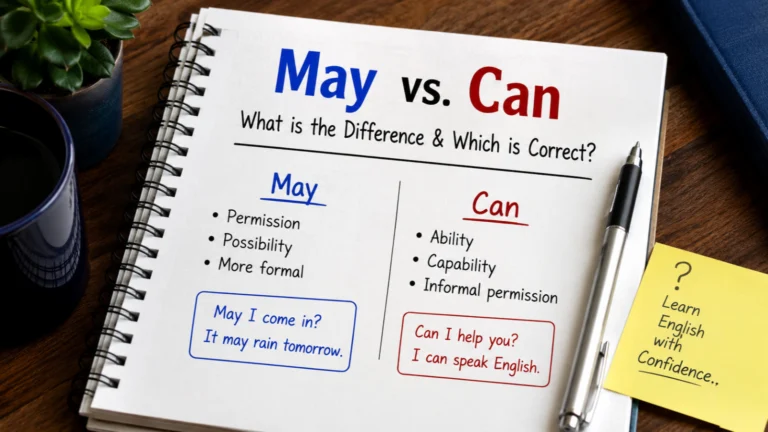
May or can is one of the most common grammar questions English learners ask. Both words are modal verbs, and both are often used when asking for permission or talking about possibility. Because their meanings sometimes overlap, many people use them interchangeably. However, they are not always the same, and choosing the correct word can make your English sound more natural and accurate. In this guide, you’ll learn the difference between may and can in simple language, discover when each one is appropriate, avoid common mistakes, and gain confidence using both words correctly in everyday conversations and writing.
Table of Contents
- Introduction
- Why “May” and “Can” Are Confusing
- May vs Can Explained Simply
- Understanding Homophones in English
- What Are Homophones?
- Why Homophones Cause Confusion
- What Does “May” Mean?
- What Does “Can” Mean?
- May vs Can: Key Differences at a Glance
- How to Remember the Difference Between May and Can
- Common Mistakes and Confusions
- Examples Section: Correct and Incorrect Usage
- Self Assessment: Test Your Knowledge
- Self Assessment Answers
- FAQs About “May and Can”
- Final Conclusion: Using “May” and “Can” Correctly
Why “May” and “Can” Are Confusing
Many English learners struggle with may and can because they are both used in similar situations. Although they have different meanings, native speakers sometimes use them interchangeably, especially in casual conversation.
Here are the main reasons they cause confusion:
Similar Pronunciation
Both words are short modal verbs and are commonly heard in everyday speech. Learners often hear them used in similar contexts, making the distinction less obvious.
Similar Spelling
Although the spellings are different, both words are simple three-letter verbs that appear frequently in English lessons and conversations.
Context Confusion
Both words can appear when asking for permission.
- May I leave early?
- Can I leave early?
These sentences have similar meanings, but they differ slightly in formality.
Common Learner Mistakes
Many learners:
- Use can when formal English requires may.
- Use may when talking about ability instead of possibility.
- Believe the two words always mean exactly the same thing.
Understanding their specific roles helps avoid these mistakes.
May vs Can Explained Simply
The easiest way to understand these two words is to remember their main purposes.
May means permission or possibility, while can means ability or informal permission.
One-Line Distinction
May is generally used for permission or possibility, while can is mainly used for ability or informal permission.
Examples
May
- You may enter the room now.
- It may rain this afternoon.
Can
- She can swim very well.
- Can I borrow your pen?
Understanding Homophones in English
Although may and can are not homophones, learners often confuse them because they appear in similar situations.
What Are Homophones?
Homophones are words that sound the same but have different meanings and spellings.
Example:
- Sea
- See
These words sound identical but mean different things.
Why Homophones Cause Confusion
When two words sound alike, learners often choose the wrong spelling or meaning.
Example:
- I can see the ocean.
- The sea is calm today.
Even though may and can are not homophones, understanding word differences helps improve grammar accuracy.
What Does “May” Mean?
Definition and Core Meaning
May is a modal verb that expresses:
- Permission
- Possibility
- Wishes or hopes (less commonly)
It often sounds more polite and formal than can.
Origin and Historical Use
The word may comes from Old English magan, meaning “to have power” or “to be allowed.” Over time, it became widely used to express permission and possibility.
Modern Usage and Synonyms
Modern uses include:
- Giving permission
- Expressing possibility
- Formal requests
Similar words include:
- Might
- Perhaps
- Possibly
- Be allowed to
Example Sentences
- You may start the exam now.
- We may visit our grandparents this weekend.
- She may know the answer.
- Guests may park here.
What Does “Can” Mean?
Definition and Core Meaning
Can is a modal verb that mainly expresses:
- Ability
- Capability
- Informal permission
- Possibility in certain situations
Origin and Historical Context
The word can comes from Old English cunnan, meaning “to know” or “to be able.”
Its meaning gradually developed into expressing ability.
Modern Usage and Synonyms
Modern meanings include:
- Be able to
- Have the ability to
- Know how to
- Be capable of
Example Sentences
- I can speak English.
- Birds can fly.
- Can you help me?
- You can leave after lunch.
May vs Can: Key Differences at a Glance
| Word | Part of Speech | Meaning | Example Context |
|---|---|---|---|
| May | Modal verb | Permission, possibility | You may leave now. |
| Can | Modal verb | Ability, capability, informal permission | She can drive. |
How to Remember the Difference Between May and Can
Learning a simple memory trick makes these words much easier.
Easy Memory Tricks
- May = Permission or Possibility
- Can = Capability (Ability)
Notice both Can and Capability begin with the letter C.
Association Technique
Think:
- May → Maybe
- Can → Capable
This association reminds you of each word’s main purpose.
Memorable Example
Imagine a classroom.
The teacher says:
“You may leave now.”
The student replies:
“Great! I can run home quickly.”
The teacher gives permission (may), while the student talks about ability (can).
Common Mistakes and Confusions
Here are mistakes many English learners make.
Wrong
Can it rain tomorrow?
Better
It may rain tomorrow.
Explanation: Rain is a possibility, not an ability.
Wrong
I may swim across the river because I’m strong.
Better
I can swim across the river because I’m strong.
Explanation: Swimming is an ability.
Wrong
May you help me?
Better
Can you help me?
Explanation: When asking someone if they are able to help, can is more natural.
Wrong
You can enter the examination room now. (Formal announcement)
Better
You may enter the examination room now.
Explanation: Formal permission often uses may.
Examples Section: Correct and Incorrect Usage
Example 1
✔ Correct: May I use your phone?
✘ Incorrect: Can I possibly be allowed to use your phone? (Too awkward in this context.)
Example 2
✔ Correct: She can speak three languages.
✘ Incorrect: She may speak three languages. (Unless you mean “perhaps.”)
Example 3
✔ Correct: It may snow tonight.
✘ Incorrect: It can snow tonight. (Possible in some contexts, but “may” better expresses uncertainty.)
Example 4
✔ Correct: Can you lift this heavy box?
✘ Incorrect: May you lift this heavy box?
Self Assessment: Test Your Knowledge
Fill in the blanks using may or can.
- ______ I borrow your notebook?
- She ______ play the piano beautifully.
- It ______ rain later this evening.
- Students ______ leave after the bell rings.
Self Assessment Answers
- May (or Can in informal conversation)
- Can
- May
- May
FAQs About “May and Can”
1. Is it more correct to say “May I” or “Can I”?
In formal English, May I is considered more polite because it asks for permission. In everyday conversation, Can I is also widely accepted.
2. Can “may” and “can” ever mean the same thing?
Yes. When asking for permission, both can have similar meanings, although may sounds more formal.
3. Which word expresses ability?
Can expresses ability, skill, or capability.
Example:
“I can drive.”
4. Which word expresses possibility?
May usually expresses possibility.
Example:
“It may snow tomorrow.”
5. Do native English speakers use “can” more often?
Yes. In everyday speech, many native speakers prefer can when asking for permission because it sounds natural and conversational
6. Is using “can” for permission grammatically wrong?
No. While traditional grammar distinguishes may for permission, can is widely accepted for informal permission in modern English.
7. How can I remember the difference quickly?
Remember this simple rule:
- May = Permission or possibility
- Can = Ability or informal permission
Final Conclusion: Using “May” and “Can” Correctly
Understanding the difference between may and can is an important step toward speaking and writing more natural English. Although these two modal verbs sometimes appear in similar situations, each has its own primary purpose. May is mainly used to express permission and possibility, making it the better choice in formal requests or when talking about something that might happen. Can, on the other hand, focuses on ability, capability, and informal permission, which is why it is so common in everyday conversations.
A simple way to remember the difference is to think of may as “maybe” or “permission,” while can relates to being “capable.” This small memory trick can help you choose the correct word without hesitation. As you read books, watch English videos, or practice speaking, pay attention to how native speakers use these words in different situations. Over time, recognizing the correct context will become second nature.
Most importantly, don’t worry if you occasionally mix them up. Even fluent speakers choose between may and can based on the level of formality and the situation. Keep practicing with real-life examples, review the exercises in this guide, and challenge yourself to use both words in your daily conversations. With consistent practice, you’ll soon feel confident using may and can correctly in both spoken and written English.