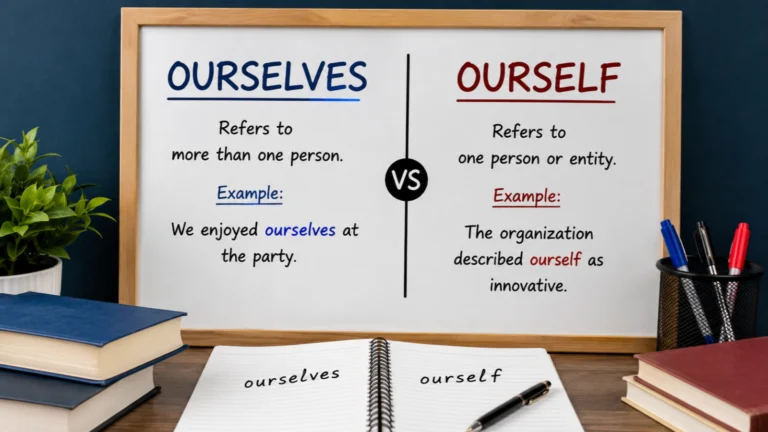
Ourselves vs Ourself is a common grammar question that confuses many English learners and even native speakers. Although these two reflexive pronouns look very similar, they are used in different situations and cannot always be exchanged. Understanding the difference between ourselves vs ourself will help you write and speak English more accurately and naturally. In most cases, ourselves is the standard and grammatically correct choice because it refers to more than one person. However, ourself has limited uses in specific contexts, such as formal or historical writing. In this guide, you’ll learn the rules, meanings, examples, and common mistakes related to ourselves vs ourself, making it easier to choose the correct word with confidence.
Why “Ourselves” and “Ourself” Are Confusing
Many learners wonder whether they should write ourselves or ourself. The confusion comes from several reasons.
Similar Pronunciation
Both words sound very similar when spoken quickly. The only noticeable difference is the extra -ves ending in ourselves.
Similar Spelling
The words differ by only a few letters, making it easy to type or write the wrong one.
Context Confusion
Since both words are reflexive pronouns, learners often assume they can replace one another. In reality, grammar determines which one is appropriate.
Common Learner Mistakes
People often write:
- We should believe in ourself.
- We prepared ourself for the test.
These sentences should normally use ourselves because the subject we is plural.
Ourselves vs Ourself Explained Simply
Ourselves refers to more than one person and is the standard reflexive pronoun used with we.
Ourself is a rare singular reflexive form used mainly when we refers to one person, such as a king, queen, editor, or organization speaking as one.
One-Line Distinction
Ourselves is the normal plural form, while ourself is a rare singular form used in special contexts.
Examples
- We taught ourselves how to cook.
- We should believe in ourselves.
Rare usage:
- We have decided to limit ourself to one statement. (formal or institutional use)
Understanding Homophones in English
Although ourselves and ourself are not true homophones, they are often confused because they sound very similar.
What Are Homophones?
Homophones are words that sound the same but have different meanings or spellings.
Example:
- Sea and see
These words are pronounced alike but have different meanings.
Why Homophones Cause Confusion
When learners hear words instead of reading them, similar sounds can lead to spelling mistakes.
For example:
- Their
- There
- They’re
Likewise, ourselves and ourself can be mistaken because they differ only slightly in pronunciation.
What Does “Ourselves” Mean?
Definition and Core Meaning
Ourselves is a reflexive pronoun and intensive pronoun used with the plural subject we.
It refers back to the people performing an action.
Examples
- We introduced ourselves.
- We should trust ourselves.
- We enjoyed ourselves at the party.
It can also emphasize the subject.
- We ourselves completed the project.
Origin and Historical Use
The word ourselves has been part of English since the Middle English period. It developed naturally as the plural reflexive form corresponding to we and has remained the standard form in modern English.
Modern Usage and Synonyms
Common uses include:
- Reflexive pronoun
- Intensive pronoun
- Everyday spoken English
- Formal and informal writing
Similar Expressions
- By ourselves
- On our own
- Personally
Example Sentences
- We blamed ourselves for the mistake.
- We should take care of ourselves.
- We reminded ourselves to stay calm.
- We challenged ourselves to improve.
What Does “Ourself” Mean?
Definition and Core Meaning
Ourself is the singular reflexive form of we, but it is uncommon in modern English.
It is mainly used when we refers to a single person or entity, rather than several people.
Examples include:
- Royal speech
- Editorial writing
- Institutional statements
- Formal legal language
Origin and Historical Context
Historically, ourself appeared in English centuries ago. It became associated with the royal we, where a monarch referred to themselves as we instead of I.
Some organizations also use we to represent a single institution, making ourself acceptable in very formal contexts.
Modern Usage and Synonyms
Today, ourself is uncommon.
You may occasionally find it in:
- Historical documents
- Legal writing
- Official announcements
- Literature
- Institutional communication
Example Sentences
- We have committed ourself to this policy.
- We find ourself responsible for the decision.
These examples sound formal because we represents one organization or authority.
Ourselves vs Ourself: Key Differences at a Glance
| Word | Part of Speech | Meaning | Example Context |
|---|---|---|---|
| Ourselves | Reflexive/Intensive Pronoun | Refers to two or more people including the speaker | We prepared ourselves for the exam. |
| Ourself | Reflexive Pronoun | Refers to one person or one institution using “we” | We consider ourself responsible. (formal) |
How to Remember the Difference Between Ourselves and Ourself
Fortunately, remembering the correct form is easy.
Easy Memory Tricks
- We = many people → ourselves
- One official using “we” → ourself
Association Technique
Think of the letter S in ourselves as standing for several people.
If there is more than one person, use ourselves.
Memorable Example
Imagine a football team saying:
“We believe in ourselves.”
Now imagine a king announcing:
“We shall prepare ourself.”
The first sentence is ordinary English. The second is formal royal language.
Ourselves vs Ourself: Common Mistakes and Confusions
Here are mistakes learners often make.
Wrong
❌ We should trust ourself.
Correct
✔ We should trust ourselves.
Explanation: The subject we refers to multiple people.
Wrong
❌ We enjoyed ourself at the concert.
Correct
✔ We enjoyed ourselves at the concert.
Explanation: The subject is plural.
Wrong
❌ We introduced ourself to the class.
Correct
✔ We introduced ourselves to the class.
Explanation: Standard English requires ourselves.
Rare but Correct
✔ We have decided to represent ourself differently.
Explanation: Here, we refers to a single institution or official body.
Examples Section: Correct and Incorrect Usage
Example 1
✔ Correct: We taught ourselves Spanish.
✘ Incorrect: We taught ourself Spanish.
Example 2
✔ Correct: We congratulated ourselves after winning.
✘ Incorrect: We congratulated ourself after winning.
Example 3
✔ Correct: We reminded ourselves to stay positive.
✘ Incorrect: We reminded ourself to stay positive.
Example 4
✔ Correct: The committee described itself as independent.
✔ Also Correct (Formal): We described ourself as independent. (Institutional style)
Self Assessment: Test Your Knowledge
Fill in the blanks.
1.
We should always believe in __________.
2.
We introduced __________ before the meeting.
3.
The king said, “We shall protect __________.”
4.
We challenged __________ to finish the marathon.
Self Assessment Answers
- ourselves
- ourselves
- ourself
- ourselves
FAQs About “Ourselves and Ourself”
Is “ourself” grammatically correct?
Yes. However, it is rare and mainly used when we refers to a single person or institution, such as the royal we or official statements.
Which is more common: ourselves or ourself?
Ourselves is far more common and is the standard choice in everyday English.
Can I use “ourself” instead of “ourselves”?
Usually, no. If we refers to multiple people, you should use ourselves.
Why do kings and queens sometimes say “ourself”?
They traditionally use the royal we, where one person speaks using we to represent the monarchy.
Is “ourselves” a reflexive pronoun?
Yes. It is both a reflexive pronoun and an intensive pronoun.
Can organizations use “ourself”?
Yes. Some companies, governments, and institutions occasionally use ourself in formal or legal writing when speaking as a single entity.
How can I remember which word to use?
Remember this simple rule:
Many people = ourselves.
One official or institution using “we” = ourself.
Final Conclusion: Using “Ourselves” and “Ourself” Correctly
Understanding the difference between ourselves and ourself becomes much easier once you know how each word is used. In everyday English, ourselves is the standard reflexive pronoun that matches the plural subject we. Whether you are talking about learning a new skill, encouraging a group, or describing something that a team has done, ourselves is almost always the correct choice. On the other hand, ourself is a rare but grammatically valid form. It appears mainly in historical writing, legal documents, official statements, or when a single person or institution uses the royal we or another formal collective voice. Because these situations are uncommon, most English learners will rarely need to use ourself in daily conversation or writing.
A simple memory tip can help you every time: if we means more than one person, choose ourselves. If we refers to one official person or a single organization speaking collectively, ourself may be appropriate. Reading authentic English books, listening to native speakers, and practicing with example sentences will help reinforce this rule. Don’t worry if the distinction feels confusing at first—many learners make the same mistake. With regular practice and careful attention to context, you’ll soon use both forms confidently and correctly whenever the situation calls for them.