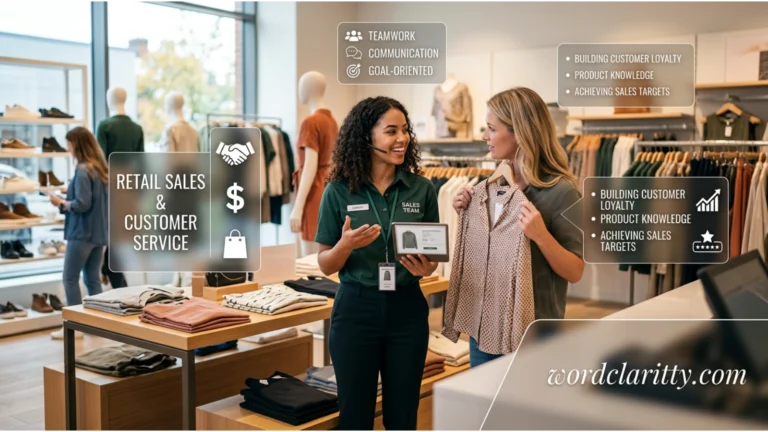
If you are learning English, you may wonder whether sales jobs and retail jobs mean the same thing. These terms are closely related because many retail workers help customers choose products and complete purchases. However, the two expressions are not exactly interchangeable.
Sales describes work that focuses mainly on selling products or services, while retail refers more broadly to selling goods directly to customers, usually in stores or through consumer-focused businesses. Understanding the difference can help you choose the right words when writing a CV, searching for a job, or describing your work experience. In this guide, we will explain both terms in simple English with clear examples.
Why “Sales or Retail jobs” Are Confusing
Sales and retail are confusing because both are strongly connected with buying and selling products.
Here are some common reasons English learners mix them up:
- Similar context: Both words are frequently used when talking about shops, customers, products, money, and business.
- Related jobs: A person working in a clothing store may work in both sales and retail, so job descriptions often use the terms together.
- Context confusion: “Sales” can describe a job function, department, target, or activity. “Retail” can describe an industry, business type, store, or job.
- Common learner mistakes: Learners may say “I work in sales” when they mean they work in a shop, or “I have a retail job” when their main responsibility is selling to business customers.
There is also an important point about pronunciation: sales and retail do not sound alike, so they are not homophones. Their connection is mainly about meaning and context, not pronunciation.
For example:
- “She works in sales.” → Her work involves selling.
- “She works in retail.” → She works in the business of selling goods directly to consumers.
Sales or Retail jobs Explained Simply
Simple explanation
Sales is the activity or job of persuading customers or clients to buy a product or service.
Retail is the business of selling products directly to individual consumers for personal use.
A retail worker may work in sales, but not every sales professional works in retail.
One-line distinction
Sales is about selling; retail is about the consumer-selling business or environment where goods are sold directly to customers.
Example sentences
- My brother works in sales for a technology company.
His job involves selling technology products or services, but he may not work in a shop. - My sister has a retail job at a clothing store.
She works in a store that sells clothes directly to customers.
This is why “sales job” and “retail job” can sometimes describe the same position, but they emphasize different things.
For example, a person working as a salesperson in an electronics store has a retail job and performs sales work.
Understanding Homophones in English
The words sales and retail are not homophones. However, understanding homophones is useful because English has many pairs of words that sound the same but have different meanings.
What Are Homophones?
Homophones are words that have the same pronunciation but different meanings, and often different spellings.
For example:
- right → correct
- write → to form words using a pen, pencil, or keyboard
Example:
“Your answer is right.”
“Please write your name here.”
The two words sound the same, but their meanings and spellings are different.
Why Homophones Cause Confusion
Homophones can be difficult because you cannot always identify the correct word by listening alone.
For example, if someone says “right,” you need the surrounding sentence to understand whether they mean correct, a direction, or another meaning.
However, sales and retail are different from this type of confusion. They have different sounds and spellings. Learners usually confuse them because their meanings overlap in business and employment situations.
What Does “Sales” Mean?
Definition and Core Meaning
Sales refers to the activity of selling products or services to customers or clients. It can also refer to a business department, a profession, or the amount of products or services sold.
In simple English:
Sales means the process or work of getting people to buy something.
For example, a salesperson may explain a product, answer questions, negotiate prices, contact potential customers, and complete a sale.
The word can be used in many industries, including technology, insurance, real estate, banking, manufacturing, and retail.
Origin and Historical Use
The word sales comes from sale, which has been used in English for many centuries to describe the act of exchanging something for money. The word is related to the verb sell.
Over time, sales developed into a broader business term. Modern companies use it to describe everything from individual selling activities to entire departments and professional careers.
Today, you may see job titles such as:
- Sales Assistant
- Sales Representative
- Sales Associate
- Sales Executive
- Sales Manager
- Sales Consultant
- Business Development Representative
Modern Usage and Synonyms
Depending on the context, related words and expressions include:
- selling
- commercial activity
- trade
- business development
- customer acquisition
- selling activity
These are not always exact synonyms. For example, business development can involve partnerships and other activities in addition to direct selling.
Examples of “Sales”
- I work in sales for a software company.
- She has five years of sales experience.
- The sales team contacted several new clients.
- He is responsible for sales in the northern region.
- Good communication skills are important in sales.
- The company wants to increase its sales this year.
Notice that sales does not necessarily mean working in a physical store.
A person could work in an office and sell software to other businesses. That person works in sales, but not necessarily in retail.
What Does “Retail” Mean?
Definition and Core Meaning
Retail refers to the business of selling goods directly to consumers, usually for personal use.
In simple English:
Retail means selling products directly to the people who will use them.
A retail business can include clothing stores, supermarkets, electronics shops, pharmacies, department stores, and many online consumer stores.
The word can describe an industry, business activity, store environment, or type of employment.
Origin and Historical Context
The word retail comes from an older French word meaning to cut or divide into small pieces. The idea developed into selling goods in small quantities rather than selling large quantities to other businesses.
For example, a manufacturer might sell 1,000 products to a wholesaler, while a retailer might sell those products individually to consumers.
This distinction remains important in modern business.
Modern Usage and Synonyms
Common expressions related to retail include:
- retail business
- retail industry
- retail store
- retail worker
- retail employee
- retail assistant
- retail sales
- customer service
Again, these expressions are related but not always identical.
A retail worker might work at the checkout, organize stock, answer customer questions, or handle returns. Their job may include sales, but selling may not be their main responsibility.
Examples of “Retail”
- She works in retail.
- He has experience in retail management.
- I found a retail job at a supermarket.
- The retail store is very busy during the holidays.
- Retail employees often help customers find products.
- The company operates hundreds of retail stores.
A retail job can therefore involve much more than selling.
For example, a retail employee might:
- serve customers
- operate a cash register
- arrange merchandise
- check inventory
- process returns
- answer questions
- maintain displays
- handle basic customer complaints
- recommend products
Sales or Retail jobs : Key Differences at a Glance
| Word | Part of Speech | Meaning | Example Context |
|---|---|---|---|
| Sales | Noun | The activity or profession of selling products or services | “She works in sales for a software company.” |
| Retail | Noun / Adjective / Verb | The business or activity of selling goods directly to consumers | “He works in retail at a department store.” |
The easiest way to understand the difference is to think about focus.
Sales focuses on the selling process.
Retail focuses on the consumer market and selling environment.
For example, imagine an electronics shop. An employee who spends most of the day recommending phones and encouraging customers to buy them is doing sales. Because the employee works in a shop selling products directly to consumers, the employee is also working in retail.
The two ideas can overlap.
However, imagine a salesperson who contacts companies by telephone and sells software subscriptions. This is clearly sales, but it is not necessarily retail.
How to Remember the Difference Between Sales or Retail jobs
Here are some easy ways to remember the difference.
Memory Trick 1: Think “Selling”
When you see sales, think:
Sales = selling
The word is closely connected to the verb sell.
- sell → sales
- salesperson → a person who sells
- sales team → a team that sells
Memory Trick 2: Think “Store and Consumer”
When you see retail, think:
Retail = selling directly to consumers
A retail business commonly sells individual products to people who want to use them themselves.
Association Technique
Imagine two questions:
Question 1: “What is the worker trying to do?”
If the answer is sell a product or service, think sales.
Question 2: “What type of business or environment does the worker work in?”
If the answer is a consumer-facing store or retail business, think retail.
One Memorable Example
A salesperson in a clothing store works in sales and retail.
This sentence shows the overlap clearly.
The person performs sales work because they sell clothing. At the same time, they work in retail because the store sells clothing directly to consumers.
Common Mistakes and Confusions in sales or retail jobs
Mistake 1
✘ I work in retail for a software company, and I sell software to other businesses.
This sentence may be inaccurate if the company sells directly to businesses rather than consumers.
✔ I work in sales for a software company.
Explanation: The main idea is selling software to business clients. That is sales, but it is not necessarily retail.
Mistake 2
✘ I have a sales job in a supermarket, so I don’t work in retail.
✔ I have a sales job in a supermarket, so I work in retail too.
Explanation: A supermarket is a retail business, while helping customers purchase products involves sales.
Mistake 3
✘ Retail means only working as a salesperson.
✔ Retail includes many types of store-based and consumer-facing jobs.
Explanation: Retail employees can work in customer service, stock management, checkout operations, merchandising, supervision, and management as well as sales.
Mistake 4
✘ Sales and retail always mean exactly the same thing.
✔ Sales and retail are related, but they are not identical.
Explanation: Sales is a broader concept connected with selling. Retail specifically concerns selling goods directly to consumers.
Examples Section: Correct and Incorrect Usage of sales or retail jobs
Example 1
✔ Correct: She works in sales for an international insurance company.
✘ Incorrect: She works in retail for an international insurance company.
Why? Insurance sales can involve selling services or policies, but this does not automatically make the job retail work.
Example 2
✔ Correct: He works in retail at a sportswear store.
✘ Incorrect: He works in retail only because he manages the company’s business-to-business accounts.
Why? Managing business accounts may be sales work without being retail.
Example 3
✔ Correct: Maria has a retail job, and part of her job is helping customers choose products.
✘ Incorrect: Maria has a retail job, so every part of her work is sales.
Why? Retail jobs can include many responsibilities besides selling.
Example 4
✔ Correct: I have three years of sales experience.
✘ Incorrect: I have three years of retail experience if all three years involved selling industrial equipment to manufacturers.
Why? Industrial equipment sales can be sales experience without being retail experience.
Example 5
✔ Correct: The store hired a new retail assistant.
✔ Correct: The store hired a new sales assistant.
Why? In a shop, both job titles can be appropriate, depending on the employer’s preferred title and the employee’s responsibilities.
Self Assessment: Test Your Knowledge
Fill in each blank with sales or retail.
- Ahmed works in ________ for a company that sells accounting software to businesses.
- Sara has a ________ job at a large department store.
- The employee works in ________ but spends most of her time managing stock and processing returns.
- He has several years of ________ experience and is applying for a salesperson position.
Self Assessment Answers
- sales — The job involves selling software to business customers.
- retail — A department store is a retail environment where products are sold directly to consumers.
- retail — Stock management and returns are common retail responsibilities, even though they are not necessarily sales activities.
- sales — Selling experience is directly relevant to sales work.
FAQs:
Is a sales job the same as a retail job?
Not always. A sales job focuses on selling products or services, while a retail job is connected with selling goods directly to consumers. A retail position can include sales responsibilities.
Is working in retail considered sales experience?
It can be, especially if your retail position involved actively selling products, recommending items, meeting sales targets, or helping customers make purchasing decisions. However, not every retail responsibility is a sales responsibility.
Can I say “I work in sales” if I work in a shop?
Yes. If selling products is an important part of your job, “I work in sales” can be correct. You can also say “I work in retail” if the shop is a retail business.
What is the difference between retail sales and sales?
Retail sales specifically means selling products directly to consumers. Sales is a broader term and can include consumer sales, business-to-business sales, telephone sales, online sales, and other types of selling.
Is “retail job” correct English?
Yes. Retail job is a common English expression for a job in the retail industry. For example: “She is looking for a retail job.”
Is “sales job” correct English?
Yes. Sales job is also correct and common. It normally describes a position where selling products or services is an important responsibility.
Which term should I use on my CV: sales or retail?
Use the term that accurately describes your experience. If your main responsibility was selling products or services, sales experience may be appropriate. If you worked in a consumer-facing store and performed broader duties, retail experience may describe your background more accurately. You can use both when both apply.
Conclusion:
The difference between sales and retail becomes much easier when you focus on what each word describes. Sales mainly refers to the activity, profession, or process of selling products or services. Retail refers to the business of selling goods directly to consumers and can also describe the stores, industry, and jobs connected with that business. Because the two areas often overlap, a person can work in both sales and retail at the same time. For example, a salesperson in a clothing shop performs sales work and is also part of the retail industry.
Remember the simple rule: sales = selling, while retail = selling directly to consumers. However, retail work is broader than simply making sales because it can include customer service, stock management, checkout duties, merchandising, and other responsibilities. When describing your job or experience, choose the word that best matches your actual responsibilities. If you are helping customers buy products in a store, both terms may be useful. If you are selling software, insurance, or professional services to clients, sales is usually the more natural term. Keep practicing these words in real sentences, and the difference will become natural with time.

Bilal Hassan is a Master’s graduate, content writer, and author at WordClaritty.com. He specializes in creating clear, informative, and reader-friendly content focused on language, word meanings, and educational topics. With a passion for accuracy and simplicity, he helps readers expand their knowledge through engaging and easy-to-understand articles.