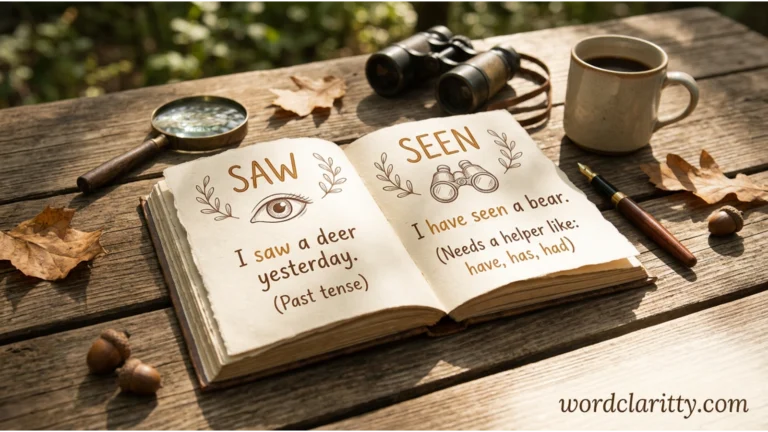
Have you ever wondered whether to say “I seen it” or “I saw it”? If so, you are not alone. Many English learners confuse “seen” and “saw” because both come from the verb “see” and describe something noticed with the eyes. However, these words have different grammatical roles, and using the wrong one can make a sentence incorrect in standard English.
The difference becomes easier once you understand the simple past tense and the past participle. In this guide, you will learn when to use “seen” or “saw,” explore their meanings, discover common mistakes, and practise with easy examples to improve your everyday English.
Why “Seen” and “Saw” Are Confusing
The words “seen” and “saw” often confuse English learners because they are different forms of the same irregular verb, “see.”
Both refer to seeing or noticing something, but they are used in different grammatical structures.
1. Similar Pronunciation
“Seen” and “saw” do not have identical pronunciations, but learners may still mix them up because they belong to the same verb family.
Their pronunciations are:
- Seen: /siːn/ — sounds like “scene.”
- Saw: /sɔː/ in many British accents and /sɔ/ or /sɑ/ in American English, depending on the accent.
Both words begin with the same “s” sound, but their vowel sounds and endings differ.
Practising their pronunciation can help you recognize them more easily in conversations.
2. Similar Spelling
Both words begin with the letter “s,” but their spellings are noticeably different.
- Seen has four letters.
- Saw has three letters.
The real difficulty is not their spelling. It is understanding which verb form belongs in a particular sentence.
3. Context Confusion
Both words describe past experiences involving sight.
For example:
- “I saw that movie yesterday.”
- “I have seen that movie before.”
Both sentences refer to watching a movie in the past, but they use different tenses.
The first sentence uses the simple past tense, while the second uses the present perfect tense.
4. Common Learner Mistakes
Common mistakes include:
- Saying “I seen” instead of “I saw” in standard English.
- Saying “I have saw” instead of “I have seen.”
- Using “seen” without a helping verb in ordinary active perfect constructions.
- Confusing the simple past with the present perfect.
- Assuming that both words can be used interchangeably.
The easiest way to avoid these mistakes is to learn the three main forms of the verb:
See → Saw → Seen
Seen vs Saw Explained Simply
The difference between “seen” and “saw” depends on their grammatical roles.
“Saw” is the simple past tense of “see,” while “seen” is its past participle.
Simple Explanation
Saw: Used to describe something you saw at a particular time in the past.
Seen: Used mainly with helping verbs such as “have,” “has,” and “had,” or in passive constructions with forms of “be.”
For example:
- “I saw a bird yesterday.”
- “I have seen that bird before.”
Both sentences are correct, but their grammar is different.
One-Line Distinction
Use “saw” for the simple past, and use “seen” as the past participle in perfect tenses and passive constructions.
Two Example Sentences
Example 1: Saw
“I saw my teacher at the supermarket yesterday.”
This sentence describes a completed event in the past.
Example 2: Seen
“I have seen my teacher at that supermarket several times.”
This sentence describes a past experience that is relevant to the present.
Quick Grammar Rule
Remember these patterns:
- Subject + saw + object
- Subject + have/has/had + seen + object
For example:
“I saw the accident.”
“I have seen the accident footage.”
These simple patterns will help you choose the correct form.
Understanding Homophones in English
Homophones are common in English and can sometimes cause confusion in spelling and pronunciation.
Although “seen” and “saw” are not homophones, learning about homophones can help you understand why some English words sound similar but have different meanings.
What Are Homophones?
Homophones are words that have the same pronunciation but different meanings and often different spellings.
For example, “seen” and “scene” are homophones.
- Seen: The past participle of the verb “see.”
- Scene: A place where something happens or a part of a movie, play, or story.
Consider these sentences:
“I have seen that movie.”
“That was my favourite scene in the movie.”
The words “seen” and “scene” sound identical, but they have different meanings and grammatical roles.
Other common homophones include:
- Hear and here
- Right and write
- Sea and see
- Sun and son
- One and won
Why Homophones Cause Confusion
Homophones cause confusion because pronunciation alone does not reveal which spelling is correct.
For example:
“I can see the sea.”
The first word, “see,” is a verb, while “sea” is a noun.
However, the confusion between “seen” and “saw” is different. These words are not homophones because they sound different.
Instead, they are irregular verb forms that learners must use in the correct grammatical structures.
Understanding this difference helps you focus on the real problem: choosing the correct verb tense.
What Does “Seen” Mean?
Definition and Core Meaning
“Seen” is the past participle of the verb “see.”
It refers to something that has been noticed, observed, watched, or experienced through sight.
In standard English, “seen” commonly appears with helping verbs such as:
- Have
- Has
- Had
- Been
- Is, was, or were in passive constructions
For example:
“I have seen that movie.”
“She has seen the new building.”
“They had seen the warning signs.”
In these sentences, “seen” forms part of a perfect tense.
It can also appear in passive sentences:
“The missing dog was seen near the park.”
Here, “seen” describes something that was observed by someone.
Origin and Historical Use
The word “seen” comes from the Old English verb sēon, meaning “to see” or “to perceive.”
English has changed significantly over the centuries, but “see” has remained an irregular verb.
Unlike regular verbs that form the past tense by adding “-ed,” “see” changes its form.
Its three principal forms are:
- Base form: See
- Simple past: Saw
- Past participle: Seen
These forms developed through the historical evolution of English grammar.
Today, “seen” remains essential in perfect tenses and passive constructions.
Modern Usage and Synonyms
In modern English, “seen” is used in conversations, professional writing, literature, news reports, and academic discussions.
Depending on the context, related words include:
- Observed: Noticed or watched carefully.
- Noticed: Became aware of something.
- Witnessed: Saw an event happen.
- Viewed: Looked at something.
- Watched: Looked at something for a period of time.
- Recognized: Identified something familiar.
These words have related meanings but are not always interchangeable.
Example Sentences
- “I have seen this movie three times.”
- “She has seen many beautiful places.”
- “We had seen the building before it was renovated.”
- “The suspect was seen near the station.”
- “Have you seen my phone?”
- “They have never seen snow before.”
Notice that “seen” appears with an appropriate helping verb in each sentence.
When Should You Use “Seen”?
Use “seen” mainly when:
- Describing experiences with “have” or “has.”
- Referring to an earlier past event with “had.”
- Forming passive sentences.
- Describing something that has been observed.
For example:
“I have seen the results.”
This sentence is correct because “seen” follows the helping verb “have.”
What Does “Saw” Mean?
Definition and Core Meaning
“Saw” is the simple past tense of the verb “see.”
It describes something that someone noticed, watched, or observed in the past.
For example:
“I saw a rainbow yesterday.”
This means the speaker noticed a rainbow at a past time.
Unlike “seen,” “saw” does not require “have,” “has,” or “had” when it functions as the simple past form of “see.”
Origin and Historical Context
The word “saw” developed from the Old English past-tense forms of sēon.
English irregular verbs often change their internal vowel sounds instead of adding “-ed.”
For example:
- See → Saw → Seen
- Give → Gave → Given
- Take → Took → Taken
- Write → Wrote → Written
These patterns developed through the history of the English language.
Today, “saw” remains the standard simple past form of “see.”
Modern Usage and Synonyms
In everyday English, “saw” is used to describe completed past experiences.
Related words include:
- Noticed: Became aware of something.
- Observed: Looked at something carefully.
- Watched: Looked at something for a period of time.
- Witnessed: Saw an event occur.
- Spotted: Noticed something, often unexpectedly.
- Viewed: Looked at something.
The best alternative depends on the sentence.
For example:
“I saw a strange animal.”
You could also say:
“I spotted a strange animal.”
Both sentences describe noticing something in the past.
Example Sentences
- “I saw my friend at the shopping centre yesterday.”
- “She saw a beautiful sunset last evening.”
- “We saw an interesting documentary last night.”
- “He saw the accident from his window.”
- “They saw their grandparents last weekend.”
- “I saw your message this morning.”
Each sentence describes an event or experience in the past.
Another Meaning of “Saw”
The word “saw” can also be a noun or a verb related to cutting materials.
For example:
“He used a saw to cut the wood.”
Here, “saw” is a noun referring to a cutting tool.
“She sawed the wooden board into two pieces.”
In this sentence, “sawed” is the past tense of the separate verb “saw,” meaning to cut with a saw.
This meaning is different from “saw” as the past tense of “see.”
Seen vs Saw: Key Differences at a Glance
The following table summarizes the main differences.
| Word | Part of Speech | Meaning | Example Context |
|---|---|---|---|
| Seen | Verb (past participle) | Something observed or experienced | “I have seen that film.” |
| Saw | Verb (simple past) | Something observed at a past time | “I saw that film yesterday.” |
| Seen | Verb (passive construction) | Something that was observed | “The bird was seen near the lake.” |
| Saw | Noun | A tool used for cutting | “He bought a new saw.” |
| Saw | Verb (base form) | To cut using a saw | “They saw wood for the workshop.” |
Which One Is Correct?
Both “seen” and “saw” are correct English words, but they are used differently.
Use saw when describing a completed past action in the simple past tense.
Use seen when forming perfect tenses or passive constructions.
Compare:
- Correct: “I saw him yesterday.”
- Correct: “I have seen him before.”
- Incorrect in standard English: “I seen him yesterday.”
- Incorrect: “I have saw him before.”
The difference is grammatical, not simply a matter of personal preference.
How to Remember the Difference Between Seen and Saw
Learning a few memory tricks can help you use these verb forms correctly.
1. Remember the Three Verb Forms
The most important pattern is:
See → Saw → Seen
Think of them as three steps:
- See = present or base form.
- Saw = simple past.
- Seen = past participle.
For example:
“I see the bird.”
“I saw the bird yesterday.”
2. Connect “Seen” with Helping Verbs
A useful memory trick is to associate “seen” with “have,” “has,” and “had.”
Remember:
- Have seen
- Has seen
- Had seen
For example:
“She has seen the movie.”
This pattern works for perfect tenses. In passive sentences, “seen” can also follow forms of “be,” such as “was seen.”
3. Connect “Saw” with Yesterday
The word “yesterday” often signals a completed past event.
For example:
“I saw him yesterday.”
You can also use “saw” with expressions such as:
- Last night
- Last week
- Two days ago
- In 2020
- This morning, when referring to a completed past event
These time expressions often appear with the simple past tense.
4. One Memorable Example
Imagine watching a movie.
Yesterday, you say:
“I saw a great movie.”
Today, someone asks whether you know the movie.
You reply:
“Yes, I have seen it.”
The first sentence focuses on a completed past event. The second describes your experience.
This simple comparison makes the difference easier to remember.
Common Mistakes and Confusions
English learners often confuse “seen” and “saw” because both describe past experiences.
Mistake 1: Saying “I Seen”
✘ Incorrect in standard English: “I seen him yesterday.”
✔ Correct: “I saw him yesterday.”
Explanation: The sentence uses the simple past tense, so “saw” is required in standard English.
Although “I seen” occurs in some regional and nonstandard varieties of English, it is not the usual form in formal standard English.
Mistake 2: Saying “I Have Saw”
✘ Incorrect: “I have saw that movie.”
✔ Correct: “I have seen that movie.”
Explanation: After the helping verb “have,” use the past participle “seen.”
Mistake 3: Saying “She Has Saw”
✘ Incorrect: “She has saw the results.”
✔ Correct: “She has seen the results.”
Explanation: The present perfect tense uses “has” plus the past participle.
Mistake 4: Using “Seen” Without the Correct Helping Verb
✘ Incorrect in standard English: “They seen the accident.”
✔ Correct: “They saw the accident.”
✔ Also correct: “They have seen the accident footage.”
Explanation: Use “saw” for the simple past and “seen” with the appropriate auxiliary verb.
Mistake 5: Confusing Simple Past and Present Perfect
✘ Incorrect: “I have seen him yesterday.”
✔ Correct: “I saw him yesterday.”
Explanation: In standard English, the present perfect is generally not used with a finished past-time expression such as “yesterday.”
Use the simple past when referring to a specific completed time.
Examples Section: Correct and Incorrect Usage
The following examples demonstrate the difference in everyday sentences.
Example 1: A Past Event
✔ Correct: “I saw a beautiful bird yesterday.”
✘ Incorrect: “I seen a beautiful bird yesterday.”
Why? The sentence describes a completed past event, so the simple past form “saw” is appropriate.
Example 2: Life Experience
✔ Correct: “I have seen that movie before.”
✘ Incorrect: “I have saw that movie before.”
Why? The present perfect tense requires the past participle “seen.”
Example 3: Third-Person Subject
✔ Correct: “She has seen the new shopping centre.”
✘ Incorrect: “She has saw the new shopping centre.”
Why? The helping verb “has” must be followed by “seen.”
Example 4: A Specific Past Time
✔ Correct: “We saw our teacher last Monday.”
✘ Incorrect: “We seen our teacher last Monday.”
Why? The sentence refers to a specific past event, so “saw” is correct in standard English.
Example 5: Past Perfect Tense
✔ Correct: “They had seen the building before it was demolished.”
✘ Incorrect: “They had saw the building before it was demolished.”
Why? The past perfect tense requires “had” plus the past participle.
Example 6: Passive Voice
✔ Correct: “The missing dog was seen near the park.”
✘ Incorrect: “The missing dog was saw near the park.”
Why? Passive constructions use the past participle “seen,” not the simple past form “saw.”
Self-Assessment: Test Your Knowledge
Choose the correct word to complete each sentence.
Question 1: I _ a beautiful rainbow yesterday.
a) Seen
b) Saw
Question 2: She has _ that movie three times.
a) Seen
b) Saw
Question 3: We _ our grandparents last weekend.
a) Seen
b) Saw
Question 4: The missing cat was _ near the school.
a) Seen
b) Saw
Self-Assessment Answers
Answer 1: b) Saw
“I saw a beautiful rainbow yesterday.”
The sentence describes a completed past event.
Answer 2: a) Seen
“She has seen that movie three times.”
The helping verb “has” requires the past participle “seen.”
Answer 3: b) Saw
“We saw our grandparents last weekend.”
The sentence uses the simple past tense.
Answer 4: a) Seen
“The missing cat was seen near the school.”
The sentence uses the passive voice, which requires the past participle.
How Did You Do?
- 4 correct: Excellent! You understand the difference.
- 3 correct: Very good. Review the example you missed.
- 1–2 correct: Practise the pattern “see, saw, seen.”
- 0 correct: Start with the basic rule: “saw” is simple past, and “seen” is the past participle.
FAQs About Seen and Saw
1. What Is the Difference Between Seen and Saw?
“Saw” is the simple past tense of “see,” while “seen” is the past participle. Use “saw” for simple past statements and “seen” in perfect tenses or passive constructions.
2. Is It Correct to Say “I Seen” or “I Saw”?
“I saw” is correct in standard English when describing a completed past event. “I seen” occurs in some nonstandard and regional dialects but is generally avoided in formal writing.
3. Is It “I Have Seen” or “I Have Saw”?
“I have seen” is correct. The present perfect tense requires the past participle “seen” after the helping verb “have.”
4. Can I Use Seen Without Have or Has?
Yes. “Seen” can appear with other helping verbs, such as “had,” “was,” and “were.” For example, “The bird was seen near the lake.” It can also appear in reduced clauses, such as “Seen from above, the city looked beautiful.”
5. What Is the Past Tense of See?
The simple past tense of “see” is “saw.” For example, “I saw my friend yesterday.” The past participle is “seen.”
6. Is It Correct to Say “I Seen It Yesterday”?
Not in standard English. The standard form is “I saw it yesterday.” Some dialects use “seen” differently, but “saw” is expected in formal standard English.
7. How Can I Remember Seen vs Saw?
Remember the three verb forms: see, saw, seen. Use “saw” for simple past events and “seen” with helping verbs in perfect tenses or passive constructions.
Final Conclusion: Using Seen and Saw Correctly
Understanding the difference between “seen” and “saw” is an important step toward improving your English grammar, especially when talking about past experiences and completed events. Although both words come from the irregular verb “see,” they serve different grammatical purposes. “Saw” is the simple past tense, used to describe something you noticed or experienced in the past. “Seen” is the past participle, commonly used with helping verbs such as “have,” “has,” and “had,” as well as in passive constructions.
For example, “I saw a movie yesterday” describes a completed past event, while “I have seen that movie before” describes a past experience connected to the present. Both sentences are correct, but their grammatical structures are different. Learning to recognize these patterns will help you avoid common mistakes such as “I seen” and “I have saw” in standard English.
The easiest way to remember the difference is to practise the three main verb forms: see, saw, seen. Connect “saw” with completed past events and remember that “seen” often appears with helping verbs. Reading example sentences aloud and creating your own examples can make these patterns feel more natural.
As you continue learning English, remember that irregular verbs become easier through repetition and regular practice. Pay attention to how these words appear in conversations, books, and everyday writing. With patience and consistent effort, you will soon use “seen” and “saw” confidently and correctly.