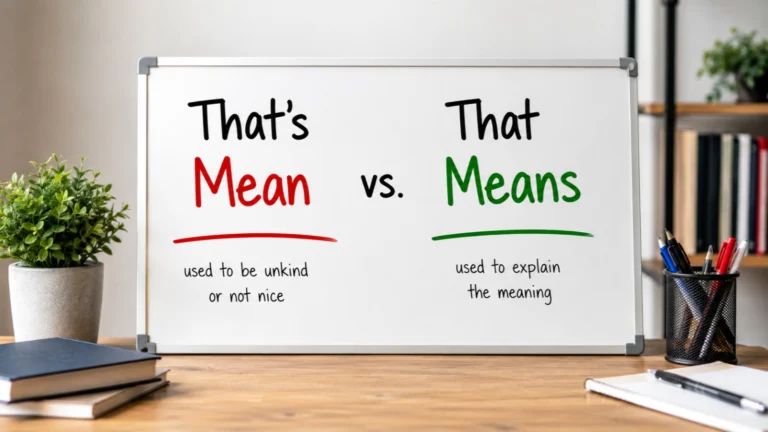
That’s Mean vs That Means is a common point of confusion for English learners because the two expressions look almost identical but have different meanings and uses. Understanding That’s Mean vs That Means can help you avoid grammar mistakes and communicate more naturally in both speaking and writing. “That’s mean” describes someone’s behavior as unkind or rude, while “that means” is used to explain the meaning or result of something. Mixing them up can completely change what you want to say. In this guide, you’ll learn the difference between these phrases, when to use each one, common mistakes to avoid, and plenty of simple examples to help you use them correctly with confidence.
Why “That’s Mean” and “That Means” Are Confusing
Many learners accidentally use “that’s mean” when they actually want to say “that means.” This happens for several reasons.
Similar Pronunciation
When spoken quickly, “that’s mean” and “that means” can sound very similar. Native speakers often connect words together, making it difficult for learners to hear the difference.
Similar Spelling
The words mean and means differ by only one letter. Because they look nearly identical, learners may type or write the wrong form.
Context Confusion
The word mean has several meanings in English. It can describe someone who is unkind, or it can refer to the meaning of something. This creates additional confusion.
Common Learner Mistakes
Many English learners write sentences like:
- “That’s mean I have to leave.”
- “That’s mean you are correct.”
These sentences are incorrect because “that’s mean” does not express explanation or interpretation.
That’s Mean vs That Means Explained Simply
The easiest way to understand the difference is this:
“That’s mean” usually describes someone or something as unkind or cruel, while “that means” explains the meaning or result of something.
One-Line Distinction
“That’s mean” describes behavior, while “that means” explains meaning or consequences.
Example Sentences
- That’s mean: “You laughed at him? That’s mean.”
- That’s mean: “Ignoring your friend is that’s mean.” (Incorrect because it should be “That is mean.”)
- That means: “The store is closed. That means we’ll come back tomorrow.”
- That means: “A red light means stop. That means you must wait.”
Understanding Homophones in English
What Are Homophones?
Homophones are words that sound the same but have different meanings or spellings.
Example:
- Their
- There
Although they sound alike, they are used differently.
Why Homophones Cause Confusion
English contains many words that sound nearly identical. Learners often rely on pronunciation instead of grammar or context.
For example:
- “They’re coming.”
- “Their car is outside.”
The pronunciation is almost the same, but the meanings are completely different. A similar problem happens with mean and means in everyday conversation.
What Does “That’s Mean” Mean?
Definition and Core Meaning
The phrase “that’s mean” is short for “that is mean.”
Here, mean is an adjective describing someone or something as:
- Unkind
- Cruel
- Hurtful
- Rude
It does not explain the meaning of something.
Origin and Historical Use
The adjective mean has existed in English for centuries. Over time, one of its most common meanings became “unkind” or “nasty.”
When people say “That’s mean!”, they are reacting to behavior they believe is unfair or hurtful.
Modern Usage and Synonyms
Common synonyms include:
- Unkind
- Cruel
- Rude
- Hurtful
- Nasty
- Harsh
Example Sentences
- That’s mean. You shouldn’t tease your little brother.
- Calling someone names is mean.
- It was mean to ignore her invitation.
- That joke was really mean.
What Does “That Means” Mean?
Definition and Core Meaning
“That means” is used when explaining the meaning, result, or consequence of something.
It answers questions such as:
- What does this indicate?
- What is the result?
- What is the explanation?
Origin and Historical Context
The verb mean comes from Old English and has long been used to express intention, significance, or explanation.
When used with that, it becomes a very common expression in both spoken and written English.
Modern Usage and Synonyms
Depending on the context, that means can be replaced with:
- That indicates
- That suggests
- That shows
- That implies
- In other words
- Therefore
Example Sentences
- The meeting starts at eight. That means we should leave early.
- She passed the exam. That means she can graduate.
- It’s raining. That means we’ll stay indoors.
- Your application was accepted. That means you got the job.
That’s Mean vs That Means: Key Differences at a Glance
| Word | Part of Speech | Meaning | Example Context |
|---|---|---|---|
| That’s mean | Adjective phrase | Someone or something is unkind or cruel | “That’s mean. Don’t say that.” |
| That means | Verb phrase | Explains meaning, result, or consequence | “That means we’re finished.” |
How to Remember the Difference Between That’s Mean and That Means
Learning a simple memory trick can make the difference much easier to remember.
Easy Memory Tricks
- Mean = Unkind person
- Means = Explains meaning
Association Technique
Think of the S in means as standing for “shows.”
If you’re explaining something, choose means.
Memorable Example
Imagine someone says:
“The train leaves in five minutes.”
You reply:
“That means we need to hurry.”
Now imagine someone pushes another person.
You say:
“That’s mean.”
One sentence explains a result, while the other describes behavior.
Common Mistakes and Confusions
Here are some mistakes learners often make.
Wrong
“That’s mean I have to study tonight.”
Correct
“That means I have to study tonight.”
Explanation: You are explaining a result, not describing someone as unkind.
Wrong
“That means of you.”
Correct
“That’s mean of you.”
Explanation: Here you are describing someone’s behavior as unkind.
Wrong
“That’s mean we missed the bus.”
Correct
“That means we missed the bus.”
Explanation: The sentence explains what happened.
Wrong
“That means to laugh at people.”
Correct
“That’s mean to laugh at people.”
Explanation: The sentence describes behavior as unkind.
Examples Section: Correct and Incorrect Usage
Example 1
✔ Correct: That means we should leave now.
✘ Incorrect: That’s mean we should leave now.
Example 2
✔ Correct: That’s mean. Please apologize.
✘ Incorrect: That means. Please apologize.
Example 3
✔ Correct: The lights are off. That means nobody is home.
✘ Incorrect: The lights are off. That’s mean nobody is home.
Example 4
✔ Correct: Making fun of others is mean.
✘ Incorrect: Making fun of others means.
Example 5
✔ Correct: The teacher smiled. That means we did well.
✘ Incorrect: The teacher smiled. That’s mean we did well.
Self Assessment: Test Your Knowledge
Fill in the blanks with that’s mean or that means.
- The bus already left. __________ we’ll have to wait.
- Laughing at someone is __________.
- The restaurant is closed. __________ we need another place to eat.
- Taking someone’s lunch without asking is __________.
Self Assessment Answers
- That means
- That’s mean
- That means
- That’s mean
FAQs About “That’s Mean” and “That Means”
Is “that’s mean” grammatically correct?
Yes. It is correct when you are saying that someone or something is unkind or cruel.
Is “that means” grammatically correct?
Yes. It is the correct phrase when explaining the meaning or result of something.
Why do people confuse “that’s mean” and “that means”?
They sound very similar in everyday speech, and the words mean and means look almost identical.
Can “mean” be both an adjective and a verb?
Yes. As an adjective, it describes someone as unkind. As a verb, it refers to expressing or explaining meaning.
Which phrase is more common?
That means appears much more frequently because people often explain ideas, instructions, and results in everyday conversations.
How can I remember which one to use?
Remember:
- Mean = unkind
- Means = explains
This simple rule works in almost every situation.
Final Conclusion: Using “That’s Mean” and “That Means” Correctly
Although “that’s mean” and “that means” may sound alike, they serve completely different purposes in English. “That’s mean” is used when describing someone or something as unkind, rude, or hurtful. It expresses an opinion about behavior. On the other hand, “that means” is used to explain the meaning, result, or consequence of a statement or situation. Knowing this distinction will help you avoid one of the most common mistakes made by English learners.
A simple way to remember the difference is to focus on the purpose of your sentence. If you are talking about someone’s behavior, use “that’s mean.” If you are explaining what something indicates or what happens next, use “that means.” Reading, listening, and practicing with real-life examples will make choosing the correct phrase feel natural over time.
English is full of similar-looking and similar-sounding expressions, but every mistake is an opportunity to learn. The more you notice these small differences, the more confident and accurate your speaking and writing will become. Keep practicing with everyday conversations, pay attention to context, and don’t be afraid to correct yourself. With regular practice, using “that’s mean” and “that means” correctly will soon become second nature.