Have you ever noticed a small, brown, biting creature and wondered whether it was a tick or a bed bug? These two pests can look similar at first, especially when they are small or have recently fed. However, they are different creatures with different habits, habitats, and health risks. English learners may also confuse their names when reading about insects, household pests, or outdoor safety.
Understanding the difference between a tick and a bed bug helps you use the correct vocabulary and recognize important signs of each pest. This guide explains their meanings, appearances, origins, pronunciation, and common uses through simple definitions and practical examples.
Why “Tick” and “Bed Bug” Are Confusing
Ticks and bed bugs are often confused because both are small parasites that feed on blood. Their bites may cause itching, redness, or irritation, and both can be difficult to identify without looking closely.
However, they belong to different groups of animals.
1. Similar Pronunciation
The words do not sound alike.
- Tick: /tɪk/ — one syllable, rhyming with “pick.”
- Bed bug: /ˈbed ˌbʌɡ/ — two words, pronounced “BED bug.”
Therefore, pronunciation is not the main reason people confuse them. The confusion usually comes from their appearance and biting behaviour.
2. Similar Spelling
The spellings are also different.
“Tick” is a single four-letter word, while “bed bug” is a two-word noun phrase. You may also see “bedbug” written as one word, particularly in scientific or pest-control writing. Both “bed bug” and “bedbug” are accepted spellings.
3. Context Confusion
Both creatures may be discussed in conversations about bites, skin irritation, and pest problems.
For example:
“I found a small brown creature on my skin.”
Without additional information, it may be difficult to know whether the creature was a tick or a bed bug.
4. Common Learner Mistakes
Common misunderstandings include:
- Thinking that ticks and bed bugs are the same animal.
- Assuming that both normally live in mattresses.
- Believing that both stay attached to the skin for several days.
- Calling ticks insects.
- Assuming that bed bugs commonly transmit diseases to humans.
- Using the names interchangeably because both creatures bite.
Learning their physical characteristics and behaviour helps prevent these mistakes.
Tick vs Bed Bug Explained Simply
A tick is a blood-feeding arachnid that attaches to a host, while a bed bug is a blood-feeding insect that usually hides near sleeping areas and feeds briefly.
Simple Explanation
Tick: A small parasitic arachnid related to spiders and mites. Ticks attach to animals or humans and may remain attached while feeding for several days.
Bed bug: A small, flat, wingless insect that feeds on blood, usually while people are resting or sleeping. It typically hides in cracks, mattress seams, or nearby furniture between meals.
One-Line Distinction
Ticks attach to their hosts for extended feeding, while bed bugs usually bite briefly and return to hiding places.
Two Example Sentences
Example 1: Tick
“The hiker found a tick attached to his leg after walking through tall grass.”
Example 2: Bed Bug
“The hotel guest noticed signs of bed bugs near the mattress seams.”
Both sentences correctly identify the creatures based on their usual behaviour and environment.
Understanding Homophones in English
Homophones are an important part of English vocabulary. However, the words “tick” and “bed bug” are not homophones.
What Are Homophones?
Homophones are words that sound the same but have different meanings and often different spellings.
For example:
- Hear: To notice sound.
- Here: In this place.
Consider these sentences:
“I can hear a strange noise.”
“Please come here.”
Although “hear” and “here” sound the same, their meanings are different.
Other common homophones include:
- Sea and see
- Right and write
- Sun and son
- One and won
Why Homophones Cause Confusion
Homophones confuse learners because pronunciation alone cannot always reveal which word is intended.
For example:
“The child saw a bee.”
“The child wanted to be a doctor.”
“Bee” and “be” sound identical but have different meanings.
The confusion between “tick” and “bed bug” is different. These terms have different pronunciations and spellings, but they refer to creatures with some similar feeding habits.
The best way to distinguish them is to understand their meanings, appearance, and behaviour.
What Does “Tick” Mean?
Definition and Core Meaning
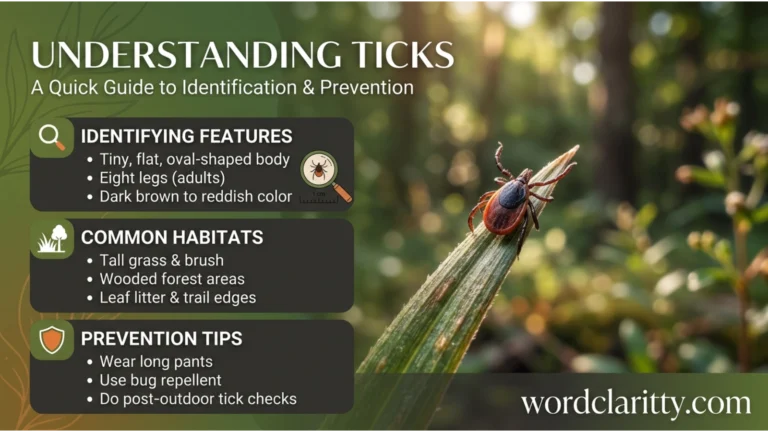
A tick is a small, blood-feeding arachnid belonging to the group that includes spiders and mites.
Unlike insects, adult ticks have eight legs. They attach to humans, pets, livestock, or wild animals to feed on blood.
Important characteristics include:
- Adult ticks have eight legs.
- Young tick larvae have six legs.
- They do not have wings.
- Many species wait on vegetation for passing hosts.
- They can remain attached while feeding for several days.
- Some species can transmit infections to humans or animals.
Ticks are commonly encountered in grassy, wooded, or brushy environments, although their habitats vary by species and region.
Origin and Historical Use
The English word “tick” has roots in Old English and has long been used for small parasitic creatures.
People have recognized ticks as blood-feeding parasites for centuries, especially because they affect livestock, pets, and humans.
Over time, scientific research helped explain their life cycles, feeding behaviour, and role in transmitting certain infectious diseases.
Today, the word is commonly used in medicine, veterinary care, outdoor safety, and pest identification.
Modern Usage and Synonyms
In modern English, “tick” has several meanings beyond the animal.
It can refer to:
- Parasitic arachnid: A creature that feeds on blood.
- Check mark: In British English, a tick can mean the mark ✓.
- Clock sound: A short clicking sound made by a clock.
- Verb: To make a ticking sound or mark an item as completed.
For the animal, related terms include “parasite” and “blood-feeding arachnid.” These are descriptions rather than exact synonyms.
Example Sentences
- “A tick attached itself to the dog’s ear.”
- “She checked her clothing for ticks after hiking.”
- “Some ticks can transmit infections through their bites.”
- “The veterinarian removed a tick from the cat.”
- “The teacher asked students to put a tick beside the correct answer.”
- “I could hear the clock tick in the quiet room.”
The last two examples show that “tick” can have meanings unrelated to the animal.
What Does “Bed Bug” Mean?
Definition and Core Meaning
A bed bug is a small, wingless insect that feeds on the blood of humans and other animals.
Bed bugs are usually reddish-brown, oval-shaped, and relatively flat before feeding. They often hide near places where people sleep.
Important characteristics include:
- Adult bed bugs have six legs.
- They are insects, not arachnids.
- They do not fly.
- They usually feed for several minutes.
- They hide in cracks, mattress seams, bed frames, and furniture.
- Their bites may cause itching or skin irritation.
- They are not known to transmit diseases to humans under ordinary conditions.
Bed bugs are mainly associated with indoor infestations, although they can spread through luggage, clothing, furniture, and other belongings.
Origin and Historical Context
The expression “bed bug” combines two familiar English words:
- Bed: Furniture used for sleeping.
- Bug: An informal term commonly used for small insects.
The name reflects the insect’s tendency to hide near sleeping areas and feed on people while they rest.
Bed bugs have lived alongside humans for thousands of years. Historical accounts describe similar blood-feeding insects in ancient societies.
Their numbers declined in some regions during parts of the twentieth century, but infestations later increased in many places.
Today, bed bugs remain an important concern for households, hotels, apartment buildings, and pest-control professionals.
Modern Usage and Synonyms
The standard terms include:
- Bed bug: Common two-word spelling.
- Bedbug: Accepted one-word spelling.
- Cimex lectularius: Scientific name of the common bed bug.
- Blood-feeding insect: A descriptive term.
- Household pest: A broader category that includes bed bugs.
“Bed bug” and “bedbug” refer to the same type of insect.
Example Sentences
- “The family discovered bed bugs in their bedroom.”
- “A bed bug was hiding near the mattress seam.”
- “The hotel arranged professional treatment for the infestation.”
- “Bed bugs can travel between locations in luggage.”
- “The pest-control specialist identified the insect as a bedbug.”
- “Bed bug bites may cause itchy red marks.”
These sentences show how the term is used in everyday conversations and pest-control discussions.
Tick vs Bed Bug: Key Differences at a Glance
The following table explains the major differences between ticks and bed bugs.
| Word | Part of Speech | Meaning | Example Context |
|---|---|---|---|
| Tick | Noun | A blood-feeding arachnid | “A tick attached to the dog’s skin.” |
| Tick | Verb | To make a clicking sound or mark something as completed | “Tick the correct answer.” |
| Bed bug | Noun phrase | A small, blood-feeding insect often found near sleeping areas | “A bed bug was hiding in the mattress seam.” |
| Bedbug | Noun | Alternative spelling of bed bug | “The inspector found a bedbug.” |
Physical and Behavioural Differences
| Feature | Tick | Bed Bug |
|---|---|---|
| Animal group | Arachnid | Insect |
| Adult legs | Eight | Six |
| Typical body shape | Oval, often becoming swollen after feeding | Broad, oval, and flat before feeding |
| Common habitat | Vegetation, outdoor environments, animal hosts | Indoor cracks, beds, and nearby furniture |
| Feeding behaviour | Attaches for an extended period | Usually feeds briefly and hides |
| Wings | None | None |
| Disease transmission | Some species transmit diseases | Not known to transmit diseases to humans |
| Common concern | Tick-borne infections | Itching, allergic reactions, sleep disruption, and infestations |
Which Word Is Correct?
Both words are correct, but they refer to different creatures.
Use tick when describing a blood-feeding arachnid that attaches to a host.
Use bed bug when describing a small insect that commonly hides near sleeping areas and feeds briefly.
The correct choice depends on the creature you are describing.
How to Remember the Difference Between Tick and Bed Bug
Simple memory tricks can help you remember the difference between these two pests.
1. Tick Means Attachment
Think of a tick as a creature that attaches firmly to its host.
Memory trick: Tick → Attach → Stay and Feed
For example:
“The tick remained attached to the dog’s skin.”
This association helps you remember the tick’s feeding behaviour.
2. Bed Bug Means Bedtime
The name “bed bug” contains the word “bed,” making it easier to remember where the insect is commonly found.
Memory trick: Bed Bug → Bed → Hide and Bite
For example:
“The bed bug hid in the mattress seam.”
Bed bugs can hide in other furniture and cracks too, but their association with sleeping areas is a useful clue.
3. Remember the Number of Legs
Another simple method is to remember the number of legs.
- Adult tick: Eight legs.
- Bed bug: Six legs.
This distinction reflects their different biological groups.
Remember that tick larvae have six legs, so leg counting alone is not always enough to identify a very small specimen.
4. One Memorable Example
Imagine two situations.
First, a person walks through tall grass and later finds a tick attached to their leg.
Second, a traveller notices small insects hiding near the seams of a hotel mattress.
The first situation suggests a tick, while the second suggests bed bugs.
These images make the differences easier to remember.
Common Mistakes and Confusions
Mistake 1: Calling a Tick an Insect
✘ Incorrect: “A tick is an insect with six legs.”
✔ Correct: “An adult tick is an arachnid with eight legs.”
Explanation: Adult ticks belong to the arachnid group, while bed bugs are insects.
Mistake 2: Assuming Bed Bugs Stay Attached
✘ Incorrect: “Bed bugs usually remain attached to people for several days.”
✔ Correct: “Bed bugs generally feed briefly and then return to hiding places.”
Explanation: Extended attachment is characteristic of ticks, not bed bugs.
Mistake 3: Assuming Both Commonly Spread Disease
✘ Incorrect: “Bed bugs and ticks commonly transmit the same diseases.”
✔ Correct: “Some ticks can transmit infections, while bed bugs are not known to transmit diseases to humans.”
Explanation: Their health risks differ significantly.
Mistake 4: Assuming Ticks Only Live in Beds
✘ Incorrect: “Ticks normally live in mattress seams.”
✔ Correct: “Ticks are commonly encountered outdoors or on animal hosts.”
Explanation: Mattress seams are more strongly associated with bed bugs.
Mistake 5: Identifying a Pest from Bites Alone
✘ Incorrect: “An itchy red bite proves that a bed bug caused it.”
✔ Correct: “An itchy bite may have several causes, so additional evidence is needed.”
Explanation: Bite marks alone cannot reliably identify the creature responsible.
Examples Section: Correct and Incorrect Usage
Example 1: Outdoor Exposure
✔ Correct: “The hiker found a tick attached to her ankle.”
✘ Incorrect: “The hiker found a bed bug attached to her ankle for three days.”
Why? Ticks can remain attached while feeding for extended periods. Bed bugs generally do not.
Example 2: Bedroom Infestation
✔ Correct: “The pest-control specialist found bed bugs in the mattress seams.”
✘ Incorrect: “The pest-control specialist found a tick colony living permanently in the mattress seams.”
Why? Bed bugs commonly hide and reproduce around sleeping areas. Ticks do not typically establish mattress infestations.
Example 3: Animal Classification
✔ Correct: “An adult tick has eight legs.”
✘ Incorrect: “An adult tick is an insect with six legs.”
Why? Adult ticks are arachnids.
Example 4: Bed Bug Classification
✔ Correct: “A bed bug is a wingless insect with six legs.”
✘ Incorrect: “A bed bug is an eight-legged arachnid.”
Why? Bed bugs belong to the insect group.
Example 5: Disease Risk
✔ Correct: “Some tick species can transmit diseases to humans.”
✘ Incorrect: “All bed bugs transmit Lyme disease.”
Why? Lyme disease is associated with certain infected ticks, not bed bugs.
Example 6: Pest Identification
✔ Correct: “The insect was identified as a bed bug after a careful inspection.”
✘ Incorrect: “Every small brown creature found indoors is a bed bug.”
Why? Many small household pests look similar, so identification requires more than colour and location.
Self-Assessment: Test Your Knowledge
Choose the correct answer to complete each sentence.
Question 1: An adult ___ has eight legs and may remain attached to a host while feeding.
a) Tick
b) Bed bug
Question 2: A ___ commonly hides in mattress seams and feeds briefly on sleeping people.
a) Tick
b) Bed bug
Question 3: Some species of ___ can transmit Lyme disease.
a) Tick
b) Bed bug
Question 4: A ___ is a wingless insect with six legs.
a) Tick
b) Bed bug
Self-Assessment Answers
Answer 1: a) Tick
An adult tick has eight legs and can remain attached while feeding.
Answer 2: b) Bed bug
Bed bugs commonly hide near sleeping areas and feed briefly.
Answer 3: a) Tick
Certain infected ticks can transmit the bacteria responsible for Lyme disease.
Answer 4: b) Bed bug
Bed bugs are insects with six legs, unlike adult ticks, which have eight.
How Did You Do?
- 4 correct: Excellent! You understand the main differences.
- 3 correct: Great work. Review the question you missed.
- 1–2 correct: Practise comparing their appearance and feeding habits.
- 0 correct: Remember: ticks attach to hosts, while bed bugs usually hide near sleeping areas.
FAQs About Tick and Bed Bug
1. What Is the Main Difference Between a Tick and a Bed Bug?
A tick is an arachnid that attaches to a host for an extended blood meal. A bed bug is an insect that usually feeds briefly and hides near sleeping areas.
2. Do Ticks and Bed Bugs Look the Same?
They can appear similar because both may be small, oval, and brown. However, adult ticks have eight legs, while bed bugs have six. Their body shapes and feeding behaviour also differ.
3. Can Bed Bugs Transmit Lyme Disease?
No. Bed bugs are not known to transmit Lyme disease. The infection is transmitted through bites from certain infected ticks.
4. Can Ticks Live in Your Bed?
A tick may be carried indoors on clothing or pets and end up in a bed. However, ticks do not normally establish household infestations in mattresses the way bed bugs do.
5. Which Is More Dangerous: a Tick or a Bed Bug?
Ticks can present a greater infectious-disease risk because some species transmit serious illnesses. Bed bugs mainly cause itching, allergic reactions, sleep disruption, and stress. The actual risk depends on the species, location, and circumstances.
6. How Can You Tell a Tick Bite from a Bed Bug Bite?
A tick may still be attached when discovered, while bed bugs usually leave after feeding. However, bite appearance alone is unreliable. Identification of the creature or other evidence is more useful.
7. What Should You Do If You Find a Tick Attached to Your Skin?
Remove it promptly with fine-tipped tweezers, gripping it as close to the skin as possible and pulling steadily upward. Clean the area afterward. Seek medical advice if you develop a rash, fever, or other concerning symptoms.
Conclusion:
Understanding the difference between a tick and a bed bug helps you improve your English vocabulary while learning useful information about two common blood-feeding pests. Although both creatures can bite humans and cause skin irritation, they belong to different animal groups and behave in different ways. A tick is an arachnid that often attaches to a host for an extended period, while a bed bug is an insect that usually feeds briefly and hides near sleeping areas. Adult ticks have eight legs, whereas bed bugs have six.
In everyday English, you will often encounter the word “tick” in discussions about hiking, pets, outdoor activities, and tick-borne diseases. Meanwhile, “bed bug” commonly appears in conversations about mattresses, hotels, household infestations, and pest-control services. Both terms are correct, but they should not be used interchangeably.To remember the distinction, associate ticks with attachment and outdoor exposure, and bed bugs with hiding near beds and feeding briefly. You can also remember their different numbers of legs as a useful identification clue.
However, identifying a real pest may require more than a quick glance, and bite marks alone are not reliable evidence. If you discover an attached tick or suspect a bed bug infestation, appropriate identification and action are important.Keep practising these words in sentences and everyday conversations. The more you connect vocabulary with real examples, the easier it becomes to use English accurately, confidently, and naturally.