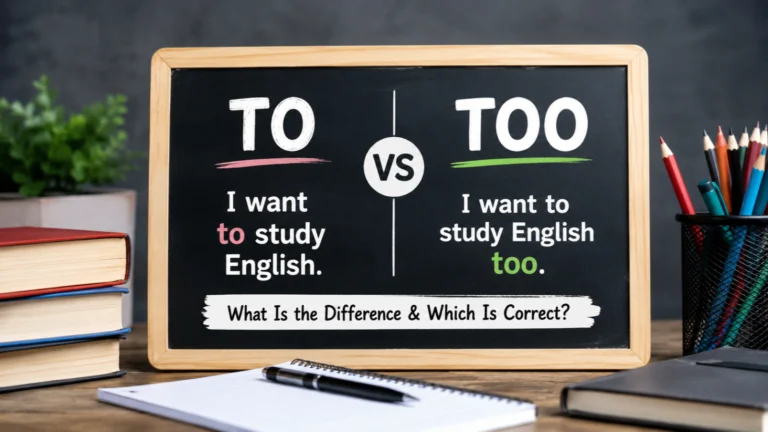
To vs Too is one of the most common grammar topics that confuses English learners because these two words sound exactly the same but have different meanings and uses. Many people accidentally use one in place of the other, leading to writing mistakes that can affect clarity and professionalism. Understanding To vs Too is easier than you might think once you learn a few simple rules and see practical examples. In this guide, you’ll discover the meaning of each word, when to use them correctly, common mistakes to avoid, and easy memory tips to help you remember the difference. By the end, you’ll feel more confident using To vs Too accurately in everyday conversations, emails, school assignments, and professional writing.
Why “To” and “Too” Are Confusing
Many people confuse to and too because they are pronounced the same but have different meanings.
Similar Pronunciation
Both words are pronounced as /tuː/. Since they sound identical, listeners cannot tell which word is being used without context.
Similar Spelling
The words differ by only one extra “o.” This small spelling difference makes typing and writing mistakes very common.
Context Confusion
The meaning changes depending on the sentence.
For example:
- I want to learn English.
- I want too learn English. ✘
The first sentence is correct because to introduces the verb learn.
Common Learner Mistakes
English learners often:
- Write too instead of to before verbs.
- Forget that too often means also or more than enough.
- Assume the words can be used interchangeably.
Fortunately, learning a few simple rules makes the difference easy to remember.
To vs Too Explained Simply
To means showing direction, purpose, destination, or introducing a verb, while too means also or more than necessary.
One-Line Distinction
“To” connects, while “too” adds.
Examples
To
- I want to read this book.
- We walked to the park.
Too
- I want to read too.
- The bag is too heavy.
Understanding Homophones in English
What Are Homophones?
Homophones are words that sound the same but have different meanings and spellings.
Example:
- two
- to
- too
Although they sound identical, each word has a different purpose.
Why Homophones Cause Confusion
Since homophones are pronounced the same, learners often choose the wrong spelling while writing.
For example:
- She went to school. ✔
- She went too school. ✘
Listening alone does not reveal which spelling is correct, so understanding grammar is essential.
What Does “To” Mean?
Definition and Core Meaning
To is one of the most frequently used words in English. It mainly functions as a preposition or as part of the infinitive form of a verb.
It can express:
- Direction
- Destination
- Purpose
- Relationship
- Time
- Movement
Origin and Historical Use
The word to comes from Old English tō, where it indicated movement toward a place or goal. It has been part of English for over a thousand years.
Modern Usage and Synonyms
Depending on context, to may mean:
- toward
- until
- for
- in the direction of
It also introduces infinitive verbs.
Examples:
- to eat
- to study
- to travel
Common Uses of “To”
- Shows direction
- Introduces infinitive verbs
- Indicates a recipient
- Expresses a limit or range
- Connects places and people
Example Sentences
- We drove to Lahore.
- I want to improve my English.
- She gave the gift to her friend.
- It is twenty to six.
What Does “Too” Mean?
Definition and Core Meaning
Too is an adverb.
It has two main meanings:
- Also
- More than enough or excessively
Origin and Historical Context
The word too developed from Old English tō, later evolving into its modern form to express excess or addition.
Modern Usage and Synonyms
When too means also, synonyms include:
- also
- as well
- likewise
When too means excessively, synonyms include:
- overly
- excessively
- extremely
Common Uses of “Too”
- Means “also”
- Means “as well”
- Shows excess
- Describes something beyond what is needed
Example Sentences
- I like pizza too.
- The coffee is too hot.
- She wants to come too.
- This box is too heavy to lift.
To vs Too: Key Differences at a Glance
| Word | Part of Speech | Meaning | Example Context |
|---|---|---|---|
| To | Preposition / Infinitive Marker | Shows direction, purpose, or introduces a verb | I want to sleep. |
| Too | Adverb | Also or more than enough | I want to sleep too. |
How to Remember the Difference Between To and Too
Here are a few easy tricks.
Memory Trick 1
Too has an extra “O.”
Think:
Extra O = Extra amount
Example:
- The soup is too salty.
Memory Trick 2
If you can replace the word with also, use too.
Example:
- I am coming too.
- I am coming also.
Both work.
Memory Trick 3
If the word comes before a verb, it is usually to.
Example:
- I want to study.
Memorable Example
“I want to go too.”
The first introduces the verb.
The second means “also.”
To vs Too: Common Mistakes and Confusions
Wrong
✘ I want too learn English.
✔ I want to learn English.
Explanation: Use to before a verb.
Wrong
✘ She is going too school.
✔ She is going to school.
Explanation: Use to for direction.
Wrong
✘ I like coffee to.
✔ I like coffee too.
Explanation: Here it means “also.”
Wrong
✘ The bag is to heavy.
✔ The bag is too heavy.
Explanation: “Too” expresses excess.
Examples Section: Correct and Incorrect Usage
Example 1
✔ Correct: I need to finish my homework.
✘ Incorrect: I need too finish my homework.
Example 2
✔ Correct: She wants ice cream too.
✘ Incorrect: She wants ice cream to.
Example 3
✔ Correct: We walked to the station.
✘ Incorrect: We walked too the station.
Example 4
✔ Correct: The weather is too cold today.
✘ Incorrect: The weather is to cold today.
Example 5
✔ Correct: He likes football, and I do too.
✘ Incorrect: He likes football, and I do to.
Example 6
✔ Correct: They decided to leave early.
✘ Incorrect: They decided too leave early.
Self Assessment: Test Your Knowledge
Fill in the blanks with to or too.
- I want _____ become a doctor.
- This chair is _____ small for two people.
- She is coming with us _____.
- We walked _____ the library after school.
Self Assessment Answers
- to
- too
- too
- to
To vs Too: FAQs About “To” and “Too”
1. What is the main difference between to and too?
To is used for direction, purpose, or before a verb, while too means also or more than enough.
2. Is too always an adverb?
Yes. Too functions as an adverb in English.
3. Can too mean “also”?
Yes.
Example:
“I enjoyed the movie too.”
4. How do I know whether to use to or too?
If the word means also or excessively, choose too. If it introduces a verb or shows direction, use to.
5. Why do learners confuse to and too?
Because they sound exactly the same and differ by only one letter.
6. Is “I want too eat” correct?
No.
The correct sentence is:
“I want to eat.”
7. What is an easy trick to remember too?
Remember that too has an extra O, which reminds you of something extra—either an extra person (“also”) or an extra amount (“more than enough”).
Final Conclusion: Using “To” and “Too” Correctly
Learning the difference between to and too may seem challenging at first, but it becomes much easier once you understand each word’s purpose. To is mainly used as a preposition or to introduce the base form of a verb, helping show direction, purpose, destination, or action. Too, on the other hand, is an adverb that means also or more than necessary. Although these words sound exactly alike, they play very different roles in English grammar. Paying attention to the context of a sentence is the key to choosing the correct word.
A simple memory trick can make a big difference: too has an extra “O,” which reminds you of something extra—an extra person included (“also”) or an extra amount (“more than enough”). If the word comes before a verb, it is usually to. If you can replace it with also, then too is almost certainly the correct choice. Reading English regularly, practicing with example sentences, and checking your own writing will help reinforce these patterns over time. Every mistake is an opportunity to learn, and even advanced English speakers occasionally pause to double-check homophones. Keep practicing, revisit these examples whenever needed, and you’ll soon use to and too naturally and confidently in both speaking and writing.