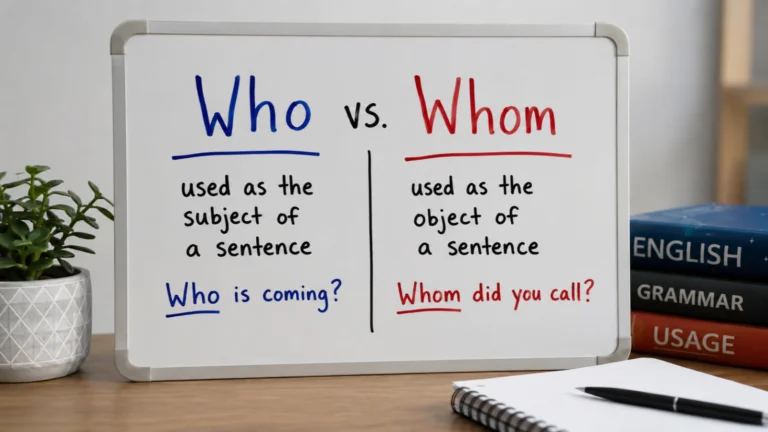
Who vs Whom is one of the most common grammar topics that confuses English learners and even native speakers. Although both words refer to people, they serve different roles in a sentence, making it easy to choose the wrong one. Understanding the difference can improve your writing, speaking, and overall confidence in English. In this guide, you’ll learn simple rules, practical examples, and easy memory tricks that make the distinction clear. Whether you’re writing an email, an essay, or a social media post, knowing when to use each word helps you communicate more accurately and professionally. By the end of this article, Who vs Whom will feel much less confusing, and you’ll be able to apply the correct form naturally in everyday English. Mastering Who vs Whom is easier than you might think.
Why “Who” and “Whom” Are Confusing
Many learners find who and whom difficult because they look similar and often appear in the same types of sentences. While the difference is based on grammar, everyday conversation doesn’t always follow strict rules.
Similar Pronunciation
In casual speech, who and whom often sound very similar. In many accents, the ending -m in whom is soft or barely noticeable.
Similar Spelling
Both words begin with who, making them easy to confuse when reading or writing.
Context Confusion
Since both words refer to people, learners may not know which one fits a particular sentence. The choice depends on the word’s grammatical role.
Common Learner Mistakes
- Using who instead of whom after prepositions.
- Using whom everywhere because it sounds more formal.
- Avoiding whom completely due to uncertainty.
Who vs Whom Explained Simply
Who is used as the subject of a sentence or clause.
Whom is used as the object of a verb or a preposition.
One-Line Distinction
“Who” performs the action, while “whom” receives the action.
Examples
- Who called you yesterday?
- Who wants to join the meeting?
- You should speak to whom you trust.
- Whom did the teacher praise?
Understanding Homophones in English
Although who and whom are not true homophones, they sound similar enough in natural speech that learners often confuse them.
What Are Homophones?
Homophones are words that sound alike but have different meanings and spellings.
Example:
- Flower and flour
These words are pronounced the same but have different meanings.
Why Homophones Cause Confusion
When two words sound alike, listeners may understand the meaning from context, but writers must choose the correct spelling and grammar.
For example:
- Their car is new.
- They’re buying a new car.
Although who and whom are not perfect homophones, they create a similar kind of confusion because their pronunciation is often very close.
What Does “Who” Mean?
Definition and Core Meaning
Who is a pronoun used to refer to the person performing an action or being described.
It answers questions such as:
- Who is coming?
- Who wrote this book?
Origin and Historical Use
The word who comes from Old English hwā, where it was used as an interrogative pronoun to ask about people. It has remained a central part of English grammar for centuries.
Modern Usage and Synonyms
Today, who is commonly used in questions and relative clauses.
Related words include:
- the person who
- whoever
- anyone who
Key Points
- Used as a subject.
- Refers only to people.
- Common in both spoken and written English.
- Frequently introduces questions.
Example Sentences
- Who opened the window?
- I know the person who helped us.
- Who is your favorite teacher?
- Who wants dessert?
What Does “Whom” Mean?
Definition and Core Meaning
Whom is the object form of who. It refers to the person receiving an action or following a preposition.
Examples:
- Whom did you invite?
- To whom should I address the letter?
Origin and Historical Context
Whom also comes from Old English and originally marked the objective case. While its use has declined in everyday speech, it remains important in formal writing and careful grammar.
Modern Usage and Synonyms
Today, whom appears most often:
- After prepositions
- In formal writing
- In academic English
- In legal documents
Key Points
- Used as an object.
- Often follows prepositions.
- More common in formal English.
- Less common in everyday conversation.
Example Sentences
- Whom did they choose?
- To whom should I send the email?
- The manager, whom everyone respected, retired.
- Whom are you waiting for?
Who vs Whom: Key Differences at a Glance
| Word | Part of Speech | Meaning | Example Context |
|---|---|---|---|
| Who | Subject pronoun | The person doing the action | Who wrote this report? |
| Whom | Object pronoun | The person receiving the action | Whom did you call? |
How to Remember the Difference Between Who and Whom
Learning a simple memory trick makes this grammar rule much easier.
Easy Memory Tricks
Trick 1: He = Who
If you can answer with he, use who.
Example:
Who called?
He called.
Therefore, who is correct.
Trick 2: Him = Whom
If you can answer with him, use whom.
Example:
Whom did you meet?
I met him.
Therefore, whom is correct.
Association Technique
Think of the matching letters:
- He → Who
- Him → Whom
Both him and whom end with m.
Memorable Example
Ask yourself:
“Can I replace the answer with he or him?”
This simple test works in most situations.
Common Mistakes and Confusions
Incorrect
Who did you give the package to?
Correct
Whom did you give the package to?
Explanation: The person receives the action.
Incorrect
Whom is coming today?
Correct
Who is coming today?
Explanation: The person performs the action.
Incorrect
Whom wants another piece?
Correct
Who wants another piece?
Explanation: The subject uses who.
Incorrect
Who should I thank?
Correct
Whom should I thank?
Explanation: The person is the object of the verb thank.
Examples Section: Correct and Incorrect Usage
Example 1
✔ Correct: Who won the competition?
✘ Incorrect: Whom won the competition?
Example 2
✔ Correct: Whom did the manager hire?
✘ Incorrect: Who did the manager hire?
Example 3
✔ Correct: The woman who lives next door is friendly.
✘ Incorrect: The woman whom lives next door is friendly.
Example 4
✔ Correct: To whom were you speaking?
✘ Incorrect: To who were you speaking?
Example 5
✔ Correct: Who is knocking at the door?
✘ Incorrect: Whom is knocking at the door?
Example 6
✔ Correct: Whom should we invite to dinner?
✘ Incorrect: Who should we invite to dinner?
Self Assessment: Test Your Knowledge
Fill in the blanks with who or whom.
- ______ called you this morning?
- To ______ should I send this message?
- ______ is responsible for this project?
- ______ did they select as team leader?
Self Assessment Answers
- Who
- Whom
- Who
- Whom
FAQs About “Who” and “Whom”
1. Is “whom” still used in modern English?
Yes. Although it is less common in everyday speech, whom is still widely used in formal writing, academic work, and professional communication.
2. Can I always use “who” instead of “whom”?
In casual conversation, many native speakers do. However, using whom correctly is recommended in formal English.
3. How can I quickly decide between who and whom?
Use the he/him test. If he fits, choose who. If him fits, choose whom.
4. Is “To whom it may concern” grammatically correct?
Yes. This is one of the most common formal uses of whom because it follows the preposition to.
5. Why do many native speakers avoid using “whom”?
Because modern spoken English has become more informal, many people simply use who in everyday conversations.
6. Is it wrong to say “Who did you call?”
Not in everyday conversation. Although whom is technically correct, who is widely accepted in informal speech.
7. Which word appears more often in formal writing?
Whom appears more frequently in formal documents, business letters, legal writing, and academic papers.
Final Conclusion: Using “Who” and “Whom” Correctly
Understanding the difference between who and whom does not have to be difficult. The key idea is simple: who is used for the person performing an action, while whom is used for the person receiving the action. Although many native English speakers use who in everyday conversation, knowing the correct grammatical rule can improve your writing, help you perform better in exams, and make your professional communication more polished.
One of the easiest ways to remember the difference is the he/him test. If the answer to your question would be he, use who. If the answer would be him, use whom. This quick trick solves most situations and builds confidence over time. Also, remember that whom often follows prepositions such as to, for, with, and by, especially in formal English.
The more examples you read and practice, the more natural these words will become. Don’t worry if you make mistakes at first—even experienced speakers occasionally pause to decide between who and whom. By applying the simple rules explained in this guide and practicing regularly, you’ll soon use both words accurately and confidently. Every small improvement strengthens your English skills, making your communication clearer, more professional, and more effective in real-life situations.