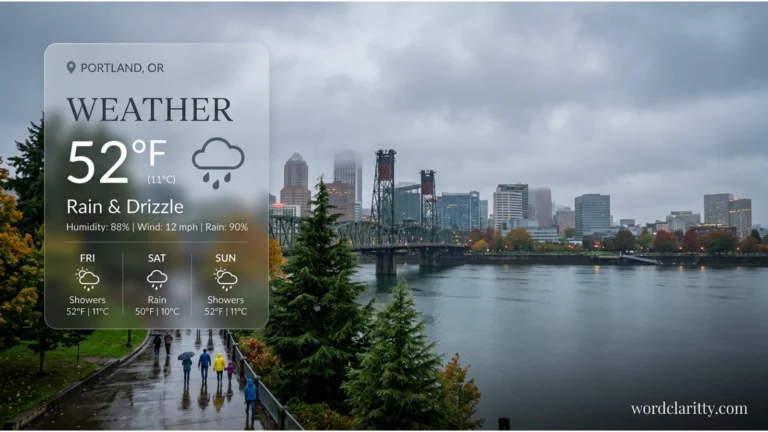
Have you ever searched for “weather Portland OR” and wondered whether it is a complete English sentence? Many English learners find weather-related search phrases confusing because search engines often use shortened expressions instead of complete sentences. The phrase is commonly used when looking for weather conditions in Portland, Oregon, but it is not a complete sentence in standard English.
Understanding the difference between a search keyword and a grammatically correct sentence can improve your English vocabulary, writing, and communication skills. This guide explains the meaning of “weather,” the abbreviation “OR,” common spelling mistakes, and how to ask about Portland’s weather correctly.
Why “Weather Portland OR” and “Weather in Portland, OR” Are Confusing
The expressions “weather Portland OR” and “weather in Portland, OR” can confuse English learners because they refer to the same subject but follow different writing conventions.
1. Similar Pronunciation
Both expressions contain the words “weather” and “Portland.” When spoken, they communicate a similar idea, although the second includes the preposition “in.”
The word “weather” is pronounced /ˈweðər/ in American English.
However, learners sometimes confuse “weather” with “whether,” which has the same pronunciation but a different meaning.
- Weather: Atmospheric conditions such as rain, sunshine, wind, and temperature.
- Whether: A word used to introduce alternatives, possibilities, or uncertainty.
For example:
“The weather in Portland is rainy.”
“I don’t know whether it will rain tomorrow.”
The words sound identical, but they perform different grammatical functions.
2. Similar Spelling
The words “weather” and “whether” look similar, making them easy to confuse.
Additionally, the abbreviation “OR” can create uncertainty because “or” is also a common English conjunction.
Compare:
- Portland, OR: Portland, Oregon.
- Tea or coffee: A choice between two drinks.
Capitalization and context help readers understand the intended meaning.
3. Context Confusion
Search engines accept short keyword phrases that omit prepositions and other grammatical elements.
For example:
This phrase is understandable as a search query.
However, in ordinary writing, the more natural expression is:
“The weather in Portland, OR.”
To ask a complete question, you could write:
“What is the weather like in Portland, Oregon?”
4. Common Learner Mistakes
English learners may:
- Confuse “weather” with “whether.”
- Forget the preposition “in” before a city name.
- Misunderstand “OR” as the conjunction “or.”
- Use search keywords as complete sentences.
- Forget to capitalize proper nouns such as Portland and Oregon.
Learning the difference between search language and standard sentence structure helps prevent these mistakes.
Weather Portland OR vs Weather in Portland, OR Explained Simply
“Weather Portland OR” is a shortened search phrase, while is a natural noun phrase used in standard English.
Both refer to atmospheric conditions in Portland, Oregon.
Simple Explanation
Weather Portland OR: A keyword-style expression commonly typed into search engines to find local weather information.
A grammatically natural phrase referring to the weather conditions in Portland, Oregon.
Neither expression is a complete sentence by itself, but the second fits naturally into standard English sentences.
One-Line Distinction
Use “weather Portland OR” for quick internet searches and “weather in Portland, OR” when writing naturally about the city’s weather.
Two Example Sentences
Example 1: Search Query
“I typed ‘weather Portland OR’ into the search engine to check the forecast.”
This sentence correctly presents the shortened phrase as a search query.
This sentence uses the preposition “in” to connect the weather with the location.
The important lesson is that search phrases and complete English sentences do not always follow the same structure.
Understanding Homophones in English
Homophones are words that sound alike but have different meanings. They are an important part of English spelling and vocabulary.
What Are Homophones?
Homophones are words that share the same pronunciation but have different meanings and often different spellings.
One common example is “weather” and “whether.”
Weather refers to atmospheric conditions.
Example:
“The weather is sunny today.”
Whether introduces alternatives or uncertainty.
Example:
“I am not sure whether it will rain.”
Both words sound the same, but they cannot be used interchangeably.
Other common homophones include:
- Here and hear
- Right and write
- Sea and see
- Their and there
- Flour and flower
Recognizing these word pairs helps learners choose the correct spelling.
Why Homophones Cause Confusion
Homophones create confusion because listeners cannot identify spelling from pronunciation alone.
For example:
Incorrect: “I don’t know weather I should take an umbrella.”
Correct: “I don’t know whether I should take an umbrella.”
The sentence expresses uncertainty, so “whether” is correct.
Compare that with:
“The weather in Portland is often rainy during the cooler months.”
Here, “weather” refers to atmospheric conditions.
Although are not themselves homophones, understanding “weather” and “whether” helps prevent a related and very common spelling mistake.
What Does “Weather Portland OR” Mean?
Definition and Core Meaning
“Weather Portland OR” is a search-engine keyword phrase used to find information about the Oregon.
The phrase contains three main elements:
- Weather: Atmospheric conditions in a particular place.
- Portland: A city in the U.S. state of Oregon.
- OR: The official two-letter postal abbreviation for Oregon.
Together, these words identify the topic and location of a weather search.
People may use this phrase to find:
- Current temperature
- Rainfall predictions
- Hourly weather conditions
- Wind speed and direction
- Daily and weekly forecasts
- Severe weather alerts
The phrase is understandable because search engines can interpret keywords without requiring complete grammatical sentences.
Origin and Historical Use
The word “weather” comes from Old English weder, which referred to atmospheric conditions such as wind, storms, and the state of the air.
The word has been used for centuries to describe conditions outdoors.
Portland, Oregon, was incorporated in 1851 and developed into an important city in the Pacific Northwest.
The abbreviation “OR” comes from the modern system of two-letter U.S. state postal abbreviations.
The exact phrase “weather Portland OR” is a modern search expression rather than a traditional English phrase. Its shortened structure reflects how people commonly search for information online.
Modern Usage and Synonyms
Today, people use variations of this phrase when looking for local forecasts.
Common alternatives include:
- Oregon
- forecast
- temperature today
- hourly
- Portland seven-day forecast
- Current weather conditions in Portland
These phrases have similar search intent, although some are more natural in full sentences.
Example Sentences
- “I searched for ‘weather before planning my trip.”
- “The search term ‘weather Portland OR’ can help users find local forecasts.”
- “My phone showed weather results after I entered ‘weather Portland OR.’”
- “The phrase ‘weather Portland OR’ is useful as a short search query.”
Notice that the keyword phrase appears in quotation marks because it is being discussed as a search term.
What Does “Weather in Portland, OR” Mean?
Definition and Core Meaning
It refers to the atmospheric conditions in, Oregon, including temperature, rainfall, wind, humidity, and sunshine.
It is a natural English noun phrase because it uses the preposition “in” to connect weather conditions with a location.
For example:
It is generally mild compared with many inland U.S. cities.”
The phrase can be used in statements, questions, articles, and weather reports.
Origin and Historical Context
English commonly uses the preposition “in” when describing conditions within a city, region, or country.
Examples include:
- Weather in London
- Weather in New York
- Weather in Seattle
- Weather in Oregon
The structure follows a familiar grammatical pattern:
Weather + in + location
This pattern is useful because it applies to almost any geographical place.
Modern Usage and Synonyms
In modern English is suitable for conversations, educational writing, news reports, and travel information.
Other natural expressions include:
- Portland’s weather
- Weather conditions in Portland
- The forecast
- The climate of Portland
- Current conditions in Portland
However, weather and climate are not exactly the same.
Weather describes atmospheric conditions over a short period, while climate describes typical weather patterns over many years.
For example:
“The weather in Portland is rainy today.”
“Portland has a climate with relatively wet winters and dry summers.”
The first sentence discusses a particular day’s conditions. The second describes the city’s general climate.
Example Sentences
- “What is the weather like in Portland, OR, today?”
- It can be rainy during winter.”
- “We checked the weather before booking our holiday.”
- “The weather in Portland is usually warmer in summer than in winter.”
- “She wants to know whether will be suitable for hiking.”
These examples show how the phrase fits naturally into standard English.
Weather Portland OR vs Weather in Portland, OR: Key Differences at a Glance
| Word or Phrase | Part of Speech | Meaning | Example Context |
|---|---|---|---|
| Weather | Noun or verb | Atmospheric conditions; also to endure or be affected by conditions | “The weather is pleasant.” |
| Whether | Conjunction | Introduces uncertainty or alternatives | “I wonder whether it will rain.” |
| Weather Portland OR | Search keyword phrase | A shortened search for Portland, Oregon weather | Searching online |
| Weather in Portland, OR | Noun phrase | Atmospheric conditions in Portland, Oregon | “The weather in Portland is mild.” |
| OR | State abbreviation | Oregon | “Portland, OR” |
| Or | Conjunction | Introduces a choice or alternative | “Rain or sunshine?” |
Which Expression Is Correct?
Both expressions can be appropriate, depending on their purpose.
For a search engine
For a complete question:
“What is the weather like in Portland, Oregon?”
For a complete statement:
“The weather in Oregon, changes with the seasons.”
The correct choice depends on whether you are entering search keywords or communicating in standard English.
How to Remember the Difference Between Weather Portland OR and Weather in Portland, OR
A few simple memory tricks can help you remember the correct wording.
1. Remember That Cities Usually Follow “In”
When discussing weather conditions in a city, English commonly uses the preposition “in.”
Examples:
- Weather in Paris
- Weather in Chicago
Think of the structure:
Weather + in + city
This pattern works in many everyday sentences.
2. Remember That “OR” Means Oregon
The uppercase letters “OR” identify the U.S. state of Oregon when they follow a city name in an address-style location.
For example:
“Portland, OR”
The lowercase word “or” is a conjunction used to introduce choices.
For example:
“Would you prefer rain or sunshine?”
Capitalization and punctuation help distinguish the meanings.
3. Associate “Weather” with Outdoor Conditions
Think of weather as everything happening in the atmosphere around you.
Examples include:
- Rain
- Snow
- Sunshine
- Wind
- Fog
- Temperature
If your sentence discusses these conditions, use “weather,” not “whether.”
4. Use One Memorable Example
Imagine you are planning a weekend trip to Portland.
You type:
Then you ask your friend:
“What is the weather like in Portland, Oregon, this weekend?”
The first expression is a search query. The second is a complete, natural English question.
Remembering this situation can help you choose the right structure.
Common Mistakes and Confusions
Mistake 1: Forgetting the Preposition
Incorrect: “What is today?”
Correct: “What is the weather like in Portland, OR, today?”
Explanation: A complete question needs natural grammatical structure. The preposition “in” connects the weather with the location.
Mistake 2: Confusing Weather and Whether
Incorrect: “I don’t know will be rainy.”
Correct: “I don’t know whether Portland will be rainy.”
Explanation: “Whether” introduces uncertainty, while “weather” refers to atmospheric conditions.
Mistake 3: Misunderstanding “OR”
Incorrect interpretation: “Portland OR” means choosing between Portland and another location.
Correct interpretation: “Portland, OR” identifies Portland in Oregon.
Explanation: Uppercase “OR” is the postal abbreviation for Oregon.
Mistake 4: Confusing Weather with Climate
Incorrect: “The climate in Portland is rainy this afternoon.”
Correct: “The weather in Portland is rainy this afternoon.”
Explanation: Weather describes short-term conditions. Climate refers to long-term patterns.
Mistake 5: Treating Search Keywords as Complete Sentences
Correct: “I checked the weather in Portland, OR.”
Explanation: Search engines accept shortened phrases, but ordinary English sentences require appropriate grammatical structure.
Examples Section: Correct and Incorrect Usage
Example 1: Asking About Today’s Weather
✔ Correct: “What is the weather like in Portland, Oregon, today?”
Why? The correct question uses natural English word order and the preposition “in.”
Example 2: Using Weather and Whether
✔ Correct: “I wonder whether the weather in Portland will improve.
Why? “Whether” introduces uncertainty, while “weather” refers to atmospheric conditions.
Example 3: Writing About Rain
✔ Correct: “The weather in Portland can be rainy during winter.”
✘ Incorrect: “The whether in Portland can be rainy during winter.”
Why? The sentence describes atmospheric conditions, so “weather” is correct.
Example 4: Using the State Abbreviation
✔ Correct: “My cousin lives in Portland, OR.”
✘ Incorrect: “My cousin lives in Portland or.”
Why? The abbreviation for Oregon is written with capital letters.
Example 5: Writing a Search Query
✘ Incorrect: “I searched for ‘whether Portland OR’ to find the temperature.”
Why? The word “weather” is appropriate when searching for temperature and atmospheric conditions.
Example 6: Describing a Forecast
✔ Correct: “The weather forecast for Portland predicts rain tomorrow.”
✘ Incorrect: “The whether forecast for Portland predicts rain tomorrow.”
Why? “Weather forecast” is the standard expression for a prediction of atmospheric conditions.
Self Assessment: Test Your Knowledge
Choose the correct word or phrase to complete each sentence.
Question 1: What is the ___ like in Portland, Oregon?
a) Weather
b) Whether
Question 2: I don’t know ___ it will rain tomorrow.
a) Weather
b) Whether
Question 3: Portland, ___, is located in the Pacific Northwest.
a) or
b) OR
Question 4: I checked the ___ before travelling.
a) in
b) at
Self Assessment Answers
Answer 1: a) Weather
The word “weather” refers to atmospheric conditions.
Answer 2: b) Whether
“I don’t know whether it will rain tomorrow.”
“Whether” introduces uncertainty.
Answer 3: b) OR
“Portland, OR, is located in the Pacific Northwest.”
The uppercase abbreviation “OR” stands for Oregon.
Answer 4: a) in
“I checked the weather in Portland before travelling.”
The preposition “in” is commonly used when describing weather conditions within a city.
FAQs:
1. What Does “Weather Portland OR” Mean?
“Weather Portland OR” is a shortened internet search phrase used to find weather information for Oregon. It commonly leads to temperature readings, rainfall predictions, and local forecasts.
2. Is “Weather Portland OR” Grammatically Correct?
It is acceptable as a search query, but it is not a complete standard English sentence. A natural alternative.
3. What Is the Difference Between Weather and Whether?
“Weather” refers to atmospheric conditions, while “whether” introduces uncertainty or alternatives. For example, “I wonder whether the weather will improve.”
4. What Does OR Mean in Portland OR?
“OR” is the official two-letter postal abbreviation for Oregon, the U.S. state where Portland is located.
5. What Is the Typical Weather in Portland, Oregon?
Portland generally has mild, wet winters and warm, relatively dry summers. Rain is common during the cooler months, while summer usually brings more sunshine and less rainfall.
6. How Do You Ask About Portland’s Weather Correctly?
You can ask, “ or “What is the weather forecast for Portland, Oregon?” Both are natural and grammatically correct questions.
7. Is Portland Weather the Same as Portland Climate?
No. Weather describes conditions at a particular time, such as today’s temperature or rainfall. Climate describes typical atmospheric patterns over many years.
Conclusion:
Understanding the difference between “weather Portland OR” and “weather in Portland, OR” can help English learners improve their grammar, vocabulary, and everyday communication. Although both expressions refer to atmospheric conditions in Portland, Oregon, they serve slightly different purposes. it is a shortened search phrase commonly used online, while it is a more natural expression for standard English writing. When asking a complete question, Oregon?” is an especially clear choice.
It is also important to remember the difference between “weather” and “whether.” Weather refers to atmospheric conditions such as rain, sunshine, wind, and temperature. Whether introduces uncertainty or alternatives. These words are homophones, so their pronunciation is the same even though their meanings are different Another useful detail is that “OR” is the official abbreviation for Oregon, while lowercase “or” is a conjunction used to express a choice. Recognizing this difference makes location-based expressions easier to understand.
To remember the correct sentence structure, use the simple pattern “weather in + city.” For example, you can say “weather in Portland,” “weather in Seattle,” or “weather in London.” This pattern works naturally in everyday EnglishAs you continue learning, practise using weather-related vocabulary in complete sentences. Pay attention to prepositions, spelling, and context when reading forecasts or discussing travel plans. With regular practice, these small differences will become easier to recognize, helping you communicate more clearly and confidently in English.

Bilal Hassan is a Master’s graduate, content writer, and author at WordClaritty.com. He specializes in creating clear, informative, and reader-friendly content focused on language, word meanings, and educational topics. With a passion for accuracy and simplicity, he helps readers expand their knowledge through engaging and easy-to-understand articles.