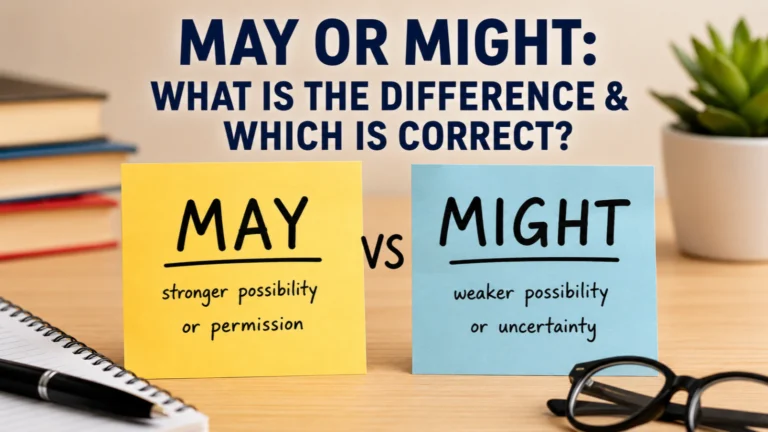
May or Might are two of the most commonly confused modal verbs in English. Many learners wonder when to use each one and whether they can be used interchangeably. Although both words often express possibility, they can carry slightly different meanings depending on the situation, level of certainty, or tone.
Understanding these differences will help you communicate more accurately in both speaking and writing. In this guide, you’ll learn the key rules, practical examples, and common mistakes to avoid, making it easier to choose the correct word with confidence. By the end of this article, you’ll clearly understand May or Might and know exactly when each one is the better choice.
Table of Contents
- Introduction
- Why “May” and “Might” Are Confusing
- May vs Might Explained Simply
- Understanding Homophones in English
- What Are Homophones?
- Why Homophones Cause Confusion
- What Does “May” Mean?
- What Does “Might” Mean?
- May vs Might: Key Differences at a Glance
- How to Remember the Difference Between May and Might
- Common Mistakes and Confusions
- Examples Section: Correct and Incorrect Usage
- Self Assessment: Test Your Knowledge
- Self Assessment Answers
- FAQs About “May and Might”
- Final Conclusion: Using “May” and “Might” Correctly
Why “May” and “Might” Are Confusing
Many English learners struggle with may and might because they often express similar ideas. In everyday conversation, native speakers sometimes use either word, making it difficult to know which one is the better choice.
Similar Pronunciation
Both words are short modal verbs and have similar sounds. They often appear in similar sentence patterns, which makes them easy to confuse.
Similar Spelling
Although may and might are spelled differently, they are closely connected in grammar and meaning. Learners often memorize them together, which can blur the distinction.
Context Confusion
Both words describe possibility, but may usually suggests a stronger possibility, while might often suggests a weaker or more uncertain one. However, in many modern conversations, the difference is very small.
Common Learner Mistakes
Some frequent mistakes include:
- Using might when asking for permission.
- Thinking may and might always mean exactly the same thing.
- Using may for hypothetical situations where might sounds more natural.
May vs Might Explained Simply
May means that something is possible or that permission is being given, while might usually expresses a less certain possibility or a hypothetical situation.
One-Line Distinction
May suggests a stronger possibility or formal permission, while might suggests a weaker possibility or uncertainty.
Examples
May
- We may visit the museum tomorrow.
- You may leave the classroom now.
Might
- We might visit the museum if the weather improves.
- She might know the answer.
Understanding Homophones in English
What Are Homophones?
Homophones are words that sound the same but have different meanings and often different spellings.
Example:
- Sea and see
Although may and might are not homophones, learners often confuse them because they have similar meanings and grammatical functions.
Why Homophones Cause Confusion
Words that sound alike—or words with very similar meanings—can easily be mixed up.
Example:
- I went to the sea.
- I want to see you tomorrow.
Likewise, learners sometimes choose may when might would express the intended level of certainty more accurately.
What Does “May” Mean?
Definition and Core Meaning
May is a modal verb used to express:
- Possibility
- Permission
- Wishes or hopes (less commonly)
It usually indicates that something has a reasonable chance of happening.
Origin and Historical Use
The word may comes from Old English mæg, meaning “to be able” or “to have permission.” Over time, it developed into the modern modal verb used for possibility and permission.
Modern Usage and Synonyms
Common meanings include:
- Possibly
- Perhaps
- Be allowed to
Synonyms
- Perhaps
- Possibly
- Be permitted to
- Could (in some situations)
Example Sentences
- It may rain this afternoon.
- You may begin the exam.
- She may accept the invitation.
- We may travel during the holidays.
What Does “Might” Mean?
Definition and Core Meaning
Might is a modal verb that usually expresses:
- A weaker possibility
- Uncertainty
- Hypothetical situations
It often suggests that something is possible but less likely.
Origin and Historical Context
Might originally developed as the past form of may. Today, it is commonly used independently to express possibility rather than simply indicating past tense.
Modern Usage and Synonyms
Modern uses include:
- Possibly
- Perhaps
- Could
- Maybe
Synonyms
- Perhaps
- Possibly
- Could
- Conceivably
Example Sentences
- It might snow tonight.
- She might join us later.
- We might miss the train.
- They might already know the news.
May vs Might: Key Differences at a Glance
| Word | Part of Speech | Meaning | Example Context |
|---|---|---|---|
| May | Modal verb | Possibility or permission | You may enter the room. |
| Might | Modal verb | Less certain possibility or hypothetical situation | We might go hiking if the weather improves. |
How to Remember the Difference Between May and Might
Fortunately, remembering the difference is easier than it seems.
Easy Memory Tricks
- May = More likely
- Might = More uncertain
Notice that both May and More begin with M, making this a useful memory connection.
Association Techniques
Think of may as giving permission.
Example:
- May I come in?
Think of might as expressing doubt.
Example:
- I might come if I finish my work.
One Memorable Example
Imagine someone says:
“It may rain.”
You should probably carry an umbrella.
If they say:
“It might rain.”
You may still take an umbrella, but the chance seems a little lower.
Common Mistakes and Confusions
Mistake 1
❌ You might leave now.
✔ You may leave now.
Explanation: Permission is usually expressed with may, especially in formal English.
Mistake 2
❌ May I have gone if I finished early?
✔ I might have gone if I had finished early.
Explanation: Hypothetical past situations usually use might have.
Mistake 3
❌ It may happen, but I’m very doubtful.
✔ It might happen, but I’m very doubtful.
Explanation: Strong doubt is often better expressed with might.
Mistake 4
❌ Might I borrow your pen? (Not wrong, but uncommon.)
✔ May I borrow your pen?
Explanation: May is the standard choice when politely asking permission.
Examples Section: Correct and Incorrect Usage
Example 1
✔ Correct: It may rain later today.
✘ Incorrect: It might rain later today if the speaker means the chance is fairly high.
Example 2
✔ Correct: She might arrive after dinner.
✘ Incorrect: She may arrive after dinner if you want to emphasize uncertainty.
Example 3
✔ Correct: May I ask a question?
✘ Incorrect: Might I ask a question? (Possible but unusually formal.)
Example 4
✔ Correct: We might win the competition.
✘ Incorrect: We may win the competition if you intend to express only a very slight chance.
Self Assessment: Test Your Knowledge
Fill in the blanks with may or might.
1.
It ______ rain tomorrow.
2.
______ I use your phone?
3.
She ______ come to the party if she finishes work.
4.
We ______ be late because of traffic.
Self Assessment Answers
- may (or might, depending on certainty)
- May
- might
- might (or may if the possibility is stronger)
FAQs About “May and Might”
1. Is it correct to use may and might interchangeably?
Sometimes. In many conversations, both are acceptable. However, may usually suggests a stronger possibility, while might often suggests greater uncertainty.
2. Which is more formal, may or might?
May is generally more common in formal writing and polite requests for permission.
3. Can might be used to ask permission?
Yes, but it sounds very formal or old-fashioned. Most speakers prefer may.
4. Which word expresses greater certainty?
May usually indicates a higher level of possibility than might.
5. Is might the past tense of may?
Historically, yes. In modern English, might is usually treated as its own modal verb expressing possibility or hypothetical meaning.
6. Can I use may in academic writing?
Yes. May is widely accepted in formal, academic, and professional writing to express possibility.
7. How can I remember the difference quickly?
Remember this simple rule: May = more likely or permission; Might = maybe, but less certain.
Final Conclusion: Using “May” and “Might” Correctly
Understanding the difference between may and might can make your English sound more natural, accurate, and confident. Although both words express possibility, may generally suggests that something is more likely to happen or is used to give or ask for permission. Might, on the other hand, usually indicates a weaker possibility or is preferred when talking about uncertain or hypothetical situations. In everyday conversations, native speakers sometimes use both words interchangeably, but knowing the subtle difference helps you choose the best option for each situation.
A helpful way to remember them is this: May is connected with more likely and permission, while might is connected with maybe and greater uncertainty. The more examples you read, hear, and practice, the easier these choices become. Pay attention to how these modal verbs appear in books, news articles, movies, and everyday conversations, and soon you’ll begin using them naturally without stopping to think. English is full of small distinctions like this, but each one you master builds stronger communication skills. Keep practicing, don’t be afraid to make mistakes, and remember that every sentence you use correctly brings you one step closer to fluent, confident English.