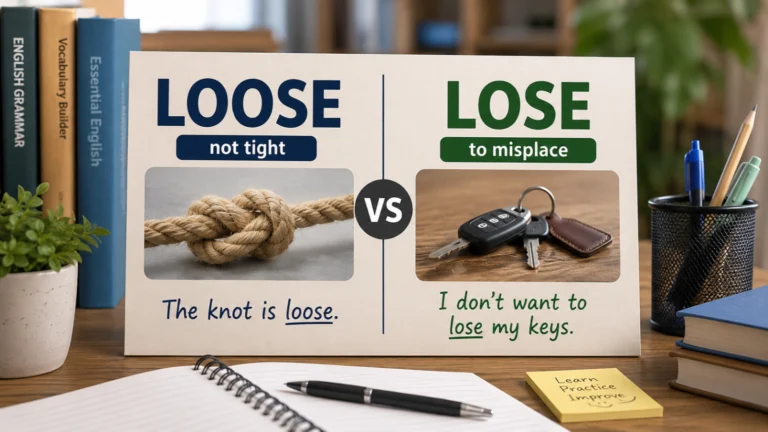
Loose vs Lose is one of the most commonly confused word pairs in English because the two words look similar but have very different meanings. Many learners accidentally use Loose vs Lose incorrectly in writing, emails, social media posts, and even professional documents. Understanding the difference is important for clear communication and avoiding embarrassing mistakes.
While loose describes something that is not tight or firmly attached, lose means to misplace something or fail to win. Learning these meanings with simple examples makes it much easier to remember which word to use.
In this guide, Loose vs Lose will be explained in clear, easy-to-understand language, along with definitions, examples, grammar tips, and memory tricks to help you use both words confidently in everyday English.
Why “Loose” and “Lose” Are Confusing
Many English learners accidentally mix up loose and lose because the words look very similar. However, they have different meanings and are used in different situations.
Similar Pronunciation
Although the words are pronounced differently, the sounds are close enough that learners often confuse them.
- Loose sounds like “looss.”
- Lose sounds like “looz.”
The difference is small, especially for non-native speakers.
Similar Spelling
The words differ by only one letter.
- Loose has double “o”.
- Lose has one “o”.
Because of this small spelling difference, typing mistakes happen frequently.
Context Confusion
Both words can appear in everyday conversations.
For example:
- “My shoes are loose.”
- “I don’t want to lose my shoes.”
Since both sentences involve shoes, learners sometimes choose the wrong word.
Common Learner Mistakes
People often write:
- ✘ I don’t want to loose my wallet.
- ✘ Please lose these screws.
The correct versions are:
- ✔ I don’t want to lose my wallet.
- ✔ Please loose these screws. (Less common; usually “loosen” is preferred.)
Loose vs Lose Explained Simply
Loose means “not tight,” while lose means “to no longer have something.”
One-Line Distinction
Loose describes a condition, while lose describes an action.
Examples
Loose
- My shirt is too loose.
- The dog’s collar became loose.
Lose
- Don’t lose your passport.
- Our team may lose the match.
Understanding Homophones in English
What Are Homophones?
Homophones are words that sound the same or very similar but have different meanings and spellings.
Example:
- Their
- There
These words sound alike but mean different things.
Why Homophones Cause Confusion
English contains many words that look or sound similar.
For example:
- Accept vs Except
- Affect vs Effect
- Loose vs Lose
Learners often remember the pronunciation but forget the spelling, leading to common writing mistakes.
What Does “Loose” Mean?
Definition and Core Meaning
Loose is usually an adjective. It describes something that is not tight, firmly attached, or securely fixed.
It can also be used as a verb in formal English, meaning to release, although loosen is much more common today.
Origin and Historical Use
The word loose comes from Old Norse and Old English roots that referred to something free, unbound, or released from restraint. It has been used in English for centuries to describe objects that are not tightly secured.
Modern Usage and Synonyms
Common meanings include:
- Not tight
- Free
- Unattached
- Relaxed
- Slack
Synonyms
- Slack
- Free
- Unfastened
- Relaxed
- Untied
Example Sentences
- These pants are too loose.
- One wheel on the bicycle feels loose.
- The rope became loose after the storm.
- Keep your pet from running loose.
What Does “Lose” Mean?
Definition and Core Meaning
Lose is a verb.
It means:
- To no longer have something
- To fail to win
- To misplace something
- To become separated from someone or something
Origin and Historical Context
The word lose comes from Old English losian, meaning to perish, fail, or be destroyed. Over time, its meaning expanded to include misplacing items and failing to win competitions.
Modern Usage and Synonyms
Common meanings include:
- Misplace
- Fail
- Be defeated
- Miss
- Forfeit
Synonyms
- Misplace
- Forfeit
- Drop
- Miss
- Surrender
Example Sentences
- Don’t lose your phone.
- We might lose the game.
- She doesn’t want to lose her job.
- If you hurry, you won’t lose your chance.
Loose vs Lose: Key Differences at a Glance
| Word | Part of Speech | Meaning | Example Context |
|---|---|---|---|
| Loose | Adjective (usually) | Not tight or securely attached | My shoelaces are loose. |
| Lose | Verb | To no longer have something or fail to win | I don’t want to lose my keys. |
How to Remember the Difference Between Loose and Lose
Here are some easy tricks that really help.
Easy Memory Tricks
- Loose has two O’s because loose clothing has extra room.
- Lose has one O because when you lose something, it’s gone.
Association Techniques
Think about these images:
- Loose = baggy jeans
- Lose = missing wallet
Visual memories often last longer than spelling rules.
One Memorable Example
“My shoes are loose, but I don’t want to lose them.”
This sentence uses both words correctly and helps you remember the difference.
Common Mistakes and Confusions
Mistake 1
✘ I don’t want to loose my phone.
✔ I don’t want to lose my phone.
Explanation: Losing means no longer having something.
Mistake 2
✘ Your belt is too lose.
✔ Your belt is too loose.
Explanation: The belt is not tight.
Mistake 3
✘ We will loose the game.
✔ We will lose the game.
Explanation: You lose a competition.
Mistake 4
✘ These screws are lose.
✔ These screws are loose.
Explanation: The screws are not tightly attached.
Examples Section: Correct and Incorrect Usage
Example 1
✔ Correct: Don’t lose your passport while traveling.
✘ Incorrect: Don’t loose your passport while traveling.
Example 2
✔ Correct: This button feels loose.
✘ Incorrect: This button feels lose.
Example 3
✔ Correct: Our team may lose the championship.
✘ Incorrect: Our team may loose the championship.
Example 4
✔ Correct: The dog’s collar is too loose.
✘ Incorrect: The dog’s collar is too lose.
Self Assessment: Test Your Knowledge
Fill in the blanks with loose or lose.
- I don’t want to ______ my wallet.
- These shoes feel too ______.
- Our team might ______ today’s match.
- One screw on the chair is ______.
Self Assessment Answers
- lose
- loose
- lose
- loose
FAQs About “Loose and Lose”
1. Is it “loose” or “lose weight”?
The correct phrase is lose weight because lose means to reduce or no longer have something.
2. Is “loose” a verb?
It can be a verb in older or formal English, but today loosen is much more common.
3. Which word means “not tight”?
Loose means not tight.
4. Which word means “to misplace something”?
Lose means to misplace something.
5. Why do people confuse loose and lose?
They look similar, sound somewhat alike, and differ by only one letter.
6. Is “I don’t want to loose my keys” correct?
No. The correct sentence is:
I don’t want to lose my keys.
7. How can I remember the difference quickly?
Remember:
- Loose = extra room (two O’s).
- Lose = something disappears (one O).
Final Conclusion: Using “Loose” and “Lose” Correctly
Understanding the difference between loose and lose is one of the easiest ways to improve your English writing. While these two words look similar, they serve completely different purposes. Loose usually describes something that is not tight, attached, or secure. In contrast, lose is a verb that means to no longer have something, to misplace it, or to fail in a competition. Keeping this distinction in mind will help you avoid one of the most common spelling mistakes in English.
A simple memory trick can make the difference stick. Think of the two O’s in loose as representing extra space, just like loose clothing has extra room. Then remember that lose has only one O because when you lose something, it is gone. Reading, writing, and practicing with real-life examples will reinforce these meanings until choosing the correct word becomes natural.
Whether you’re writing emails, school assignments, social media posts, or professional documents, using loose and lose correctly will make your communication clearer and more confident. Every small improvement in vocabulary builds stronger language skills. Keep practicing, review confusing word pairs regularly, and don’t be discouraged by occasional mistakes. With consistent effort, you’ll soon use loose and lose accurately every time.