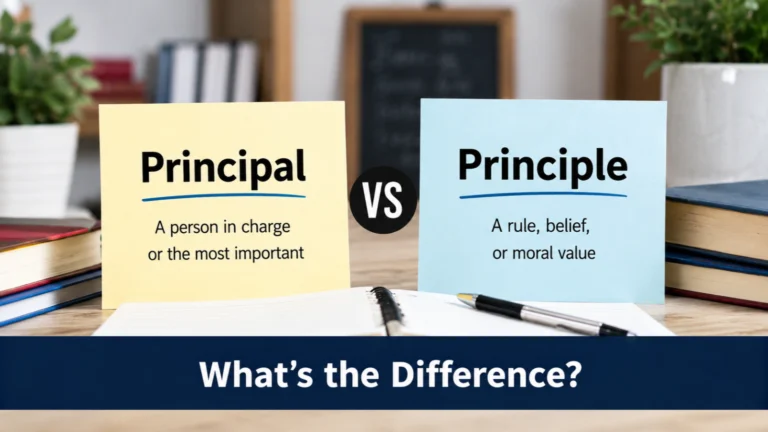
Principal vs Principle is one of the most commonly confused word pairs in English because the two words sound exactly alike but have very different meanings. Many students, writers, and professionals accidentally use one in place of the other, which can change the meaning of a sentence and create unnecessary mistakes. Learning the difference between Principal vs Principle is essential for improving grammar, writing, and everyday communication. While principal usually refers to a school leader or something of primary importance, principle means a rule, belief, or fundamental truth. In this guide, you’ll discover clear definitions, simple examples, practical memory tricks, and common mistakes to avoid, making Principal vs Principle easy to understand and use correctly in any situation.
Why “Principal” and “Principle” Are Confusing
The words principal and principle are among the most commonly confused words in English. Even native speakers occasionally mix them up because they sound almost identical.
Here are the main reasons for the confusion:
Similar Pronunciation
Both words are pronounced nearly the same, making them classic examples of homophones.
Similar Spelling
They differ by only two letters at the end:
- Principal
- Principle
This small spelling difference is easy to overlook when writing quickly.
Context Confusion
Both words appear in education, business, law, ethics, and finance. Since they often appear in similar topics, learners may accidentally choose the wrong one.
Common Learner Mistakes
People commonly write:
- “The school principle spoke to the students.”
- “Honesty is an important principal.”
Both sentences contain the wrong word.
Principal vs Principle Explained Simply
Principal means a person in charge or the most important thing, while principle means a rule, belief, or moral standard.
One-line Distinction
Principal refers to a person or something primary, while principle refers to a rule or belief.
Examples
Principal
- The principal welcomed the new students.
- Safety is our principal concern.
Principle
- She believes in the principle of honesty.
- Fairness is an important principle in society.
Understanding Homophones in English
What Are Homophones?
Homophones are words that sound the same but have different spellings and meanings.
Example:
- Sea
- See
Although they sound identical, they mean completely different things.
Why Homophones Cause Confusion
Since we hear the same pronunciation, our brains sometimes choose the wrong spelling while writing.
For example:
- Their
- There
- They’re
Each has a different meaning even though they sound alike.
The same happens with principal and principle.
What Does “Principal” Mean?
Definition and Core Meaning
Principal is usually a noun or an adjective.
As a noun, it refers to the head of a school or organization.
As an adjective, it means main, chief, or most important.
It can also refer to the original amount of money in finance before interest is added.
Origin and Historical Use
The word principal comes from the Latin word principalis, meaning first, chief, or most important.
Over time, English adopted the word to describe leaders and primary things.
Modern Usage and Synonyms
Common meanings include:
- School leader
- Chief person
- Main reason
- Primary concern
- Original amount of money
Synonyms
- Main
- Chief
- Primary
- Leading
- Head
Example Sentences
- The school principal announced the holiday.
- Her principal goal is improving her English.
- The bank calculated interest on the loan’s principal.
- Water is the principal source of life.
What Does “Principle” Mean?
Definition and Core Meaning
A principle is a rule, truth, belief, law, or standard that guides someone’s actions or decisions.
It often relates to ethics, science, education, philosophy, and personal values.
Origin and Historical Context
The word principle comes from the Latin principium, meaning beginning, foundation, or basic truth.
Its meaning later expanded to include moral beliefs and scientific laws.
Modern Usage and Synonyms
Common meanings include:
- Rule
- Belief
- Moral value
- Guideline
- Fundamental truth
Synonyms
- Rule
- Belief
- Standard
- Doctrine
- Value
- Ideal
Example Sentences
- Honesty is an important principle.
- She refused because of her personal principles.
- Newton’s principles changed science.
- Respect should be a guiding principle.
Principal vs Principle: Key Differences at a Glance
| Word | Part of Speech | Meaning | Example Context |
|---|---|---|---|
| Principal | Noun, Adjective | School head, main, chief, primary | The principal welcomed the students. |
| Principle | Noun | Rule, belief, moral value, basic truth | Honesty is an important principle. |
How to Remember the Difference Between Principal and Principle
Fortunately, there are several easy ways to remember these words.
Easy Memory Tricks
Principal = Pal
Think:
The principal is your pal.
Since pal appears inside principal, it’s easy to remember that a principal is a person.
Principle = Rule
A principle is something you follow.
Whenever you think about:
- honesty
- fairness
- respect
- ethics
you need principle.
Association Techniques
Remember:
- Principal = Person
- Principal = Primary
- Principle = Policy
- Principle = Belief
Memorable Example
“The principal teaches students to follow good principles.”
One sentence contains both words correctly.
Common Mistakes and Confusions
Wrong
The school principle greeted everyone.
Correct
The school principal greeted everyone.
Explanation: A school leader is called a principal.
Wrong
Honesty is my strongest principal.
Correct
Honesty is my strongest principle.
Explanation: Honesty is a belief, not a person.
Wrong
Our company follows important principals.
Correct
Our company follows important principles.
Explanation: Companies follow rules and values.
Wrong
The principle reason was lack of time.
Correct
The principal reason was lack of time.
Explanation: Here, principal means main.
Examples Section: Correct and Incorrect Usage
Example 1
✔ Correct: The principal spoke during the graduation ceremony.
✘ Incorrect: The principle spoke during the graduation ceremony.
Example 2
✔ Correct: Fairness is an important principle.
✘ Incorrect: Fairness is an important principal.
Example 3
✔ Correct: Education is our principal priority.
✘ Incorrect: Education is our principle priority.
Example 4
✔ Correct: She lives by strong moral principles.
✘ Incorrect: She lives by strong moral principals.
Self Assessment: Test Your Knowledge
Fill in the blanks with principal or principle.
1.
The school ______ welcomed new students.
2.
Respect is an important ______ of good leadership.
3.
Our ______ objective is customer satisfaction.
4.
She never breaks her personal ______.
Self Assessment Answers
- principal
- principle
- principal
- principles
FAQs About “Principal and Principle”
1. What is the difference between principal and principle?
Principal refers to a person in charge or something most important, while principle means a rule, belief, or moral value.
2. Is a school leader called a principal or principle?
A school leader is called a principal.
3. Is honesty a principal or a principle?
Honesty is a principle because it is a moral belief.
4. Can principal be used as an adjective?
Yes. It can mean main, chief, or most important.
Example:
“Our principal concern is safety.”
5. Is principle always a noun?
Yes. Principle functions only as a noun.
6. How can I remember the difference easily?
Remember:
- The principal is your pal.
- A principle is a rule you follow.
These memory tricks work well for most learners.
7. Are principal and principle homophones?
Yes. They sound almost identical but have different spellings and meanings.
Final Conclusion: Using “Principal” and “Principle” Correctly
Understanding the difference between principal and principle is an important step toward becoming a more confident English writer and speaker. Although these words sound almost the same, they serve very different purposes. Principal usually refers to a person in charge, such as the head of a school, or it describes something that is the main or most important. It can also refer to the original amount of money in financial contexts. Principle, on the other hand, always refers to a rule, belief, moral value, or fundamental truth that guides actions and decisions.
A simple memory trick can help you avoid confusion: the principal is your “pal,” making it easy to remember that a principal is often a person. For principle, think of the values and rules you choose to follow, such as honesty, fairness, and respect. Reading, writing, and practicing with real-life examples will reinforce the difference over time.
Whenever you’re unsure, pause and ask yourself a simple question: Am I talking about a person or something primary? If yes, use principal. Am I talking about a belief, rule, or moral value? If so, use principle. With regular practice and these easy memory techniques, you’ll soon use both words naturally and accurately in everyday English.