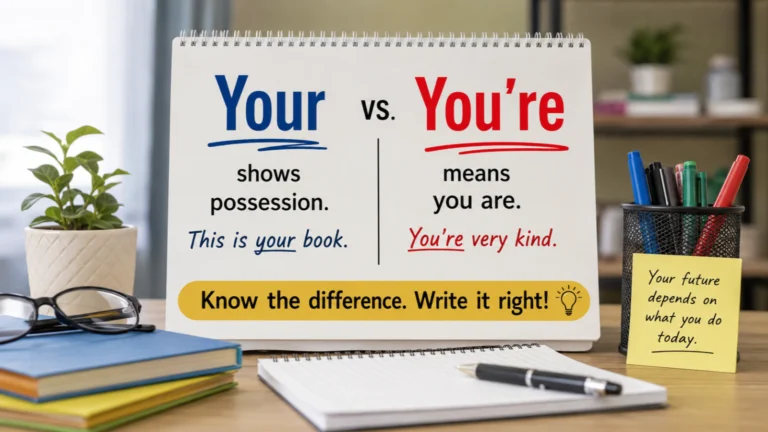
Your vs You’re is one of the most common grammar topics that confuses English learners and even native speakers. Although these two words sound exactly the same, they have different meanings and uses in writing.
Mixing them up can make emails, assignments, social media posts, and professional documents look less polished. Understanding the difference is simple once you know the basic grammar rule behind each word. In this guide, you’ll learn when to use your to show possession and when to use you’re as a contraction for “you are.”
By the end, Your vs You’re will no longer be confusing, and you’ll be able to avoid one of the most frequent English writing mistakes with confidence. Your vs You’re is easier to master than you might think.
Why “Your” and “You’re” Are Confusing
Many people confuse your and you’re because they are homophones, meaning they sound exactly the same but have different meanings and spellings.
Here are the main reasons learners mix them up.
Similar Pronunciation
Both words are pronounced as /jɔːr/ or /jʊr/ in everyday English. Since they sound identical, it’s easy to choose the wrong spelling while writing.
Similar Spelling
The two words begin with the same letters: your and you’re. The apostrophe in you’re is often forgotten or overlooked.
Context Confusion
Both words frequently appear before nouns or in everyday conversations, making learners uncertain about which one fits a sentence.
Common Learner Mistakes
Some common mistakes include:
- Writing your welcome instead of you’re welcome
- Using you’re book instead of your book
- Forgetting that you’re is a shortened form of two words
Fortunately, remembering one simple grammar rule can help you avoid these errors.
Your vs You’re Explained Simply
Your means something belongs to someone, while you’re is the short form of you are.
One-line distinction
Your shows ownership, while you’re means you are.
Examples
Your
- Your backpack is on the chair.
- I like your handwriting.
You’re
- You’re very kind.
- You’re going to enjoy this movie.
Understanding Homophones in English
What Are Homophones?
Homophones are words that have the same pronunciation but different meanings and spellings.
Example:
- Flower
- Flour
Although they sound alike, they refer to completely different things.
Why Homophones Cause Confusion
When people hear words rather than see them written, it is easy to confuse homophones.
For example:
- Your car is new.
- You’re very lucky.
Both sentences sound similar, but each word serves a different grammatical purpose.
What Does “Your” Mean?
Definition and Core Meaning
Your is a possessive determiner. It shows that something belongs to the person being spoken to.
Examples include possessions, qualities, relationships, and ideas.
Origin and Historical Use
The word your comes from Old English and has been used for centuries to indicate ownership. Over time, its spelling changed, but its purpose remained the same.
Modern Usage and Synonyms
Depending on context, similar possessive words include:
- My
- His
- Her
- Our
- Their
- Its
Key Points
- Shows ownership
- Comes before a noun
- Never means “you are”
- Does not contain an apostrophe
Example Sentences
- Your phone is ringing.
- I admire your creativity.
- Please bring your notebook tomorrow.
- Is this your jacket?
What Does “You’re” Mean?
Definition and Core Meaning
You’re is a contraction of you are.
Whenever you can replace you’re with you are, it is correct.
Origin and Historical Context
English contractions became popular because they make speech and writing smoother. The apostrophe replaces the missing letter a in are.
You are → You’re
Modern Usage and Synonyms
There is no direct synonym because you’re simply means you are.
Key Points
- Means “you are”
- Always includes an apostrophe
- Functions as a subject and verb
- Never shows ownership
Example Sentences
- You’re doing a wonderful job.
- I think you’re right.
- You’re welcome.
- You’re the first person here.
Your vs You’re: Key Differences at a Glance
| Word | Part of Speech | Meaning | Example Context |
|---|---|---|---|
| Your | Possessive determiner | Shows ownership | Your laptop is fast. |
| You’re | Contraction | Means “you are” | You’re very helpful. |
How to Remember the Difference Between Your and You’re
Learning a few simple memory tricks can help you avoid mistakes forever.
Easy Memory Tricks
- If you can replace the word with you are, use you’re.
- If the word shows ownership, use your.
- Remember that apostrophes often indicate contractions.
Association Techniques
Think of it this way:
- Your = Yours
- You’re = You are
This quick comparison works in almost every sentence.
Your vs You’re: One Memorable Example
Try replacing the word:
You’re my best friend.
Becomes:
You are my best friend.
It still makes sense.
Now try:
Your my best friend.
Becomes:
Yours my best friend.
This does not make sense, so you’re is correct.
Your vs You’re: Common Mistakes and Confusions
Wrong
Your welcome.
Correct
You’re welcome.
Explanation: It means you are welcome, not ownership.
Wrong
I like you’re shoes.
Correct
I like your shoes.
Explanation: The shoes belong to you.
Wrong
Your very funny.
Correct
You’re very funny.
Explanation: The sentence means you are very funny.
Wrong
Is this you’re backpack?
Correct
Is this your backpack?
Explanation: The backpack belongs to someone.
Examples Section: Correct and Incorrect Usage
Example 1
✔ Correct: Your homework is finished.
✘ Incorrect: You’re homework is finished.
Example 2
✔ Correct: You’re learning English quickly.
✘ Incorrect: Your learning English quickly.
Example 3
✔ Correct: I found your keys.
✘ Incorrect: I found you’re keys.
Example 4
✔ Correct: You’re always helpful.
✘ Incorrect: Your always helpful.
Example 5
✔ Correct: Your idea is brilliant.
✘ Incorrect: You’re idea is brilliant.
Example 6
✔ Correct: You’re going to love this book.
✘ Incorrect: Your going to love this book.
Self Assessment: Test Your Knowledge
Fill in the blanks with your or you’re.
- ________ my best friend.
- I like ________ new bicycle.
- ________ going to enjoy the concert.
- Please bring ________ passport.
Self Assessment Answers
- You’re
- Your
- You’re
- Your
FAQs About “Your” and “You’re”
1. What is the difference between your and you’re?
Your shows ownership, while you’re is the contraction of you are.
2. Is “you’re” always short for “you are”?
Yes. If you cannot replace it with you are, then you’re is incorrect.
3. Why do people confuse your and you’re?
Because they sound exactly alike and are commonly used in everyday English.
4. Is “your welcome” correct?
No. The correct expression is you’re welcome because it means you are welcome.
5. Can “your” ever replace “you’re”?
No. One indicates possession, while the other is a verb contraction.
6. Is forgetting the apostrophe a grammar mistake?
Yes. The apostrophe changes the meaning of the word. Without it, your and you’re have different grammatical functions.
7. What is the easiest way to check which word to use?
Replace you’re with you are. If the sentence still makes sense, you’re is correct. Otherwise, use your.
Final Conclusion: Using “Your” and “You’re” Correctly
Understanding the difference between your and you’re is one of the easiest ways to improve your English writing. Although these two words sound exactly the same, they serve very different purposes. Your is used to show ownership or possession, such as your book, your family, or your opinion.
On the other hand, you’re is simply a contraction of you are, making it useful in sentences like you’re amazing, you’re ready, or you’re learning English. A simple replacement test can help you choose correctly: if you are fits naturally in the sentence, use you’re. If the sentence is talking about something that belongs to someone, use your.
Practicing with examples, reading carefully, and proofreading your writing will make the distinction feel natural over time. Even experienced writers occasionally make this mistake, so don’t be discouraged if you get it wrong at first. Every correction is another step toward stronger grammar and clearer communication. Keep practicing these common English word pairs, and you’ll soon use your and you’re with confidence in emails, essays, conversations, and everyday writing.