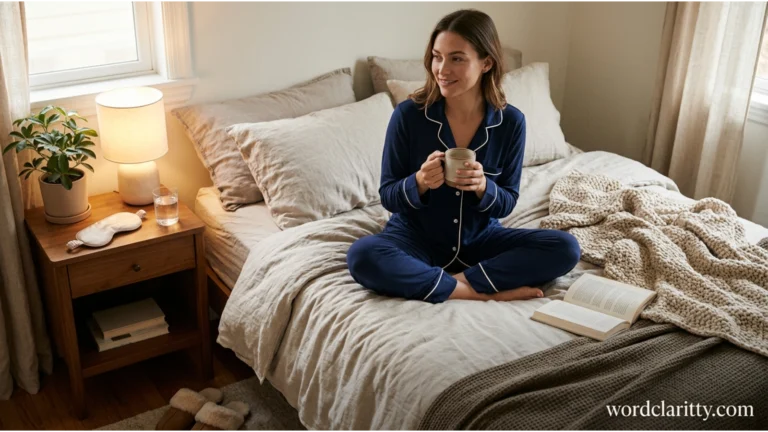
Have you ever wondered whether to write “pyjamas” or “pajamas” when talking about comfortable clothes worn for sleeping? If so, you are not alone. Many English learners find these two spellings confusing because they refer to exactly the same type of clothing but appear differently in British and American English.
The good news is that both spellings are correct. The main difference is where they are commonly used. Understanding this distinction can help you improve your spelling, communicate more clearly, and choose the appropriate word for your audience. In this guide, you will learn their meanings, origins, pronunciation, regional differences, examples, and easy memory tricks.
Why “Pyjamas” and “Pajamas” Are Confusing
The words “pyjamas” and “pajamas” often confuse English learners because they have the same meaning but different spellings.
Unlike many confusing English word pairs, neither spelling is inherently incorrect. Instead, the difference comes mainly from regional spelling conventions.
1. Similar Pronunciation
Both words are generally pronounced in the same way within a given English accent.
Their common pronunciations include:
- British English: /pəˈdʒɑː.məz/
- American English: /pəˈdʒæm.əz/
The pronunciation difference is mostly related to the accent rather than the spelling.
For example:
“I bought new pyjamas yesterday.”
“I bought new pajamas yesterday.”
Both sentences sound natural in their respective varieties of English.
2. Similar Spelling
The words differ by only one letter.
- Pyjamas: Uses the letter “y.”
- Pajamas: Uses the letter “a.”
Everything else remains the same.
This small difference makes it easy to confuse the spellings, especially when reading books, shopping online, or communicating with people from different countries.
3. Context Confusion
Both words describe clothing worn for sleeping or relaxing at home.
For example:
“She changed into her pyjamas before going to bed.”
“She changed into her pajamas before going to bed.”
The sentences have exactly the same meaning.
The only difference is the spelling convention associated with the writer’s variety of English.
4. Common Learner Mistakes
English learners sometimes make these mistakes:
- Assuming that one spelling is grammatically incorrect.
- Mixing British and American spellings in the same document.
- Believing that pyjamas and pajamas describe different types of clothing.
- Using the singular form incorrectly.
- Thinking that pronunciation must change when the spelling changes.
The simplest solution is to choose the spelling appropriate for your audience and use it consistently.
Pyjamas vs Pajamas Explained Simply
The difference between “pyjamas” and “pajamas” is mainly geographical.
Pyjamas is the standard British English spelling, while pajamas is the standard American English spelling. Both refer to clothes worn for sleeping.
Simple Explanation
Pyjamas: The spelling commonly used in British English and many countries that follow British spelling conventions.
Pajamas: The spelling commonly used in American English.
Both words usually refer to comfortable sleepwear, such as a matching shirt and trousers or other clothing designed for bedtime.
One-Line Distinction
Pyjamas means sleepwear in British English, while pajamas means the same thing in American English.
Two Example Sentences
Example 1: British English
“After taking a shower, Emma put on her warm pyjamas.”
Example 2: American English
“After taking a shower, Emily put on her comfortable pajamas.”
Both sentences are correct.
The spelling you choose should depend on whether you are writing in British or American English.
Which Spelling Should You Use?
If you are writing for a British audience, choose “pyjamas.”
Understanding Homophones in English
English contains many words that sound alike but have different spellings or meanings. Understanding these words helps learners improve their vocabulary and avoid common mistakes.
What Are Homophones?
Homophones are words that have the same pronunciation but different meanings and often different spellings.
For example:
- Sea: A large body of salt water.
- See: To notice something with your eyes.
Consider these sentences:
“I can see the sea from my window.”
Both words sound alike, but they have different meanings.
Other common homophones include:
- Hear and here
- Right and write
- Flour and flower
- Sun and son
- One and won
However, “pyjamas” and “pajamas” are not a typical homophone pair because they have the same meaning.
They are better described as regional spelling variants of the same word.
Why Homophones Cause Confusion
Homophones can cause confusion because pronunciation alone does not always tell you which spelling to use.
For example:
“I want to buy some flour.”
“The flower looks beautiful.”
The words “flour” and “flower” sound alike but have different meanings.
The confusion between “pyjamas” and “pajamas” is different. Both words describe the same clothing, but their spelling depends on regional English conventions.
Recognizing this difference helps learners understand that not every spelling variation represents a different word or meaning.
What Does “Pyjamas” Mean?
Definition and Core Meaning
Pyjamas is a plural noun used mainly in British English to describe comfortable clothing worn for sleeping or relaxing at home.
Traditional pyjamas often consist of two pieces:
- A loose-fitting shirt or top.
- A pair of comfortable trousers.
However, modern pyjamas can include different styles, fabrics, and designs.
The word may also refer more generally to sleepwear rather than only a matching two-piece outfit.
Origin and Historical Use
The word “pyjamas” entered English through Hindi and Urdu, ultimately deriving from Persian words meaning “leg garment.”
The original expression referred to loose trousers worn in parts of South Asia.
During the period of British colonial involvement in the Indian subcontinent, the term entered English vocabulary.
Over time, its meaning changed in British usage. Instead of referring mainly to loose trousers, it became associated with comfortable clothing worn for sleeping.
By the nineteenth and early twentieth centuries, pyjamas had become increasingly familiar as nightwear in Britain.
Today, the word is commonly used in British English and in many regions influenced by British spelling traditions.
Modern Usage and Synonyms
In modern British English, “pyjamas” usually refers to sleepwear.
Related words and expressions include:
- Nightwear: Clothing designed for sleeping.
- Sleepwear: A general term for bedtime clothing.
- Nightclothes: Clothes worn at night.
- Loungewear: Comfortable clothing worn while relaxing.
- Nightdress: A loose garment worn for sleeping.
These terms are related, but they are not always exact synonyms.
For example, loungewear may be worn during the day, while pyjamas are mainly associated with sleeping.
Example Sentences
- “I bought a new pair of pyjamas for winter.”
- “The children changed into their pyjamas before bedtime.”
- “She prefers cotton pyjamas because they are comfortable.”
- “My grandmother gave me warm pyjamas for Christmas.”
- “He spent Sunday morning relaxing in his pyjamas.”
- “These pyjamas are too small for me.”
In British English, all these sentences use the standard spelling.
Is “Pyjamas” Singular or Plural?
“Pyjamas” is normally treated as a plural noun.
For example:
Correct: “My pyjamas are comfortable.”
Incorrect in standard usage: “My pyjamas is comfortable.”
When referring to one set, you can say:
“A pair of pyjamas.”
For example:
“I bought a pair of pyjamas yesterday.”
What Does “Pajamas” Mean?
Definition and Core Meaning
Pajamas is the standard American English spelling of the word used to describe clothing worn for sleeping.
The meaning is the same as “pyjamas.”
Pajamas may include:
- A matching shirt and pants.
- Loose cotton sleepwear.
- Warm winter sleeping clothes.
- Lightweight summer nightwear.
- Comfortable clothing worn at bedtime.
In American English, the word is widely used in everyday conversations, clothing stores, advertisements, and online shopping.
Origin and Historical Context
“Pajamas” shares the same historical origin as “pyjamas.”
Both spellings developed from the South Asian term that entered English through Hindi and Urdu, with earlier Persian roots.
As English developed different regional spelling conventions, the American form became commonly written with the letter “a.”
The British spelling retained “y,” while American English standardized “pajamas.”
Despite this difference, both spellings continue to describe the same type of clothing.
The development of these forms is another example of how English vocabulary can vary across countries without changing its basic meaning.
Modern Usage and Synonyms
In American English, “pajamas” is a familiar everyday word.
Common related expressions include:
- PJs: An informal abbreviation for pajamas.
- Sleepwear: Clothing worn while sleeping.
- Nightwear: Clothes designed for bedtime.
- Loungewear: Comfortable clothing for relaxing.
- Sleep clothes: An informal description of clothing worn to bed.
For example:
“I changed into my PJs after dinner.”
Here, “PJs” is an informal alternative to “pajamas.”
Example Sentences
- “I bought new pajamas for my vacation.”
- “The baby looks adorable in those pajamas.”
- “She wears soft cotton pajamas every night.”
- “My pajamas are hanging in the closet.”
- “He forgot to pack his pajamas for the trip.”
- “The store is offering a discount on winter pajamas.”
These sentences follow American English spelling conventions.
Is “Pajamas” Singular or Plural?
Like “pyjamas,” the word “pajamas” is normally plural.
Correct: “My pajamas are clean.”
Incorrect in standard usage: “My pajamas is clean.”
To refer to one set, use “a pair of pajamas.”
For example:
“She bought a pair of pajamas for her brother.”
Pyjamas vs Pajamas: Key Differences at a Glance
The following table summarizes the differences between the two spellings.
| Word | Part of Speech | Meaning | Example Context |
|---|---|---|---|
| Pyjamas | Plural noun | Comfortable clothing worn for sleeping | British English: “I bought new pyjamas.” |
| Pajamas | Plural noun | Comfortable clothing worn for sleeping | American English: “I bought new pajamas.” |
Additional Comparison
| Feature | Pyjamas | Pajamas |
|---|---|---|
| Main usage | British English | American English |
| Spelling | Contains “y” | Contains “a” |
| Meaning | Sleepwear | Sleepwear |
| Pronunciation | Varies by accent | Varies by accent |
| Grammatical form | Usually plural | Usually plural |
| Informal abbreviation | PJs | PJs |
| Correct spelling? | Yes | Yes |
Which One Is Correct?
Both “pyjamas” and “pajamas” are correct.
The difference is regional rather than grammatical.
Use “pyjamas” when following British English spelling conventions.
Use “pajamas” when following American English spelling conventions.
Neither spelling changes the meaning of the sentence.
How to Remember the Difference Between Pyjamas and Pajamas
Remembering the correct spelling becomes easier when you connect each form with its regional usage.
1. Remember “Y” for British English
Think of the letter “y” in “pyjamas” as a reminder of the British spelling.
Memory trick: Pyjamas → Y → British English
Although this is simply a learning association, it can help you remember which spelling is commonly used in Britain.
Example:
“The children are wearing their pyjamas.”
2. Remember “A” for American English
The word “pajamas” contains the letter “a” after the first letter.
Associate that “a” with America.
Memory trick: Pajamas → A → America
Example:
“I need to buy new pajamas.”
This is one of the easiest ways to remember the American spelling.
3. Connect the Spellings with Other Regional Differences
English contains many words that have different British and American spellings.
For example:
| British English | American English |
|---|---|
| Colour | Color |
| Favourite | Favorite |
| Centre | Center |
| Theatre | Theater |
| Pyjamas | Pajamas |
Learning these patterns can help you become more confident when writing for different audiences.
However, remember that not every British-American spelling difference follows the same rule.
4. One Memorable Example
Imagine two friends discussing their bedtime clothes.
A British friend says:
“I bought some new pyjamas.”
An American friend replies:
“I bought new pajamas too!”
Both friends are talking about exactly the same type of clothing.
The only difference is their regional spelling preference.
Common Mistakes and Confusions
English learners sometimes make mistakes when choosing between British and American spelling conventions.
Mistake 1: Thinking One Spelling Is Wrong
✘ Incorrect assumption: “Pyjamas is wrong, and pajamas is correct.”
✔ Correct understanding: “Both pyjamas and pajamas are correct regional spellings.”
Explanation: The difference depends mainly on whether you are using British or American English.
Mistake 2: Mixing Spellings in the Same Document
✘ Inconsistent: “I bought new pyjamas. My pajamas are blue.”
✔ Consistent British English: “I bought new pyjamas. My pyjamas are blue.”
✔ Consistent American English: “I bought new pajamas. My pajamas are blue.”
Explanation: Both spellings are valid, but using one consistently makes your writing more professional.
Mistake 3: Using Incorrect Subject-Verb Agreement
✘ Incorrect: “My pajamas is comfortable.”
✔ Correct: “My pajamas are comfortable.”
Explanation: “Pajamas” and “pyjamas” are normally plural nouns, so they take plural verbs.
Mistake 4: Confusing Pyjamas with Daywear
✘ Incorrect assumption: “All comfortable clothes are pyjamas.”
✔ Correct understanding: “Pyjamas are mainly designed for sleeping, while other comfortable clothes may be called loungewear.”
Explanation: Clothing categories can overlap, but the words do not always mean exactly the same thing.
Mistake 5: Thinking Pronunciation Changes Because of Spelling
✘ Incorrect assumption: “Pyjamas and pajamas must have completely different pronunciations.”
✔ Correct understanding: “Both spellings represent the same word, although pronunciation may vary between accents.”
Explanation: The spelling difference does not create two separate meanings or two unrelated pronunciations.
Examples Section: Correct and Incorrect Usage
The following examples demonstrate how to use both spellings correctly.
Example 1: British English
✔ Correct: “She bought a new pair of pyjamas.”
✘ Incorrect for a British spelling exercise: “She bought a new pair of pajamas.”
Why? British English normally uses “pyjamas.” The American spelling is still valid in American English.
Example 2: American English
✔ Correct: “He wears comfortable pajamas every night.”
✘ Incorrect for an American spelling exercise: “He wears comfortable pyjamas every night.”
Why? American English normally uses “pajamas.”
Example 3: Subject-Verb Agreement
✔ Correct: “My pyjamas are very soft.”
✘ Incorrect: “My pyjamas is very soft.”
Why? The noun is plural and requires the verb “are.”
Example 4: Referring to One Set
✔ Correct: “I bought a pair of pajamas yesterday.”
✘ Incorrect in standard usage: “I bought a pajamas yesterday.”
Why? Use “a pair of pajamas” when referring to one set.
Example 5: British English Shopping
✔ Correct: “The shop sells children’s pyjamas.”
✘ Incorrect for consistent British spelling: “The shop sells children’s pajamas.”
Why? British retailers and writers generally prefer “pyjamas.”
Example 6: American English Shopping
✔ Correct: “The store has a large collection of winter pajamas.”
✘ Incorrect for consistent American spelling: “The store has a large collection of winter pyjamas.”
Why? American retailers and writers generally prefer “pajamas.”
Self Assessment: Test Your Knowledge
Choose the correct answer for each question.
Question 1: Which spelling is most commonly used in British English?
a) Pajamas
b) Pyjamas
Question 2: Which spelling is standard in American English?
a) Pyjamas
b) Pajamas
Question 3: Choose the grammatically correct sentence.
a) My pajamas is comfortable.
b) My pajamas are comfortable.
Question 4: Complete this British English sentence:
“I bought a new pair of ___ for winter.”
a) Pyjamas
b) Pajamas
Self Assessment Answers
Answer 1: b) Pyjamas
“Pyjamas” is the standard British English spelling.
Answer 2: b) Pajamas
“Pajamas” is the standard American English spelling.
Answer 3: b) My pajamas are comfortable.
“Pajamas” is normally a plural noun, so it takes the plural verb “are.”
Answer 4: a) Pyjamas
The sentence follows British English spelling conventions, so “pyjamas” is the preferred choice.
How Did You Do?
- 4 correct: Excellent! You understand the difference.
- 3 correct: Very good. Review the question you missed.
- 1–2 correct: Practise identifying British and American spellings.
- 0 correct: Remember the simple rule: pyjamas is British English, and pajamas is American English.
FAQs:
1. Is It Pyjamas or Pajamas?
Both spellings are correct. “Pyjamas” is the standard British English spelling, while “pajamas” is the standard American English spelling. Both refer to clothing worn for sleeping.
2. What Is the Difference Between Pyjamas and Pajamas?
The main difference is spelling and regional usage. “Pyjamas” is commonly used in British English, while “pajamas” is commonly used in American English. Their meanings are the same.
3. Is Pyjamas British or American English?
“Pyjamas” is the standard British English spelling. It is also commonly used in countries that follow British spelling conventions, including Australia and New Zealand.
4. Why Do Americans Spell Pyjamas as Pajamas?
American English developed and standardized the spelling “pajamas,” while British English retained “pyjamas.” Both forms share the same historical origin and meaning.
5. Is Pajamas Singular or Plural?
“Pajamas” is normally a plural noun. You should say “my pajamas are comfortable” rather than “my pajamas is comfortable.” For one set, use “a pair of pajamas.”
6. What Is the Short Form of Pyjamas or Pajamas?
The common informal abbreviation is “PJs.” It is used in both British and American English.
For example:
“I changed into my PJs before watching television.”
7. Which Spelling Should English Learners Use?
English learners should use the spelling that matches the variety of English they are studying. Choose “pyjamas” for British English and “pajamas” for American English. Consistency is more important than choosing one spelling over the other.
Conclusion:
Understanding the difference between “pyjamas” and “pajamas” is an easy but valuable step toward improving your English spelling and vocabulary. Although these two words look slightly different, they have exactly the same meaning. Both describe comfortable clothing worn for sleeping or relaxing at home. The main difference is regional: “pyjamas” is the standard spelling in British English, while “pajamas” is the standard spelling in American English. Neither form is inherently incorrect, so the best choice depends on your audience and the variety of English you are using.
In everyday life, you may encounter “pyjamas” in British books, clothing shops, and websites, while “pajamas” commonly appears in American conversations, advertisements, and online stores. Both words are normally treated as plural nouns, so remember to use expressions such as “my pyjamas are comfortable” or “a pair of pajamas.”
To remember the spelling difference, associate the letter “y” in pyjamas with British English and the letter “a” in pajamas with America. These simple memory tricks can help you select the appropriate spelling without hesitation.Most importantly, try to remain consistent when writing. If you begin an article or assignment using British English, continue using British spelling throughout. The same principle applies to American English.