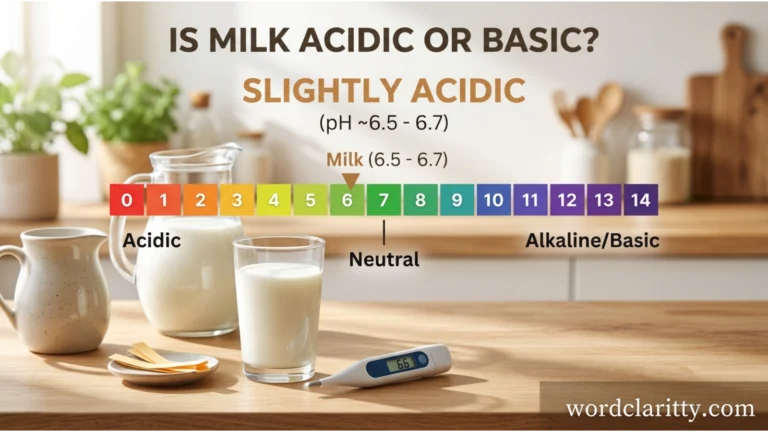
Have you ever wondered, is milk acidic or basic? Many people assume milk is neutral because it has a mild taste and does not seem as sour as lemon juice or vinegar. However, the science behind milk’s pH level tells a slightly different story. Fresh cow’s milk is usually slightly acidic, with a pH between 6.5 and 6.8.
Understanding the difference between acidic and basic substances helps English learners improve their science vocabulary while learning about everyday foods and drinks. In this guide, you will discover what acidic and basic mean, why milk is slightly acidic, how its pH changes, and how to use these scientific terms correctly.
Why “Acidic” and “Basic” Are Confusing
The terms “acidic” and “basic” often confuse English learners because they describe opposite chemical properties. Their meanings become clearer when you understand how the pH scale works.
1. Similar Pronunciation
“Acidic” and “basic” do not have the same pronunciation, although both contain a similar short vowel sound in their stressed syllables.
Their approximate pronunciations are:
- Acidic: /əˈsɪdɪk/ — uh-SID-ik
- Basic: /ˈbeɪsɪk/ — BAY-sik
These words are not homophones. However, learners may confuse them because they frequently appear together in science lessons.
2. Similar Spelling
Both words end with the letters “ic,” which commonly appear in English adjectives.
For example:
- Acid → Acidic
- Base → Basic
Although the spellings are different, both words describe chemical properties.
This shared grammatical function can make them seem more closely related than they actually are.
3. Context Confusion
People often associate acids with strong sour tastes and bases with cleaning products. However, many everyday substances are only mildly acidic or mildly basic.
Milk is a good example.
Fresh cow’s milk usually has a pH slightly below 7, making it mildly acidic even though it does not normally taste sour.
4. Common Learner Mistakes
Common misunderstandings include:
- Assuming milk is basic because it has a mild taste.
- Believing every acidic substance tastes strongly sour.
- Thinking acidic substances are always dangerous.
- Confusing “basic” with “simple” in scientific contexts.
- Assuming that milk always has exactly the same pH.
- Believing that milk’s calcium content makes it chemically basic.
Understanding pH helps explain why these assumptions are incorrect.
Acidic vs Basic Explained Simply
The difference between acidic and basic substances depends on their chemical properties and their position on the pH scale.
An acidic substance has a pH below 7, while a basic substance has a pH above 7, under ordinary conditions.
A substance with a pH of exactly 7 is considered neutral at approximately 25°C.
Simple Explanation
Acidic: Describes a substance with a pH below 7, such as lemon juice, vinegar, or fresh milk.
Basic: Describes a substance with a pH above 7, such as many baking soda solutions and some cleaning products.
The word “alkaline” is also commonly used to describe basic substances.
One-Line Distinction
Acidic means having a pH below 7, while basic means having a pH above 7; fresh cow’s milk is usually slightly acidic.
Two Example Sentences
Example 1:
“Fresh cow’s milk is slightly acidic because its pH is usually around 6.5 to 6.8.”
Example 2:
“A baking soda solution is usually basic because its pH is higher than 7.”
These examples demonstrate how the terms describe different chemical conditions.
What Is the pH Scale?
The pH scale measures how acidic or basic an aqueous solution is.
For everyday learning, it is often shown as a scale from 0 to 14, although pH values can extend beyond this range in some conditions.
- Below 7: Acidic
- Exactly 7: Neutral at about 25°C
- Above 7: Basic or alkaline
Fresh milk falls just below the neutral point.
Understanding Homophones in English
Learning science vocabulary also provides an opportunity to improve general English language skills.
What Are Homophones?
Homophones are words that sound the same but have different meanings and often different spellings.
For example:
- Sea: A large body of salt water.
- See: To notice something with your eyes.
Consider these sentences:
“The sea looks beautiful today.”
“I can see the mountains.”
The words sound identical, but their meanings are different.
Other examples include:
- Hear and here
- Right and write
- Flour and flower
- One and won
- Sun and son
However, “acidic” and “basic” are not homophones because their pronunciations differ.
Why Homophones Cause Confusion
Homophones can confuse learners because the sound of a word does not always reveal its spelling or meaning.
For example:
“Please write your answer.”
“You gave the right answer.”
The words “write” and “right” sound alike but serve different purposes.
The confusion between “acidic” and “basic” is different. These terms are scientific opposites rather than words with identical pronunciation.
Learning their definitions and understanding the pH scale is the best way to distinguish them.
What Does “Acidic” Mean?
Definition and Core Meaning
The word “acidic” is an adjective used to describe a substance that has the properties of an acid.
In an aqueous solution, acidic conditions involve a relatively high activity of hydrogen ions, represented in simplified explanations as H⁺.
Acidic solutions generally have a pH below 7 at ordinary temperatures.
Common characteristics include:
- A pH below 7
- The ability to turn blue litmus paper red
- Chemical reactions characteristic of acids
- A sour taste in many familiar food acids
- The ability to react with suitable bases in neutralization reactions
However, not all acidic substances are safe to taste, and acidity should never be tested by tasting unknown chemicals.
Origin and Historical Use
The word “acidic” comes from “acid,” which is related to Latin acidus, meaning “sour.”
Historically, people recognized acidic substances through familiar examples such as vinegar and sour fruits.
As chemistry developed, scientists created more precise definitions of acids based on their chemical behaviour.
Today, acidity is commonly described using the pH scale, particularly when discussing water-based solutions.
Modern Usage and Synonyms
The word “acidic” appears in chemistry, biology, agriculture, food science, and everyday conversations.
Related terms include:
- Acid: A substance with acid-related chemical properties.
- Sour: A taste commonly associated with certain acids.
- Low-pH: Describing a relatively acidic condition.
- Acidified: Made more acidic through a process.
- Acidulous: Slightly sour or acidic, especially in descriptions of taste.
These words are related but are not interchangeable in every situation.
Why Is Milk Slightly Acidic?
Fresh cow’s milk contains several components that influence its pH, including proteins, dissolved carbon dioxide, phosphate compounds, and other naturally occurring substances.
These components contribute to milk’s mildly acidic reaction.
Milk also contains buffering systems that help resist sudden changes in pH.
Although lactose is the main natural sugar in milk, lactose itself is not responsible for making fresh milk strongly acidic.
When certain bacteria ferment lactose, they produce lactic acid. This can lower the pH and make milk noticeably sour.
Example Sentences
- “Fresh milk is slightly acidic.”
- “Lemon juice is more acidic than milk.”
- “The scientist measured the acidic solution using a pH meter.”
- “Fermentation can make milk more acidic.”
- “Vinegar is an acidic liquid commonly used in cooking.”
What Does “Basic” Mean?
Definition and Core Meaning
The word “basic” has several meanings in English.
In everyday language, it often means simple, fundamental, or essential.
In chemistry, however, “basic” describes a substance or solution with the properties of a base.
A basic aqueous solution generally has a pH above 7 at ordinary temperatures.
Common characteristics include:
- A pH above 7
- The ability to turn red litmus paper blue
- Chemical reactions characteristic of bases
- The ability to neutralize suitable acids
- The presence of hydroxide ions in many common basic solutions
Not every base contains hydroxide ions in its original chemical formula, but many bases produce or increase hydroxide ions when dissolved in water.
Origin and Historical Context
The word “basic” comes from “base,” which developed through historical scientific and linguistic usage.
In chemistry, bases became recognized as substances that could react with acids to form salts.
As scientific knowledge expanded, several definitions of acids and bases were developed, including the Arrhenius, Brønsted–Lowry, and Lewis theories.
For beginner-level chemistry, the pH scale offers a useful way to identify whether an aqueous solution is acidic, neutral, or basic.
Modern Usage and Synonyms
In chemistry, “basic” is often associated with the term “alkaline.”
Related words include:
- Alkaline: Having basic chemical properties.
- Base: A substance capable of participating in acid-base reactions.
- High-pH: Describing a relatively basic condition.
- Alkalinity: A measure of a solution’s capacity to neutralize acid, which is related to but different from pH.
In everyday English, “basic” can also mean elementary, simple, or fundamental.
For example:
“Students need a basic understanding of chemistry.”
Here, “basic” means fundamental, not alkaline.
Is Milk Basic?
Fresh cow’s milk is generally not basic because its pH is usually below 7.
However, the pH of milk can vary depending on factors such as:
- The type and composition of the milk
- Animal health
- Storage conditions
- Microbial activity
- Processing methods
- Temperature and measurement conditions
Some milk samples may have an unusually high pH, but this does not change the general classification of normal fresh cow’s milk as slightly acidic.
Example Sentences
- “A baking soda solution is usually basic.”
- “The teacher explained the difference between acidic and basic solutions.”
- “Soap solutions are often alkaline.”
- “The laboratory used a pH meter to identify the basic solution.”
- “Fresh cow’s milk is generally slightly acidic rather than basic.”
Acidic vs Basic: Key Differences at a Glance
The following table summarizes the major differences between acidic and basic substances.
| Word | Part of Speech | Meaning | Example Context |
|---|---|---|---|
| Acidic | Adjective | Having acid-related properties, generally with pH below 7 in water | “Fresh milk is slightly acidic.” |
| Basic | Adjective | Having base-related properties, generally with pH above 7 in water | “A baking soda solution is basic.” |
| Neutral | Adjective | Neither acidic nor basic, with pH 7 at approximately 25°C | “Pure water is neutral under standard conditions.” |
| Alkaline | Adjective | Having basic properties | “The cleaning solution is alkaline.” |
Typical pH Values of Common Substances
| Substance | Approximate pH | Classification |
|---|---|---|
| Lemon juice | 2–3 | Acidic |
| Vinegar | 2–3 | Acidic |
| Fresh cow’s milk | 6.5–6.8 | Slightly acidic |
| Pure water at 25°C | 7 | Neutral |
| Baking soda solution | 8–9 | Basic |
| Household ammonia solution | 11–12 | Basic |
These values are approximate. Actual pH depends on concentration, composition, temperature, and other conditions.
Is Milk Acidic or Basic?
Fresh cow’s milk is slightly acidic, with a typical pH of about 6.5 to 6.8.
It is close to neutral but still falls on the acidic side of the pH scale.
How to Remember the Difference Between Acidic and Basic
A few simple memory tricks can help you remember the difference between these scientific terms.
1. Remember That Acids Have Lower pH Values
Think of the letter “A” in “acidic” as a reminder of the lower end of a typical classroom pH scale.
Memory trick: Acidic → Below 7
For example:
“Lemon juice is acidic because its pH is below 7.”
2. Remember That Bases Have Higher pH Values
Connect the word “basic” with the upper end of the pH scale.
Memory trick: Basic → Above 7
For example:
“A baking soda solution is basic because its pH is above 7.”
3. Associate Milk with the Neutral Point
Milk is close to neutral, but its pH is generally slightly lower than 7.
Remember:
Milk → Around pH 6.6 → Slightly acidic
This simple association is useful for school science lessons and everyday discussions.
4. One Memorable Example
Imagine three glasses containing lemon juice, fresh milk, and a baking soda solution.
- Lemon juice has a low pH and is acidic.
- Fresh milk has a pH just below 7 and is slightly acidic.
- Baking soda solution has a pH above 7 and is basic.
This comparison helps you remember that not all acidic substances have the same level of acidity.
Common Mistakes and Confusions
Mistake 1: Assuming Milk Is Neutral
✘ Incorrect: “Fresh milk always has a pH of exactly 7.”
✔ Correct: “Fresh cow’s milk usually has a pH between 6.5 and 6.8.”
Explanation: Milk is close to neutral but generally slightly acidic.
Mistake 2: Assuming Milk Is Basic Because It Contains Calcium
✘ Incorrect: “Milk contains calcium, so it must be basic.”
✔ Correct: “Milk contains calcium, but its overall pH is usually slightly acidic.”
Explanation: The presence of calcium does not automatically determine whether a food or drink is acidic or basic.
Mistake 3: Confusing Sour Taste with Acidity
✘ Incorrect: “Milk cannot be acidic because fresh milk does not taste sour.”
✔ Correct: “Fresh milk can be slightly acidic without having a noticeably sour taste.”
Explanation: Taste alone is not a reliable way to determine pH.
Mistake 4: Assuming All Acids Are Dangerous
✘ Incorrect: “Every acidic substance is unsafe to consume.”
✔ Correct: “Many foods and drinks contain naturally occurring acids and are safe to consume when properly prepared and stored.”
Explanation: Acidity alone does not determine whether something is safe.
Mistake 5: Thinking Milk Always Has the Same pH
✘ Incorrect: “The pH of milk never changes.”
✔ Correct: “Milk’s pH can change because of fermentation, microbial activity, and other conditions.”
Explanation: As microorganisms produce acids during fermentation or spoilage, milk may become more acidic.
Examples Section: Correct and Incorrect Usage
Example 1: Fresh Milk
✔ Correct: “Fresh cow’s milk is slightly acidic.”
✘ Incorrect: “Fresh cow’s milk is always strongly basic.”
Why? Its typical pH is below 7.
Example 2: Neutral Water
✔ Correct: “Pure water has a pH of 7 at approximately 25°C.”
✘ Incorrect: “Pure water always has a pH of 7 at every temperature.”
Why? The neutral pH value changes with temperature.
Example 3: Fermented Milk
✔ Correct: “Fermentation can increase the acidity of milk.”
✘ Incorrect: “Fermentation always makes milk more basic.”
Why? Lactic acid bacteria commonly produce acid during milk fermentation.
Example 4: Baking Soda
✔ Correct: “A baking soda solution is mildly basic.”
✘ Incorrect: “A baking soda solution is normally strongly acidic.”
Why? Baking soda solutions generally have a pH above 7.
Example 5: Measuring Acidity
✔ Correct: “A pH meter can measure the pH of milk.”
✘ Incorrect: “The colour of milk tells us its exact pH.”
Why? Colour alone cannot reliably determine the pH of milk.
Example 6: Understanding pH
✔ Correct: “A pH of 6.6 indicates slightly acidic conditions at ordinary temperatures.”
✘ Incorrect: “A pH of 6.6 indicates a strongly alkaline solution.”
Why? A pH below 7 indicates acidity under ordinary conditions.
Self-Assessment: Test Your Knowledge
Choose the correct answer to complete each sentence.
Question 1: Fresh cow’s milk is usually slightly ___ because its pH is below 7.
a) Acidic
b) Basic
Question 2: A solution with a pH of 9 is generally considered ___.
a) Acidic
b) Basic
Question 3: When bacteria produce lactic acid during milk fermentation, the milk usually becomes more ___.
a) Acidic
b) Basic
Question 4: Pure water at approximately 25°C has a pH of 7 and is considered ___.
a) Neutral
b) Strongly acidic
Self-Assessment Answers
Answer 1: a) Acidic
Fresh cow’s milk generally has a pH between 6.5 and 6.8, making it slightly acidic.
Answer 2: b) Basic
A pH of 9 is above 7, indicating basic conditions under ordinary circumstances.
Answer 3: a) Acidic
Lactic acid production lowers the pH of milk during fermentation.
Answer 4: a) Neutral
Pure water at approximately 25°C has a neutral pH of 7.
How Did You Do?
- 4 correct: Excellent! You understand the difference.
- 3 correct: Very good. Review the question you missed.
- 1–2 correct: Practise comparing everyday substances on the pH scale.
- 0 correct: Remember: acidic is below 7, neutral is 7, and basic is above 7 at ordinary temperatures.
FAQs About Acidic and Basic Milk
1. Is Milk Acidic or Basic?
Fresh cow’s milk is slightly acidic. Its typical pH is approximately 6.5 to 6.8, which is just below the neutral value of 7.
2. What Is the pH Level of Milk?
The normal pH of fresh cow’s milk is generally around 6.5 to 6.8. The exact value can vary depending on milk composition, temperature, processing, and storage conditions.
3. Why Is Milk Slightly Acidic?
Milk contains proteins, phosphate compounds, dissolved carbon dioxide, and other components that influence its acid-base balance. These substances contribute to its naturally slightly acidic pH.
4. Is Milk More Acidic Than Water?
Fresh cow’s milk is generally more acidic than pure water at the same ordinary temperature because milk’s pH is usually below 7, while pure water has a pH of approximately 7 at 25°C.
5. Does Boiling Milk Make It Acidic or Basic?
Heating can change milk’s pH slightly through chemical and physical changes. However, boiling does not normally turn fresh milk into a strongly acidic or strongly basic substance.
6. Is Yogurt More Acidic Than Milk?
Yes. Yogurt is generally more acidic than fresh milk because bacteria ferment lactose and produce lactic acid. Yogurt commonly has a pH around 4.0 to 4.6, although values vary.
7. Does Milk Neutralize Stomach Acid?
Milk may temporarily buffer some stomach acid, but it does not reliably or permanently neutralize stomach acidity. Its effects vary, and it should not be considered a dependable treatment for acid reflux or other digestive conditions.
Final Conclusion: Using Acidic and Basic Correctly
Understanding whether milk is acidic or basic is a useful way to learn about everyday chemistry while improving your English science vocabulary. The most important fact to remember is that fresh cow’s milk is slightly acidic, not basic, with a typical pH between 6.5 and 6.8. Although milk has a mild taste and appears close to neutral, its pH falls just below 7. This makes it different from basic substances such as baking soda solutions, which generally have pH values above 7.
The words “acidic” and “basic” describe different chemical conditions. Acidic solutions have relatively low pH values, while basic solutions have higher pH values. At approximately 25°C, a pH of 7 represents neutralityr. Learning these differences helps you understand food chemistry, fermentation, household substances, and basic scientific measurements.
To remember the distinction, use a simple rule: acidic means below 7, basic means above 7, and fresh milk is close to 7 but slightly below it. You can also compare milk with lemon juice and baking soda solution to see how different substances fit on the pH scale.
Remember that milk’s acidity can change during storage and fermentation, so its pH is not always identical. By practising these terms in everyday sentences and connecting them with familiar examples, you can develop a clearer understanding of both chemistry and English. Keep asking questions, exploring scientific ideas, and building your vocabulary with confidence.