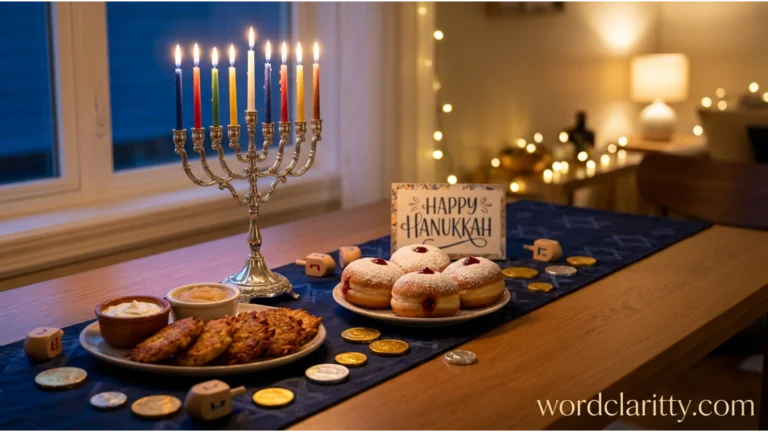
Have you ever wondered whether to write Chanukah or Hanukkah when talking about the Jewish Festival of Lights? If so, you are not alone. Many English learners find these spellings confusing because they refer to the same holiday but look slightly different. Unlike ordinary spelling mistakes, both versions are accepted in English. The difference comes from how the original Hebrew word is written using English letters.
Understanding this distinction can help you write holiday greetings, read cultural articles, and communicate respectfully about Jewish traditions. In this guide, you will discover the meanings, pronunciation, history, spelling differences, and practical examples of Chanukah and Hanukkah.
Why “Chanukah” and “Hanukkah” Are Confusing
The spellings “Chanukah” and “Hanukkah” confuse many English learners because both represent the same Hebrew word and refer to the same Jewish holiday.
The confusion is mainly connected to pronunciation, transliteration, and different English spelling traditions.
1. Similar Pronunciation
Chanukah and Hanukkah are generally pronounced in the same way by a given speaker.
A common English pronunciation sounds approximately like:
HAH-nuh-kuh
However, the original Hebrew word begins with a sound that does not have an exact equivalent in standard English.
This sound is produced toward the back of the throat and is often represented by the letters “ch” in transliteration.
Therefore, some speakers pronounce the beginning with a sound similar to the “ch” in the Scottish word “loch,” while many English speakers use an ordinary “h” sound.
Neither English spelling requires a different meaning or a different holiday.
2. Similar Spelling
The two words share most of their letters.
- Chanukah: C-h-a-n-u-k-a-h
- Hanukkah: H-a-n-u-k-k-a-h
The main differences are the initial letters and the number of letters “k.”
These variations occur because Hebrew and English use different writing systems.
When Hebrew words are represented using English letters, several spellings may be possible.
3. Context Confusion
Both spellings appear in holiday greetings, educational articles, calendars, religious discussions, and social media posts.
For example:
“Happy Chanukah!”
“Happy Hanukkah!”
Both greetings are correct and express the same wish.
However, someone unfamiliar with transliteration may assume that one spelling is a mistake.
4. Common Learner Mistakes
Common misunderstandings include:
- Thinking Chanukah and Hanukkah are two different holidays.
- Assuming that one spelling is always incorrect.
- Believing that “Ch” must sound like the “ch” in “chair.”
- Thinking the two spellings represent different religious traditions.
- Using inconsistent spellings in the same document without a reason.
- Assuming that Hebrew words must have only one English spelling.
Understanding transliteration helps explain why both forms are accepted.
Chanukah vs Hanukkah Explained Simply
Chanukah and Hanukkah are two accepted English spellings of the same Jewish holiday, also known as the Festival of Lights.
The holiday commemorates the rededication of the Second Temple in Jerusalem following the Maccabean revolt against Seleucid rule in the second century BCE.
Simple Explanation
Chanukah: An accepted English transliteration of the Hebrew name for the Jewish Festival of Lights.
Hanukkah: Another accepted English transliteration of the same Hebrew name, widely used in general English writing.
One-Line Distinction
Chanukah and Hanukkah mean exactly the same thing; the difference is their English spelling, not their meaning.
Two Example Sentences
Example 1:
“Our family celebrates Chanukah by lighting candles and spending time together.”
Example 2:
“Hanukkah is an eight-day Jewish festival that celebrates the rededication of the Temple.”
Both sentences use the holiday’s name correctly.
Which Spelling Should You Use?
For general English writing, Hanukkah is a widely used and familiar spelling.
However, Chanukah is also correct and may be preferred by particular individuals, communities, publications, or organizations.
When writing to someone who uses a specific spelling, following their preference is a thoughtful choice.
Understanding Homophones in English
Homophones are an important part of English vocabulary. Learning about them helps students recognize words that sound alike but have different meanings.
What Are Homophones?
Homophones are words that have the same pronunciation but different meanings and often different spellings.
For example, “sea” and “see” are homophones.
- Sea: A large body of salt water.
- See: To notice something with your eyes.
Consider these sentences:
“The sea looks beautiful today.”
“I can see the mountains.”
The words sound alike, but their meanings are different.
Other common homophones include:
- Hear and here
- Right and write
- Sun and son
- One and won
- Flour and flower
Why Homophones Cause Confusion
Homophones can confuse English learners because pronunciation alone does not always reveal which word should be written.
For example:
“I can hear the music.”
“Please come here.”
The words “hear” and “here” sound alike but communicate different meanings.
The situation with Chanukah and Hanukkah is different.
They are not a typical pair of homophones, because they are not two separate words with different meanings. Instead, they are alternative English spellings of the same Hebrew name.
This type of variation is called transliteration, which means representing a word from one writing system using the letters of another.
Understanding this distinction makes the spelling variation much easier to explain.
What Does “Chanukah” Mean?
Definition and Core Meaning
Chanukah is an accepted English spelling of the Hebrew word חנוכה, meaning “dedication.”
It refers to the Jewish Festival of Lights, an eight-day celebration remembering the rededication of the Second Temple in Jerusalem.
The holiday is associated with religious freedom, Jewish identity, historical remembrance, and the tradition of lighting lamps.
Important features of Chanukah include:
- An eight-day Jewish festival.
- The rededication of the Second Temple.
- The lighting of a special nine-branched lamp called a hanukkiah.
- Traditional blessings, songs, and celebrations.
- Foods cooked in oil, such as latkes and sufganiyot.
- Games such as dreidel, particularly in many Jewish communities.
Customs can vary between families and communities.
Origin and Historical Use
The word Chanukah comes from the Hebrew חנוכה, connected to the meaning “dedication.”
The festival commemorates events in the second century BCE, when Jewish rebels known as the Maccabees fought against Seleucid rule and the Temple in Jerusalem was rededicated.
A well-known tradition tells of a small amount of ritually pure oil that lasted for eight days, although it was expected to last only one.
This account is associated with the Talmud and helps explain the central role of light and oil in the holiday.
The spelling “Chanukah” uses the letters “Ch” to represent the Hebrew letter chet, which produces a sound unfamiliar to many English speakers.
This spelling can help readers recognize that the original pronunciation differs from an ordinary English “h.”
Modern Usage and Synonyms
Today, Chanukah appears in religious publications, educational materials, community announcements, holiday greetings, and everyday communication.
Related terms include:
- Hanukkah: An alternative spelling of the same holiday.
- Hanukah: Another transliteration variation.
- Chanukkah: Another accepted spelling variation.
- Festival of Lights: A familiar descriptive name.
- Feast of Dedication: Another traditional name connected to the holiday’s meaning.
These terms refer to the same festival, although some are transliterations and others are descriptive titles.
Example Sentences
- “Our neighbours invited us to their Chanukah celebration.”
- “Chanukah lasts for eight days.”
- “The children learned about the history of Chanukah.”
- “We sent a Chanukah greeting card to our friends.”
- “During Chanukah, many families light a hanukkiah.”
- “The community organized a special Chanukah gathering.”
Each sentence uses the spelling correctly.
What Does “Hanukkah” Mean?
Definition and Core Meaning
Hanukkah is another accepted English spelling of the Hebrew name for the Jewish Festival of Lights.
It has exactly the same meaning as Chanukah and refers to the same eight-day celebration.
The spelling Hanukkah is particularly familiar in general English-language newspapers, educational resources, dictionaries, and public holiday discussions.
Important facts about Hanukkah include:
- It is a Jewish holiday.
- It lasts eight days.
- Its dates follow the Hebrew calendar.
- It begins on the 25th day of the Hebrew month of Kislev.
- It commemorates the rededication of the Second Temple.
- Lighting the hanukkiah is one of its best-known traditions.
Because the Hebrew calendar differs from the Gregorian calendar, the holiday’s dates change from year to year on commonly used civil calendars.
Origin and Historical Context
Like Chanukah, Hanukkah comes from the Hebrew word חנוכה.
The spelling developed through the process of transliteration, in which Hebrew sounds are represented with English letters.
There is no single universally required English spelling because the Hebrew and English writing systems do not match perfectly.
The Hebrew letter chet may be represented by “h” or “ch,” depending on the transliteration system.
The doubled “k” in Hanukkah reflects one conventional way of representing the Hebrew word’s consonants and sounds.
Over time, Hanukkah became one of the most widely recognized English spellings.
The historical meaning remains the same regardless of the spelling chosen.
Modern Usage and Synonyms
Hanukkah is widely used in contemporary English, especially in general-interest writing.
You may encounter it in:
- School lessons about world religions.
- Holiday calendars.
- News articles.
- Greeting cards.
- Cultural discussions.
- Community announcements.
- Books and educational websites.
Common alternative names and spellings include:
- Chanukah
- Chanukkah
- Hanukah
- Festival of Lights
- Feast of Dedication
These alternatives refer to the same Jewish celebration.
Example Sentences
- “Hanukkah is celebrated for eight days.”
- “My friend invited me to a Hanukkah dinner.”
- “The children played dreidel during Hanukkah.”
- “Many families enjoy traditional foods during Hanukkah.”
- “The school organized a lesson about Hanukkah traditions.”
- “We wished our neighbours a happy Hanukkah.”
All these sentences use the standard English spelling correctly.
Chanukah vs Hanukkah: Key Differences at a Glance
The following comparison table summarizes the differences between the two spellings.
| Word | Part of Speech | Meaning | Example Context |
|---|---|---|---|
| Chanukah | Proper noun | The Jewish Festival of Lights; a transliteration emphasizing the Hebrew initial consonant | “We celebrate Chanukah with our family.” |
| Hanukkah | Proper noun | The same Jewish Festival of Lights; a widely recognized English spelling | “Hanukkah begins on the 25th of Kislev.” |
Main Differences
| Feature | Chanukah | Hanukkah |
|---|---|---|
| Meaning | Jewish Festival of Lights | Jewish Festival of Lights |
| Correct English spelling | Yes | Yes |
| Original language | Hebrew | Hebrew |
| Initial letters | Ch | H |
| Number of k’s | One | Two |
| Refers to a different holiday | No | No |
| Common use | Religious, community, and general writing | General, educational, and community writing |
Which One Is Correct?
Both Chanukah and Hanukkah are correct.
Neither spelling changes the holiday’s meaning, religious importance, or historical background.
For general English writing, Hanukkah is a practical default because it is widely recognized.
However, Chanukah is equally valid, especially when it reflects an individual’s or community’s preferred spelling.
How to Remember the Difference Between Chanukah and Hanukkah
Learning the difference becomes easier when you understand that both spellings represent one Hebrew word.
1. Remember That Both Mean the Same Holiday
The simplest memory trick is:
Chanukah = Hanukkah = Festival of Lights
There is no difference in the holiday being described.
Whether you see Chanukah or Hanukkah, think of the same eight-day Jewish celebration.
2. Connect “Ch” with Hebrew Pronunciation
The letters “Ch” in Chanukah can remind you of the original Hebrew consonant.
Unlike the “ch” in “chair,” the sound is produced farther back in the mouth or throat.
This connection explains why some English spellings begin with “Ch.”
3. Associate Hanukkah with Common English Writing
The spelling Hanukkah is widely recognized in English-language writing.
If you are unsure which version to use in a general article or school assignment, Hanukkah is a sensible choice.
However, always follow a publication’s style guide or a person’s preferred spelling when appropriate.
4. Use a Visual Memory Trick
Imagine two greeting cards.
One says:
“Happy Chanukah!”
The other says:
“Happy Hanukkah!”
Both cards show a hanukkiah and express the same holiday greeting.
The spelling changes, but the meaning does not.
5. One Memorable Example
“Whether you write Chanukah or Hanukkah, you are talking about the same Festival of Lights.”
This sentence is a useful reminder that both forms are correct.
Common Mistakes and Confusions
Mistake 1: Thinking One Spelling Is Wrong
✘ Incorrect: “Chanukah is wrong because Hanukkah is the only correct spelling.”
✔ Correct: “Both Chanukah and Hanukkah are accepted English spellings.”
Explanation: The different spellings result from transliteration, not from a difference in meaning.
Mistake 2: Thinking They Are Different Holidays
✘ Incorrect: “Chanukah and Hanukkah are two separate Jewish festivals.”
✔ Correct: “Chanukah and Hanukkah refer to the same Jewish festival.”
Explanation: Both spellings represent the same Hebrew name.
Mistake 3: Mispronouncing the Initial “Ch”
✘ Incorrect: Pronouncing the “Ch” in Chanukah like the “ch” in “chair.”
✔ Correct: Using the Hebrew-influenced throat sound or the common English “h” pronunciation.
Explanation: The spelling “Ch” represents a Hebrew consonant, not the usual English “ch” sound.
Mistake 4: Assuming Hanukkah Has a Different Meaning
✘ Incorrect: “Hanukkah means lights, but Chanukah means dedication.”
✔ Correct: “Both spellings come from the same Hebrew word meaning dedication.”
Explanation: The holiday is called the Festival of Lights because of its traditions, but both names share the same origin.
Mistake 5: Mixing Spellings Unnecessarily
✘ Inconsistent writing: “Hanukkah is an eight-day holiday. During Chanukah, families light candles. Hanukkah is celebrated in many communities.”
✔ More consistent writing: “Hanukkah is an eight-day holiday. During Hanukkah, families light candles. Hanukkah is celebrated in many communities.”
Explanation: Both spellings are correct, but choosing one spelling throughout an article usually makes the writing clearer.
Examples Section: Correct and Incorrect Usage
Example 1: Holiday Greetings
✔ Correct: “Happy Hanukkah to everyone celebrating!”
✔ Also correct: “Happy Chanukah to everyone celebrating!”
✘ Incorrect: “Only one of these greetings is grammatically acceptable.”
Why? Both spellings are recognized English transliterations.
Example 2: Religious History
✔ Correct: “Chanukah commemorates the rededication of the Second Temple.”
✔ Also correct: “Hanukkah commemorates the rededication of the Second Temple.”
✘ Incorrect: “Chanukah and Hanukkah commemorate different historical events.”
Why? Both names refer to the same historical commemoration.
Example 3: Holiday Duration
✔ Correct: “Hanukkah lasts eight days.”
✘ Incorrect: “Hanukkah lasts twelve days.”
Why? The festival lasts eight days, regardless of its English spelling.
Example 4: Writing a Greeting Card
✔ Correct: “Wishing you a joyful Chanukah!”
✔ Also correct: “Wishing you a joyful Hanukkah!”
✘ Incorrect: “Chanukah cannot be used in an English greeting card.”
Why? Both spellings are acceptable in English.
Example 5: Pronunciation
✔ Correct: “The ‘Ch’ in Chanukah represents a Hebrew sound.”
✘ Incorrect: “The ‘Ch’ in Chanukah must be pronounced like the ‘ch’ in chocolate.”
Why? The spelling reflects Hebrew pronunciation rather than the ordinary English “ch” sound.
Example 6: Cultural Writing
✔ Correct: “The school organized an educational event about Hanukkah.”
✘ Incorrect: “Hanukkah and Chanukah are unrelated cultural celebrations.”
Why? The two names identify the same holiday.
Self-Assessment: Test Your Knowledge
Choose the correct answer to complete each sentence.
Question 1: Both Chanukah and Hanukkah refer to the same Jewish ___.
a) Festival
b) Language
c) Country
Question 2: The difference between Chanukah and Hanukkah mainly comes from ___.
a) Different religious beliefs
b) Transliteration from Hebrew
c) Different holiday dates
Question 3: The Hebrew word behind Chanukah and Hanukkah means ___.
a) Dedication
b) Winter
c) Celebration
Question 4: When writing a general English article, ___ is a widely recognized spelling of the holiday.
a) Hanukkah
b) Neither spelling
c) Only the Hebrew alphabet is acceptable
Self-Assessment Answers
Answer 1: a) Festival
Both names refer to the Jewish Festival of Lights.
Answer 2: b) Transliteration from Hebrew
The different spellings result from representing Hebrew sounds with English letters.
Answer 3: a) Dedication
Both spellings come from a Hebrew word meaning “dedication.”
Answer 4: a) Hanukkah
Hanukkah is widely recognized in general English writing, although Chanukah is also correct.
How Did You Do?
- 4 correct: Excellent! You understand the spelling difference.
- 3 correct: Very good. Review the question you missed.
- 1–2 correct: Practise remembering that both spellings refer to one holiday.
- 0 correct: Start with the main rule: Chanukah and Hanukkah are both correct spellings of the same name.
FAQs:
1. Is It Chanukah or Hanukkah?
Both Chanukah and Hanukkah are correct English spellings. They are alternative transliterations of the same Hebrew word and refer to the Jewish Festival of Lights.
2. Why Are There Two Spellings of Hanukkah?
The different spellings exist because Hebrew and English use different alphabets. The Hebrew sounds can be represented in more than one way using English letters.
3. Is Chanukah the Same as Hanukkah?
Yes. Chanukah and Hanukkah are exactly the same Jewish holiday. The difference is only in how the Hebrew name is written in English.
4. Which Spelling Is More Common: Chanukah or Hanukkah?
Hanukkah is widely used in general English-language writing. Chanukah is also common in Jewish community and religious contexts. Usage varies by publication, community, and personal preference.
5. What Does Hanukkah Mean in English?
Hanukkah comes from a Hebrew word meaning “dedication.” The holiday commemorates the rededication of the Second Temple in Jerusalem.
6. How Do You Pronounce Chanukah and Hanukkah?
Both names refer to the same Hebrew word. Many English speakers pronounce them approximately as “HAH-nuh-kuh,” while Hebrew-influenced pronunciation begins with a sound produced farther back in the throat.
7. Can I Use Chanukah and Hanukkah Interchangeably?
Yes. Both spellings are correct and have the same meaning. However, using one spelling consistently in a single article or document is generally recommended for clarity.
Conclusion:
Understanding the difference between Chanukah and Hanukkah is an excellent example of how language, culture, and history influence English spelling. Although these two words look different, they refer to exactly the same Jewish holiday, commonly known as the Festival of Lights. Both come from the Hebrew word meaning “dedication,” and both commemorate the rededication of the Second Temple in Jerusalem. The difference between them is not religious or historical; it comes from the process of transliteration, which allows Hebrew sounds to be represented in different ways using English letters.
In everyday English, you can confidently use either spelling in holiday greetings, educational articles, conversations, and cultural discussions. Hanukkah is a widely recognized spelling and is a useful default for general writing. However, Chanukah is equally correct, and some people or communities may prefer it because the initial “Ch” reflects the original Hebrew consonant more closely.
A simple memory trick is to remember that Chanukah and Hanukkah are two spellings of one celebration. Whether a greeting card says “Happy Chanukah” or “Happy Hanukkah,” the message remains the same. For clear writing, choose one spelling and use it consistently unless you have a reason to do otherwise.
As you continue learning English, remember that not every spelling variation is a mistake. Some differences reflect the history and pronunciation of words borrowed from other languages. Keep exploring unfamiliar vocabulary, asking questions, and practising with real examples. Each new word you understand will help you become a more confident and thoughtful English communicator.

Bilal Hassan is a Master’s graduate, content writer, and author at WordClaritty.com. He specializes in creating clear, informative, and reader-friendly content focused on language, word meanings, and educational topics. With a passion for accuracy and simplicity, he helps readers expand their knowledge through engaging and easy-to-understand articles.