
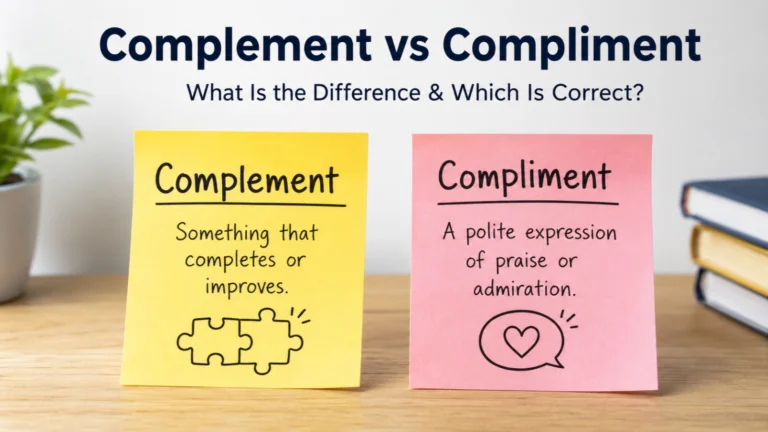
Complement vs Compliment is one of the most commonly confused word pairs in English because the two words sound almost identical but have very different meanings. Many English learners and even native speakers use them interchangeably, which can lead to misunderstandings in both writing and conversation.
Understanding the difference between these terms helps you communicate more accurately and confidently, whether you’re writing an email, speaking in a meeting, or improving your grammar skills.
In this guide, you’ll learn the meanings, correct usage, and simple tricks to remember each word with clear examples. By the end, Complement vs Compliment will no longer be confusing, and you’ll know exactly which word fits every situation. Mastering Complement vs Compliment is a small step that makes a big difference in your English.
Why “Complement” and “Compliment” Are Confusing
Many English learners mix up complement and compliment because they are pronounced the same. Although their spellings differ by only one letter, their meanings are completely different.
Here are the main reasons for the confusion:
Similar pronunciation
Both words are pronounced as /ˈkɒm.plɪ.mənt/ (or /ˈkɑːm.plə.mənt/ in American English). Since they sound identical, people often choose the wrong spelling when writing.
Similar spelling
Only one letter changes:
- Complement
- Compliment
This small spelling difference is easy to overlook.
Context confusion
Both words are used in positive situations. One refers to something that completes or improves another thing, while the other refers to expressing praise or admiration.
Common learner mistakes
Many learners write:
- “Your dress complements you.” ✔
- “Thank you for the compliment.” ✔
But they sometimes accidentally swap the two words because they focus on pronunciation instead of meaning.
Complement vs Compliment Explained Simply
Complement means something that completes, improves, or goes well with something else, while compliment means a polite expression of praise or admiration.
One-line distinction
Complement completes; compliment praises.
Examples
Complement
- The blue tie complements his white shirt.
- Fresh herbs complement the flavor of the soup.
Compliment
- She gave me a compliment about my presentation.
- I complimented him on his excellent work.
Understanding Homophones in English
What Are Homophones?
Homophones are words that sound the same but have different meanings and spellings.
Example:
- Sea
- See
Although they sound alike, they mean different things.
Why Homophones Cause Confusion
Homophones often confuse writers because pronunciation does not help you choose the correct spelling.
For example:
- “Their house is beautiful.”
- “They’re coming tomorrow.”
Both sound similar but have completely different meanings and uses.
The same idea applies to complement and compliment.
What Does “Complement” Mean?
Definition and Core Meaning
Complement means something that completes, enhances, or goes perfectly with something else. It can be used as both a noun and a verb.
As a noun, it refers to something that completes another thing.
As a verb, it means to improve or match something well.
Origin and Historical Use
The word complement comes from the Latin word complementum, meaning “that which fills up or completes.” It entered English through French and has long been used to describe things that complete one another.
Modern Usage and Synonyms
Today, complement is common in writing about fashion, food, design, business, and relationships.
Synonyms
- Complete
- Enhance
- Match
- Improve
- Go well with
- Perfect
Key Points
- Refers to completing something.
- Can be a noun or a verb.
- Often describes things that work well together.
Example Sentences
- The sauce complements the grilled chicken perfectly.
- Her skills complement those of her teammates.
- The curtains complement the room’s color scheme.
- This software complements our existing tools.
What Does “Compliment” Mean?
Definition and Core Meaning
A compliment is a kind or positive remark that expresses admiration, praise, or approval.
As a verb, compliment means to praise someone.
Origin and Historical Context
The word compliment comes from Italian and French words related to polite greetings and expressions of respect. Over time, it became associated with praise and admiration.
Modern Usage and Synonyms
Today, compliment is widely used in daily conversations, workplaces, schools, and social situations.
Synonyms
- Praise
- Admiration
- Flattery
- Appreciation
- Kind words
- Encouragement
Key Points
- Refers to praise or admiration.
- Can be a noun or a verb.
- Usually directed toward a person.
Example Sentences
- Thank you for the compliment.
- She complimented me on my new haircut.
- His teacher complimented his hard work.
- Everyone complimented the chef after dinner.
Complement vs Compliment: Key Differences at a Glance
| Word | Part of Speech | Meaning | Example Context |
|---|---|---|---|
| Complement | Noun / Verb | Something that completes or improves another thing | The shoes complement the dress. |
| Compliment | Noun / Verb | A polite expression of praise or admiration | She gave me a nice compliment. |
How to Remember the Difference Between Complement and Compliment
Fortunately, there are easy ways to remember these words.
Memory Trick 1
Complement = Complete
Both begin with “Comple-“.
If something helps complete another thing, use complement.
Memory Trick 2
Compliment contains “I”.
Think:
I like your work.
When you praise someone, use compliment.
Association Technique
Imagine this sentence:
“A compliment can make someone smile, but matching colors complement each other.”
Memorable Example
- Your smile deserves a compliment.
- Your shoes complement your outfit.
Common Mistakes and Confusions
Wrong
She gave me a nice complement.
Correct
She gave me a nice compliment.
Explanation: She praised you, so use compliment.
Wrong
These colors compliment each other.
Correct
These colors complement each other.
Explanation: The colors match well, so they complete each other.
Wrong
I compliment your cooking because the spices complement each other.
Correct
I compliment your cooking because the spices complement each other.
Explanation: Here, both words are used correctly because the first refers to praise, while the second refers to matching flavors.
Wrong
The painting gave the room a beautiful compliment.
Correct
The painting was a beautiful complement to the room.
Explanation: The painting completes the room’s appearance rather than praising it.
Examples Section: Correct and Incorrect Usage
Example 1
✔ Correct: Your necklace complements your dress.
✘ Incorrect: Your necklace compliments your dress.
Example 2
✔ Correct: Thank you for the lovely compliment.
✘ Incorrect: Thank you for the lovely complement.
Example 3
✔ Correct: His calm personality complements hers.
✘ Incorrect: His calm personality compliments hers.
Example 4
✔ Correct: The manager complimented the team after the successful project.
✘ Incorrect: The manager complemented the team after the successful project.
Self Assessment: Test Your Knowledge
Fill in the blanks using complement or compliment.
- Thank you for the wonderful __________.
- These curtains __________ the furniture perfectly.
- My teacher gave me a __________ after my speech.
- Fresh lemon juice can __________ seafood dishes.
Self Assessment Answers
- compliment
- complement
- compliment
- complement
FAQs About “Complement and Compliment”
1. What is the difference between complement and compliment?
A complement completes or improves something, while a compliment is a word of praise or admiration.
2. Are complement and compliment pronounced the same?
Yes. They are homophones, meaning they sound the same but have different meanings and spellings.
3. Is “Your shoes compliment your outfit” correct?
No. The correct sentence is:
Your shoes complement your outfit.
4. Can both words be nouns and verbs?
Yes. Both complement and compliment can function as nouns and verbs.
5. Which word relates to praise?
Compliment always relates to praise, admiration, or kind words.
6. Which word means “go well together”?
Complement means two things match well or improve one another.
7. How can I remember the difference easily?
Remember:
- Complement = Complete
- Compliment = Praise
Final Conclusion: Using “Complement” and “Compliment” Correctly
Learning the difference between complement and compliment is easier than it first appears. Although these words sound exactly alike, they serve completely different purposes in English. Complement refers to something that completes, improves, or matches another thing, making it useful when talking about colors, clothing, food, skills, or anything that works well together. Compliment, on the other hand, refers to praise, admiration, or kind words directed toward a person. A simple way to remember them is this: complement completes, while compliment praises. This memory trick can help you choose the correct word whenever you write or speak. As you continue reading, listening, and practicing English, you’ll see both words used in different situations. Paying attention to the context will quickly become second nature.

