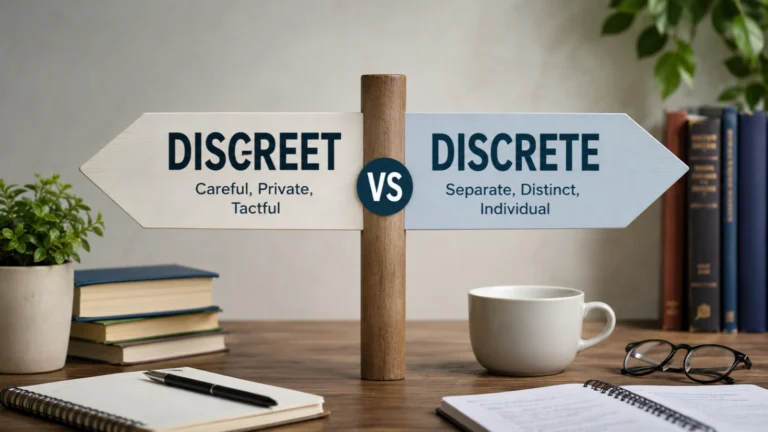
Discreet vs discrete is one of the most confusing word pairs in English because the two words look almost identical and sound very similar.
Many English learners—and even native speakers—accidentally use one instead of the other. However, their meanings are completely different. Using the wrong word can change the meaning of your sentence and make your writing appear less accurate.
Fortunately, once you understand what each word means and learn a simple memory trick, telling them apart becomes much easier.
This guide explains discreet vs discrete in clear, simple language with examples, comparisons, and practice exercises to help you use both words correctly every time.
Why “Discreet” and “Discrete” Are Confusing
Many learners struggle with discreet vs discrete because these words share nearly identical spelling and pronunciation. Yet they describe completely different ideas.
Here are the main reasons people mix them up:
Similar Pronunciation
Both words are pronounced almost the same:
- Discreet: /dɪˈskriːt/
- Discrete: /dɪˈskriːt/
Because they sound identical, listeners often cannot tell which spelling is intended.
Similar Spelling
Only one letter differs:
- Discreet
- Discrete
This tiny spelling difference is easy to overlook while writing quickly.
Context Confusion
Both words usually appear in formal writing, making it difficult for learners to remember which one belongs in a particular sentence.
Common Learner Mistakes
Many people write:
- “The data is discreet.”
- “Please be discrete about the surprise.”
Both examples are incorrect because the words have been swapped.
Discreet vs Discrete Explained Simply
The easiest way to understand these words is to focus on their meanings.
Discreet means careful, private, or tactful, while discrete means separate, distinct, or individual.
One-Line Distinction
Discreet refers to behavior.
Discrete refers to things being separate.
Example Sentences
Discreet
- She was discreet about the confidential information.
- Please be discreet when discussing personal matters.
Discrete
- The report divides the project into three discrete stages.
- Each student completed a discrete assignment.
Understanding Homophones in English
What Are Homophones?
Homophones are words that sound the same but have different meanings and spellings.
Example:
- Flour
- Flower
Although they sound alike, they have completely different meanings.
Why Homophones Cause Confusion
Homophones rely entirely on context.
For example:
- “I need flour to bake bread.”
- “The flower smells wonderful.”
Similarly, discreet and discrete sound the same, so only the sentence’s meaning tells you which word is correct.
What Does “Discreet” Mean?
Definition and Core Meaning
Discreet is an adjective that means:
- Careful
- Tactful
- Respectful of privacy
- Not attracting attention
- Showing good judgment
Someone who is discreet knows how to keep information private and behave appropriately.
Origin and Historical Use
The word discreet comes from the Latin discretus, meaning “separated” or “distinguished.” Over time, its meaning developed into being careful, wise, and thoughtful in speech or actions.
For centuries, English speakers have used discreet to describe people who handle sensitive matters with care.
Modern Usage and Synonyms
Today, discreet commonly appears when discussing:
- Confidential conversations
- Professional behavior
- Privacy
- Diplomacy
- Personal matters
Synonyms
- Careful
- Tactful
- Cautious
- Diplomatic
- Private
- Reserved
- Circumspect
Example Sentences
- The lawyer remained discreet throughout the investigation.
- We appreciate your discreet handling of the complaint.
- He gave her discreet advice during the meeting.
- They chose a discreet location for the interview.
What Does “Discrete” Mean?
Definition and Core Meaning
Discrete is an adjective that means:
- Separate
- Distinct
- Individual
- Not connected to other parts
It describes things that exist independently rather than continuously.
Origin and Historical Context
Like discreet, discrete also comes from the Latin discretus. However, English eventually assigned a different meaning to the spelling discrete, emphasizing separate or individual units.
Today, it is especially common in mathematics, computer science, engineering, and technical writing.
Modern Usage and Synonyms
You will often see discrete in discussions about:
- Mathematics
- Statistics
- Technology
- Scientific research
- Independent categories
Synonyms
- Separate
- Distinct
- Independent
- Individual
- Isolated
- Detached
Example Sentences
- The experiment consists of four discrete phases.
- The survey measured several discrete variables.
- Each chapter covers a discrete topic.
- The software performs discrete tasks independently.
Discreet vs Discrete: Key Differences at a Glance
| Word | Part of Speech | Meaning | Example Context |
|---|---|---|---|
| Discreet | Adjective | Careful, tactful, private | Be discreet about the surprise party. |
| Discrete | Adjective | Separate, distinct, individual | The project contains discrete sections. |
How to Remember the Difference Between Discreet and Discrete
Fortunately, there are several simple memory tricks.
Easy Memory Tricks
Discreet = Secret
Notice that discreet contains two e’s, just like the word secret.
Think:
DiscrEEt → sEcrEt
Both involve keeping information private.
Discrete = Separate Pieces
The second e in discrete reminds many learners that separate pieces stand apart from one another.
Think of:
- Discrete numbers
- Discrete categories
- Discrete parts
All of these are separate units.
Association Techniques
Imagine:
- A discreet friend quietly keeping your secret.
- Discrete boxes lined up separately on a shelf.
One Memorable Example
“A discreet doctor keeps your medical information private, while your medical records contain discrete sections.”
Common Mistakes and Confusions
Below are mistakes learners frequently make.
Wrong
“The scientist collected discreet samples.”
Correct
“The scientist collected discrete samples.”
Explanation: The samples are separate, not secret.
Wrong
“Please remain discrete about the surprise.”
Correct
“Please remain discreet about the surprise.”
Explanation: You should keep the information private.
Wrong
“The report contains discreet categories.”
Correct
“The report contains discrete categories.”
Explanation: Categories are separate groups.
Wrong
“Our accountant is very discrete.”
Correct
“Our accountant is very discreet.”
Explanation: A person can be careful or tactful, not separate.
Examples Section: Correct and Incorrect Usage
Example 1
✔ Correct: She was discreet when discussing confidential documents.
✘ Incorrect: She was discrete when discussing confidential documents
Example 2
✔ Correct: The graph contains five discrete data points.
✘ Incorrect: The graph contains five discreet data points.
Example 3
✔ Correct: He gave me discreet advice after the meeting.
✘ Incorrect: He gave me discrete advice after the meeting.
Example 4
✔ Correct: The machine performs several discrete functions.
✘ Incorrect: The machine performs several discreet functions.
Self Assessment: Test Your Knowledge
Fill in the blanks with discreet or discrete.
1.
Please be ______ when discussing confidential business information.
2.
The software divides the process into ______ stages.
3.
Our manager handled the complaint in a very ______ manner.
4.
The research analyzed several ______ variables.
Self Assessment Answers
- discreet
- discrete
- discreet
- discrete
FAQs About “Discreet and Discrete”
1. Are discreet and discrete pronounced the same?
Yes. They are generally pronounced the same, making them homophones in modern English.
2. Which word means private?
Discreet means careful, tactful, and respectful of privacy.
3. Which word means separate?
Discrete means separate, distinct, or individual.
4. Is discrete commonly used in mathematics?
Yes. In mathematics, discrete describes values that are separate rather than continuous, such as whole numbers.
5. Can I use discreet to describe data?
Usually no. Data is typically described as discrete if it consists of separate values.
6. Can a person be discrete?
Normally, no. People are described as discreet when they act with care and good judgment. Discrete usually describes objects, categories, or units that are separate.
7. What is the easiest way to remember the difference?
Remember:
- Discreet = Secret
- Discrete = Separate
This simple association helps most learners choose the correct word quickly.
Final Conclusion: Using “Discreet” and “Discrete” Correctly
Understanding discreet vs discrete is an important step toward becoming a more confident English writer and speaker. Although these two words are pronounced almost exactly the same and differ by only one letter, they express completely different ideas. Discreet refers to people or actions that are careful, tactful, and respectful of privacy. It is the right choice when talking about keeping secrets, handling sensitive information, or behaving with good judgment. Discrete, on the other hand, describes things that are separate, distinct, or independent. It is commonly used in academic, scientific, mathematical, and technical contexts where individual units or categories are discussed.
One of the simplest ways to remember the difference is the phrase “discreet keeps secrets, discrete keeps things separate.” This memory trick connects each word with its core meaning and makes choosing the correct spelling much easier. As you read books, articles, and professional writing, pay attention to how these words are used in context. With regular practice and careful observation, recognizing the correct word will soon become automatic. Every confusing pair of English words you master strengthens your vocabulary and improves your communication skills. Keep learning, keep practicing, and don’t be discouraged by small spelling differences—each one is another opportunity to become a more skilled and confident English user.